On this page
Multiple-correct questions reward a habit more than a formula: judge each option as its own true-or-false statement, then tick only what you have proved. Here are eight original questions on sequences and series in that format.
How does partial marking work in JEE Advanced multiple-correct questions?
In the official JEE Advanced 2025 Paper 1 mathematics answer key, Section 2 has questions where one or more of four options is correct, marked like this:
+4 if you choose all the correct options and nothing else.
+3 if all four options are correct and you choose exactly three.
+2 if three or more options are correct and you choose two, both correct.
+1 if two or more options are correct and you choose one correct option.
0 if you leave it blank; −2 in all other cases.
The scheme is printed in each paper's instructions and can change between years, so read it again on exam day.
Eight sequences and series questions, option by option
Q1. The sum of the first n terms of a sequence is Sₙ = 3n² + 5n. Which are true?
(A) If instead Sₙ = 3n² + 5n + 1, the sequence would still be an AP. False: the terms become 9, 14, 20, so the gaps are 5 and 6.
(B) The sequence is an AP with common difference 6. True: aₙ = Sₙ − Sₙ₋₁ = 6n + 2, and a₁ = 8 fits.
(C) a₁₀ = 62. True.
(D) Sₙ/n is also an AP. True: it equals 3n + 5.
Answer: B, C, D. A is the wrong tick: a constant term in Sₙ breaks the AP at the first term.
Q2. A GP of real numbers has a₃ = 4 and a₇ = 64. Which must be true?
(A) r = 2. False: r⁴ = 16 allows r = −2 too.
(B) a₅ = 16. True: a₅ = a₃r² and r² = 4 either way.
(C) a₁ = 1. True: a₁ = a₃/r².
(D) The first six terms add to 63. False: with r = −2 they add to −21.
Answer: B, C. Students tick A and D by forgetting the negative ratio.
Q3. a, b, c are positive and a + b + c = 3. Which are true?
(A) abc ≤ 1. True: AM ≥ GM.
(B) ab + bc + ca ≤ 3. True: (a + b + c)² ≥ 3(ab + bc + ca).
(C) a² + b² + c² ≥ 3. True: the same inequality, rearranged.
(D) 1/a + 1/b + 1/c ≤ 3. False: AM ≥ HM makes it at least 3; try a = 2, b = c = 1/2.
Answer: A, B, C. D is the classic reversed inequality.
Q4. Which are true for every n ≥ 1?
(A) 1/(1·2) + 1/(2·3) + … + 1/(n(n+1)) = n/(n+1). True: each term is 1/k − 1/(k+1).
(B) 1/(1·3) + 1/(2·4) + … + 1/(n(n+2)) = (1/2)(1 − 1/(n+2)). False: two terms survive at each end; at n = 2 it gives 3/8, not 11/24.
(C) The sum in (A) is below 1. True.
(D) The sum in (A) at n = 99 is 0.99. True.
Answer: A, C, D. B passes a check at n = 1, which is why students tick it; always test n = 2.
Q5. Which are true?
(A) 1/2 + 2/4 + 3/8 + … = 2. True: the sum of nxⁿ is x/(1 − x)².
(B) 1/3 + 2/9 + 3/27 + … = 3/4. True: the same formula with x = 1/3.
(C) The sum of n²/2ⁿ from n = 1 is 6. True: it is x(1 + x)/(1 − x)³ at x = 1/2.
(D) 1 + 2/2 + 3/4 + 4/8 + … = 4. True: it is 1/(1 − x)² at x = 1/2.
Answer: A, B, C, D. Doubting that all four can be right and dropping one earns +3, not +4.
Q6. The 5th, 9th and 16th terms of a non-constant AP (first term a, difference d) are in GP. Which are true?
(A) a/d = 3/4. False: (a + 8d)² = (a + 4d)(a + 15d) gives a/d = 4/3.
(B) The common ratio is 4/3. False.
(C) The common ratio is 7/4. True: the terms are 16d/3, 28d/3, 49d/3.
(D) The first three terms are also in GP. False: 4, 7, 10 (times d/3) are not.
Answer: C only. Inverting a/d leads students to A.
Q7. Which are true?
(A) 1³ + 2³ + … + 10³ = 3025. True: it is (10·11/2)².
(B) 1² + 2² + … + 10² = 385. True: n(n + 1)(2n + 1)/6.
(C) 11³ + 12³ + … + 20³ = (11 + 12 + … + 20)². False: 41075 against 155² = 24025.
(D) 1³ + 2³ + … + 20³ = 44100. True: 210².
Answer: A, B, D. The identity in C only works when the sum starts at 1.
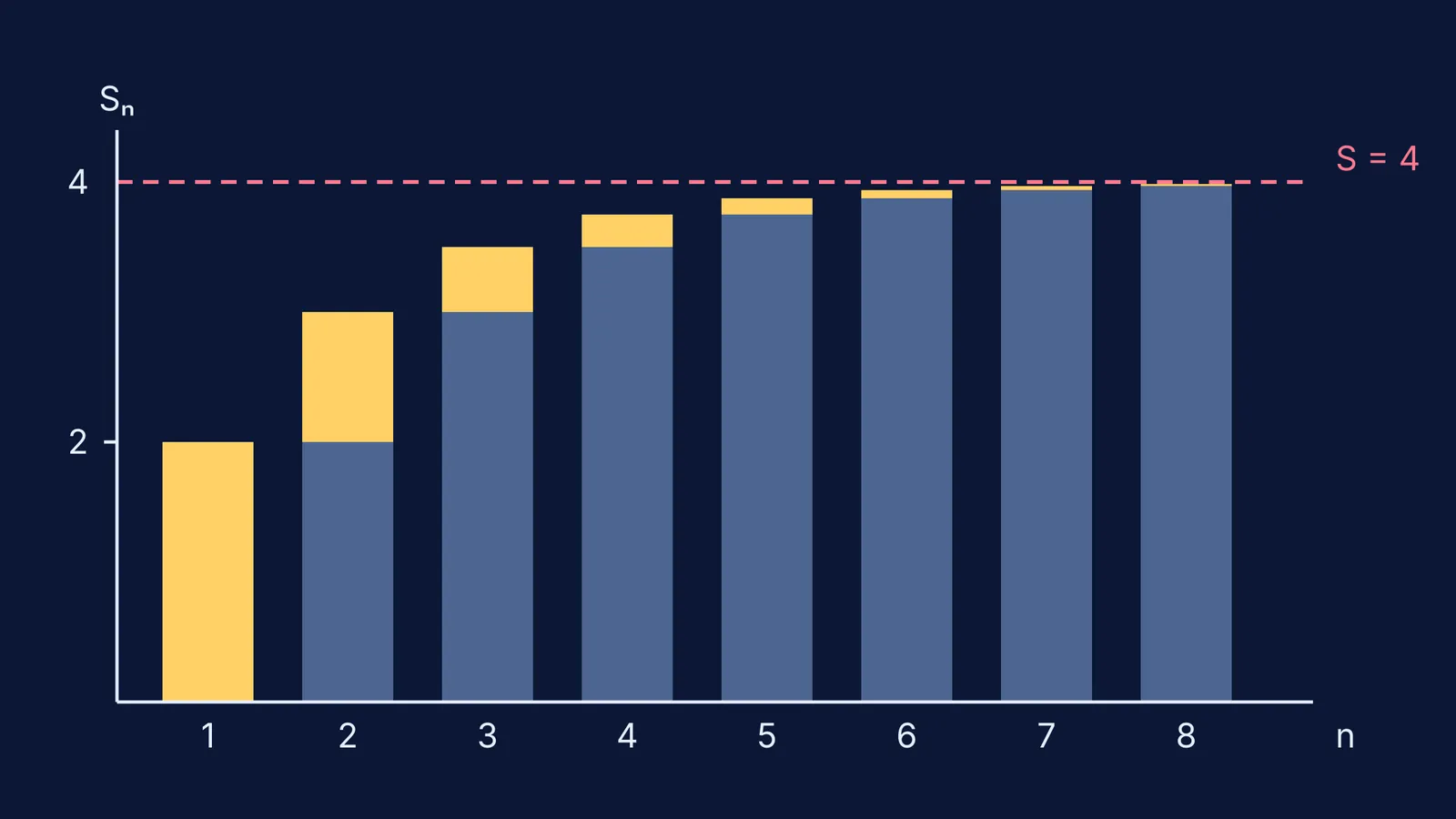
Q8. An infinite GP has sum 4, and the squares of its terms add to 16/3. Which are true?
(A) The first term is 2. True: dividing a²/(1 − r²) by a/(1 − r) gives a/(1 + r) = 4/3, so r = 1/2.
(B) The third term is 1. False: it is 1/2.
(C) The cubes of the terms add to 64/7. True: 8/(1 − 1/8).
(D) The terms in even positions add to 4/3. True: ar/(1 − r²).
Answer: A, C, D. Students miss D by assuming the even terms take half the sum.
What should you do with options you cannot settle?
Mark each option T, F or ? before ticking anything.
Test a formula at n = 1 and n = 2, and a ratio at both signs.
Tick every T. Never tick a ?.
Leave the question blank if you have no sure T; a guess risks −2.
For fully worked solutions, try the sequences, series and binomial theorem JEE Advanced practice questions, keep the Class 11 sequences and series formulas list beside you, and read our guide on how to prepare sequences and binomial theorem for JEE Advanced. If one wrong option keeps fooling you, the Fermi Problem Library has a step-by-step solver that explains the reasoning. For the rest of your JEE Main and Advanced preparation, start at Fermi Test Prep.