On this page
Chapter 4 of the NCERT Class 11 Psychology textbook explains how senses pick up stimuli, attention selects a few, and perception gives them meaning.
How much is this chapter worth in the 2026-27 exam?
The CBSE Psychology curriculum for 2026-27 gives Unit IV, Sensory, Attentional and Perceptual Processes, 8 marks out of 70 in the Class 11 theory paper. Its topic list follows the chapter's main sections, from sense modalities to socio-cultural influences; the boxes on divided attention, span of attention and ADHD are not named in it separately.
What are sensation, attention and perception?
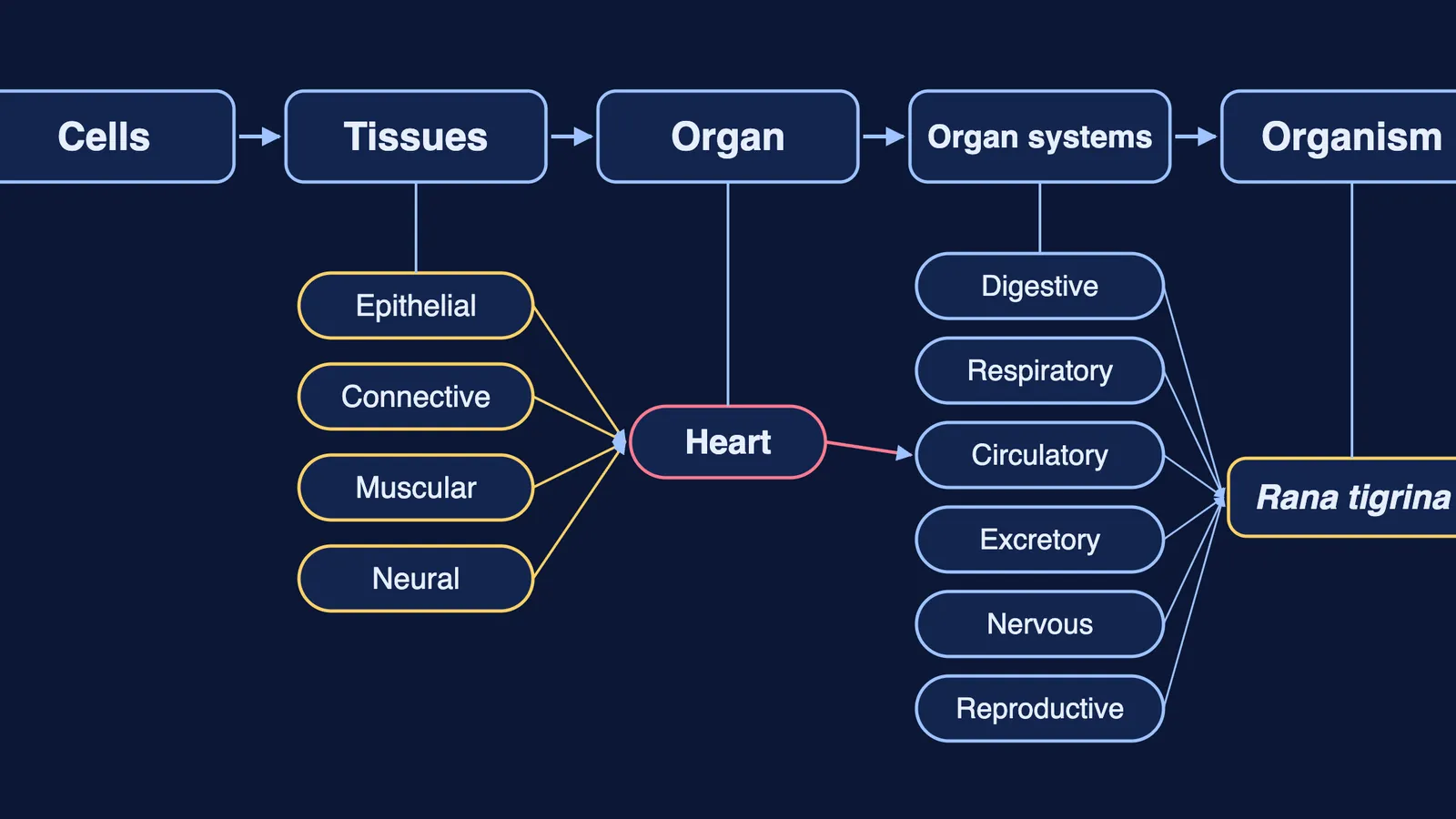
The NCERT chapter treats them as three linked steps of one process, cognition.
Sensation is the first experience of a stimulus registered by a sense organ: hard, warm, loud, blue. Each specialised sense organ is a sense modality.
Humans have seven sense organs: five external (eyes, ears, nose, tongue, skin) and two deep senses, the kinesthetic and vestibular systems, which report body position and movement.
Absolute threshold (AL) is the minimum value of a stimulus that a sense registers on 50 per cent of trials. Difference threshold (DL) is the smallest change noticed as different on 50 per cent of trials. NCERT explains both by adding sugar granules to water one at a time.
Senses have limits: very dim light or very faint sound goes unnoticed, and damage from receptor to brain can cause loss of sensation.
What is the difference between selective and sustained attention?
Attention selects some stimuli from many. Its properties are alertness, concentration and search; it has a focus and a fringe.
Selective attention picks a few stimuli from many. External factors are size, intensity, motion, novelty and moderate complexity. Internal factors are motivational (needs such as hunger) and cognitive (interest, attitude, preparatory set). NCERT gives three theories:
Filter theory (Broadbent): a bottleneck lets only one stimulus through for higher processing.
Filter-attenuation theory (Treisman): blocked stimuli are only weakened, so your own name can still slip through at a noisy dinner.
Multimode theory (Johnston and Heinz): selection can happen at a sensory, a semantic or a conscious stage; later selection costs more effort.
Sustained attention, or vigilance, is holding attention for long periods, as air traffic controllers must. It is better for auditory, clear and intense signals that come at regular times and fixed places.
The span of attention is seven plus or minus two items, the figure from George Miller's 1956 paper, which NCERT links to short number plates. It returns as short-term memory capacity in our Class 11 guide to human memory.
How do we organise what we perceive?
Perception is giving meaning to sensory information. Bottom-up processing builds the whole from parts; top-down processing starts from the whole. Motivation, expectations (perceptual set), cognitive style (field dependent or independent) and culture shape what you see.
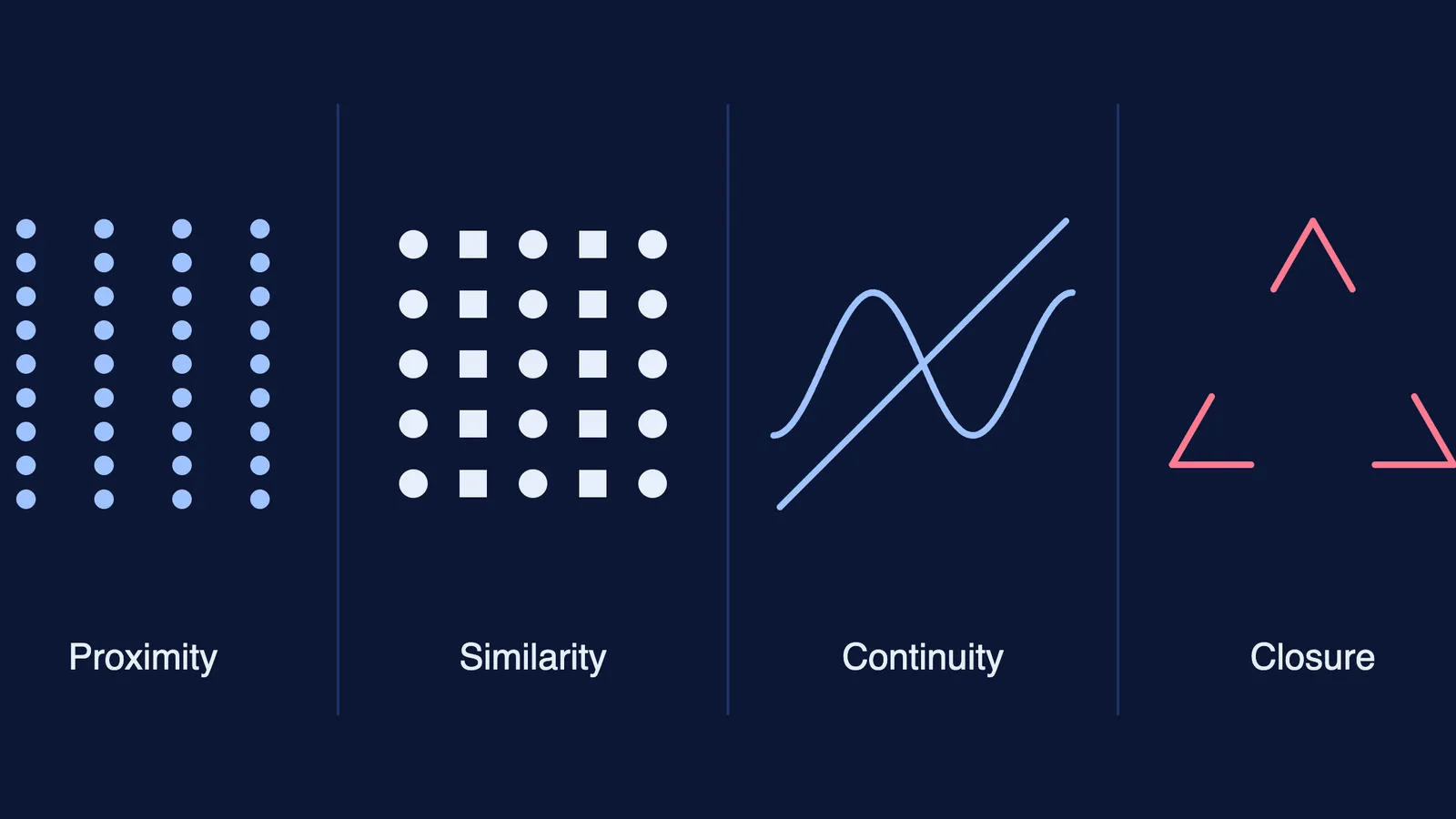
Gestalt psychologists (Wertheimer, Köhler, Koffka) said we see organised wholes, starting with figure-ground segregation. Their principles in the chapter are proximity, similarity, continuity, smallness, symmetry, surroundedness and closure. The diagram above draws four of them.
Depth comes from cues. Monocular (pictorial) cues: relative size, interposition, linear perspective, aerial perspective, light and shade, relative height, texture gradient, plus motion parallax, which needs movement. Binocular cues: retinal disparity (the eyes sit about 6.5 cm apart), convergence and accommodation.
Constancies keep size, shape and brightness stable while the retinal image changes. Illusions are misperceptions: the Muller-Lyer and vertical-horizontal illusions, and the phi-phenomenon behind cinema. Segall, Campbell and Herskovits found African samples more prone to the vertical-horizontal illusion and Western samples to the Muller-Lyer, which NCERT reads as learnt perceptual habits.
A worked example: crossing a busy road
Sensation: your eyes register a red light and moving shapes; your ears register a horn.
Selective attention: the loud, sudden horn beats the shop signs (external factor); wanting to get home safely keeps you scanning (internal).
Top-down perception: you expect a bus at this stop, so a large shape is read as a bus at once (perceptual set).
Depth: the bus's retinal image grows and your eyes converge, so you judge it near.
Constancy: the bus does not seem to shrink as it drives away (size constancy).
Relabel it for a cricket match and you have revised the chapter.
Practice questions
Short answer:
Distinguish absolute threshold from difference threshold with an example other than sugar in water.
Why does your name stand out in a noisy room? Name the theory.
Give one monocular and one binocular cue a cricketer uses to judge a catch.
Long answer:
A student revises with the TV on. Use external and internal factors to explain what grabs her attention, and what would help her stay focused for two hours.
Describe five Gestalt principles, drawing a simple shape pattern for each.
Two groups misjudge the same line illusions differently. Using the Segall, Campbell and Herskovits findings, explain where perceptual habits come from.
Check answers against the NCERT text, then move on to Chapter 5 with our guide to learning and conditioning.
Fermi's AI tutor works out what you already know, builds a plan for the session and checks understanding as it goes.
Start by drawing the four patterns above from memory.