On this page
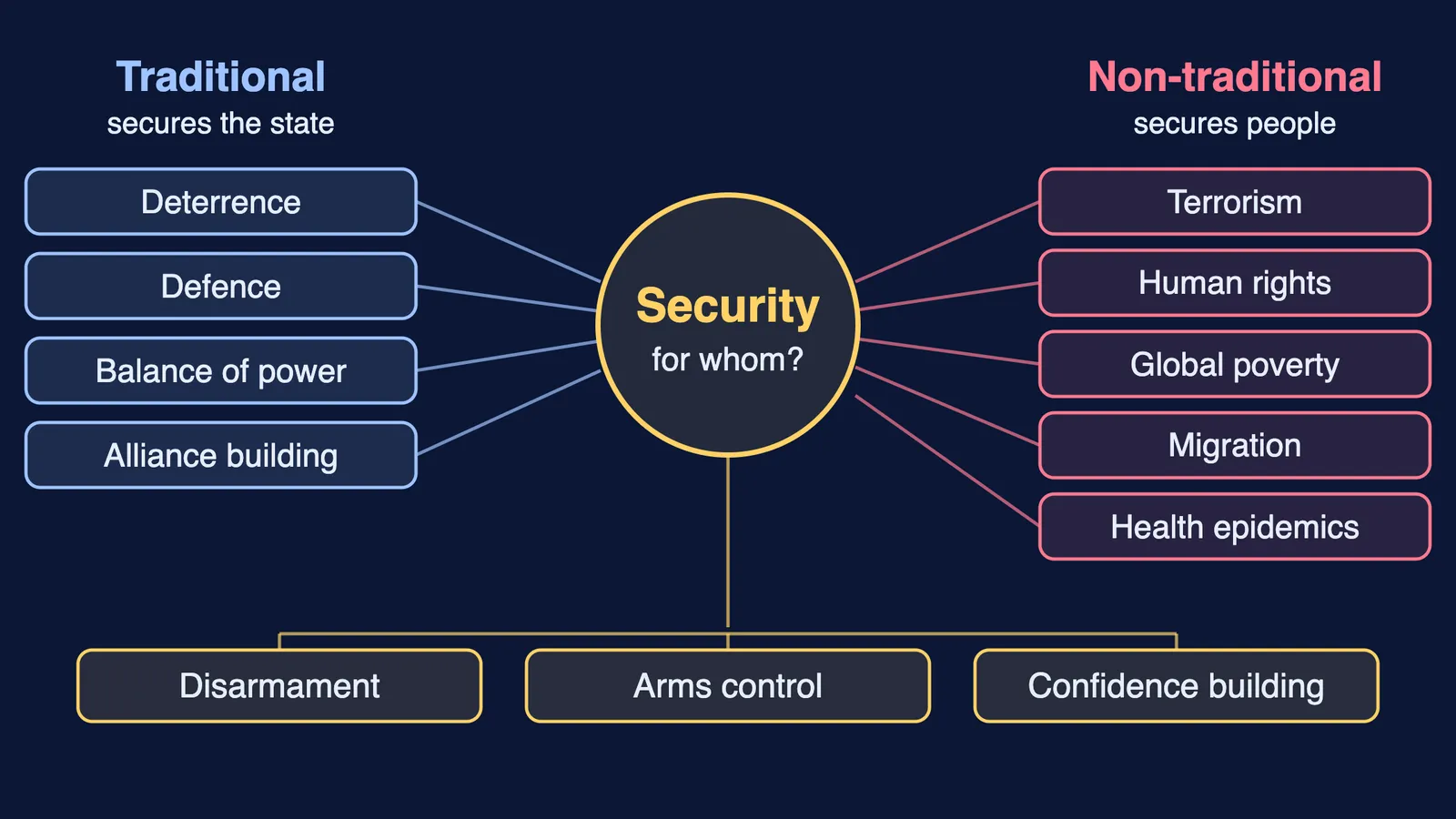
Security in the Contemporary World is chapter 5 of the NCERT book Contemporary World Politics, and the CBSE Political Science curriculum for 2026-27 allots it 6 of the 40 marks for Part A, Contemporary World Politics (the theory paper totals 80). Its central question is: security for whom?
What does security mean in Class 12 political science?
In the current NCERT chapter (Reprint 2026-27), security at its most basic means freedom from threats. The chapter narrows this: only threats that could damage core values beyond repair count. It then sorts ideas of security into two groups, traditional and non-traditional.
Traditional vs non-traditional security: what is the difference?
In the traditional view, as NCERT presents it, the greatest danger is military attack by another country, which threatens sovereignty, independence and territorial integrity. Governments respond with four components:
Deterrence: preventing war by making its cost unacceptable.
Defence: limiting or ending a war once it starts.
Balance of power: watching stronger neighbours and building military, economic and technological strength.
Alliance building: a coalition of states that coordinate to deter or defend against attack. Alliances follow national interests, so they change; NCERT's example is the US backing militants in Afghanistan in the 1980s and later attacking them after the 11 September 2001 attacks.
Traditional security also has an internal side: newly independent states feared both neighbours and separatist movements, and NCERT notes that over 95 per cent of the world's armed conflicts are now fought within states.
Even the traditional view accepts cooperation. Disarmament means giving up certain weapons (the 1972 Biological Weapons Convention, the 1997 Chemical Weapons Convention). Arms control regulates weapons (the 1972 ABM Treaty, SALT II, START, and the 1968 NPT, which let countries that had tested before 1967 keep their weapons). Confidence building means sharing military information so rivals do not fight by misunderstanding.
Non-traditional security widens the referent, the answer to "security for whom?", from the state to individuals, communities and humankind. It has two strands. Human security protects people more than states; its narrow version covers violent threats, while its broad version adds hunger, disease and natural disasters, and its broadest form stresses "freedom from want" and "freedom from fear". Global security arose in the 1990s for threats no country can solve alone; NCERT's example is Bangladesh, where seas rising by 1.5–2.0 metres would put a fifth (20 percent) of the country under water.
What are the new sources of threat?
NCERT lists five, and each is worth one crisp definition:
Terrorism: political violence aimed on purpose at civilians, without picking targets; it is international when it involves more than one country's citizens or territory.
Human rights: political, economic and social, and the rights of colonised people or minorities; there is no agreement on when the UN should intervene.
Global poverty: six countries account for half of all population growth worldwide, widening the North-South gap.
Migration: migrants leave by choice, refugees flee war, disaster or persecution, and internally displaced people flee but stay inside their country.
Health epidemics: HIV-AIDS, bird flu and SARS spread across borders; by 2003 an estimated 4 crore people had HIV-AIDS worldwide.
Not every distress is a security issue: a threat must endanger the very existence of the referent. Because these threats cross borders, NCERT argues for cooperative security involving the UN, WHO, NGOs and others, with force only as a collectively sanctioned last resort.
What is India's security strategy?
NCERT gives four components, used in varying combinations:
Military capability: after conflicts with Pakistan in 1947–48, 1965, 1971 and 1999 and with China in 1962; India tested a nuclear device in 1974 and conducted tests in 1998.
International norms and institutions: support for disarmament and the UN, a non-discriminatory non-proliferation regime, non-alignment, the Kyoto Protocol and UN peacekeeping.
Internal challenges: democracy, so groups can voice grievances and share power.
Economic development: lifting citizens out of poverty and limiting inequality.
The curriculum's added reference material on terrorism records India's position that terrorism cannot be divided into "good" and "bad".
How is this chapter tested in 2026-27?
The 2026-27 sample paper set question 29 (6 marks) entirely on this chapter, with a choice between human security and balance of power with alliance building. Six-mark answers should not exceed 170–180 words; the marking scheme answer opens with a definition, then lists explained points.
A frame for any 6-marker here: define the concept, name the referent, give four or five explained points, and add one NCERT example.
Practice questions we wrote for you:
(2 marks) Distinguish between a migrant and a refugee.
(4 marks) How is disarmament different from arms control? Give one treaty for each.
(6 marks) "Security for whom?" Explain how this question separates traditional from non-traditional security.
(6 marks) Explain the four components of India's security strategy.
For the wider context, revise the Cold War era chapter on blocs and arms control and why the Soviet Union broke up.
If science subjects also compete for your week, Fermi's AI tutor works out what you already know and builds a plan for the session, so you sit down to a clear next step.