On this page
Secondary activities make natural resources worth more by transforming raw materials into useful products, such as cotton into yarn or iron ore into steel. NCERT groups them as manufacturing, processing and construction (NCERT Class 12 Fundamentals of Human Geography, Chapter 5, Reprint 2026-27).
How many marks is Secondary Activities in 2026-27?
The CBSE Geography curriculum for 2026-27 gives Unit III a combined 19 marks, shared by five chapters from Primary Activities to International Trade. There is no separate figure for this chapter, and it has no map items.
The syllabus keeps four topics: characteristics of modern large-scale manufacturing, industrial location factors, classification of industries, and high-tech industry. Footloose industries sit inside the location section of the NCERT text, so learn them too.
What are the characteristics of modern large-scale manufacturing?
The NCERT chapter gives five:
Specialisation: mass production, with each worker repeating one task, in contrast to costly made-to-order craft work.
Mechanisation: machines do the tasks; automation with closed-loop computer control is its advanced stage.
Technological innovation: research and development for quality, less waste and less pollution.
Organisational structure: extreme division of labour, vast capital, large organisations and an executive bureaucracy.
Uneven distribution: the main manufacturing centres occupy under a tenth of the world's land.
NCERT's contrast: an area of 2.5 sq km in the American corn belt usually holds about four large farms with 10-20 workers; as large integrated factories, it could employ thousands.
Which factors influence the location of industries?
Industries locate where costs are lowest. NCERT lists seven factors. CBSE's 2026-27 sample paper offered "any five factors" as option Q24(B), worth 5 marks; the marking scheme prints "1X5=5", lists all seven and says "Explain any five points".
Market: the most important factor; people with demand and the purchasing power to buy. Aircraft and arms have global markets.
Raw material: cheap, bulky, weight-losing materials pull steel, sugar and cement plants to the source; perishable inputs do the same for agro-processing and dairy.
Labour: some work still needs skilled labour, though automation has reduced the dependence.
Energy: power-hungry industries such as aluminium sit near the energy supply.
Transport and communication: dense networks drew industry to Western Europe and eastern North America.
Government policy: regional policies place industries for balanced development.
Agglomeration economies: savings from being near a leader industry and linked industries.
Footloose industries need no specific raw material, use parts available anywhere, employ few people and are generally non-polluting. Road access decides where they go.
A worked method (our rule of thumb, not NCERT's). Ask in order and stop at the first yes:
Does the raw material lose weight or spoil? Locate near it (a sugar mill, a dairy plant).
Does it use huge amounts of power? Locate near energy (an aluminium plant).
Are the inputs parts bought anywhere? It is footloose; follow the roads.
None of these? Weigh market, labour, transport, policy and linkages together, as NCERT stresses.
How are manufacturing industries classified?
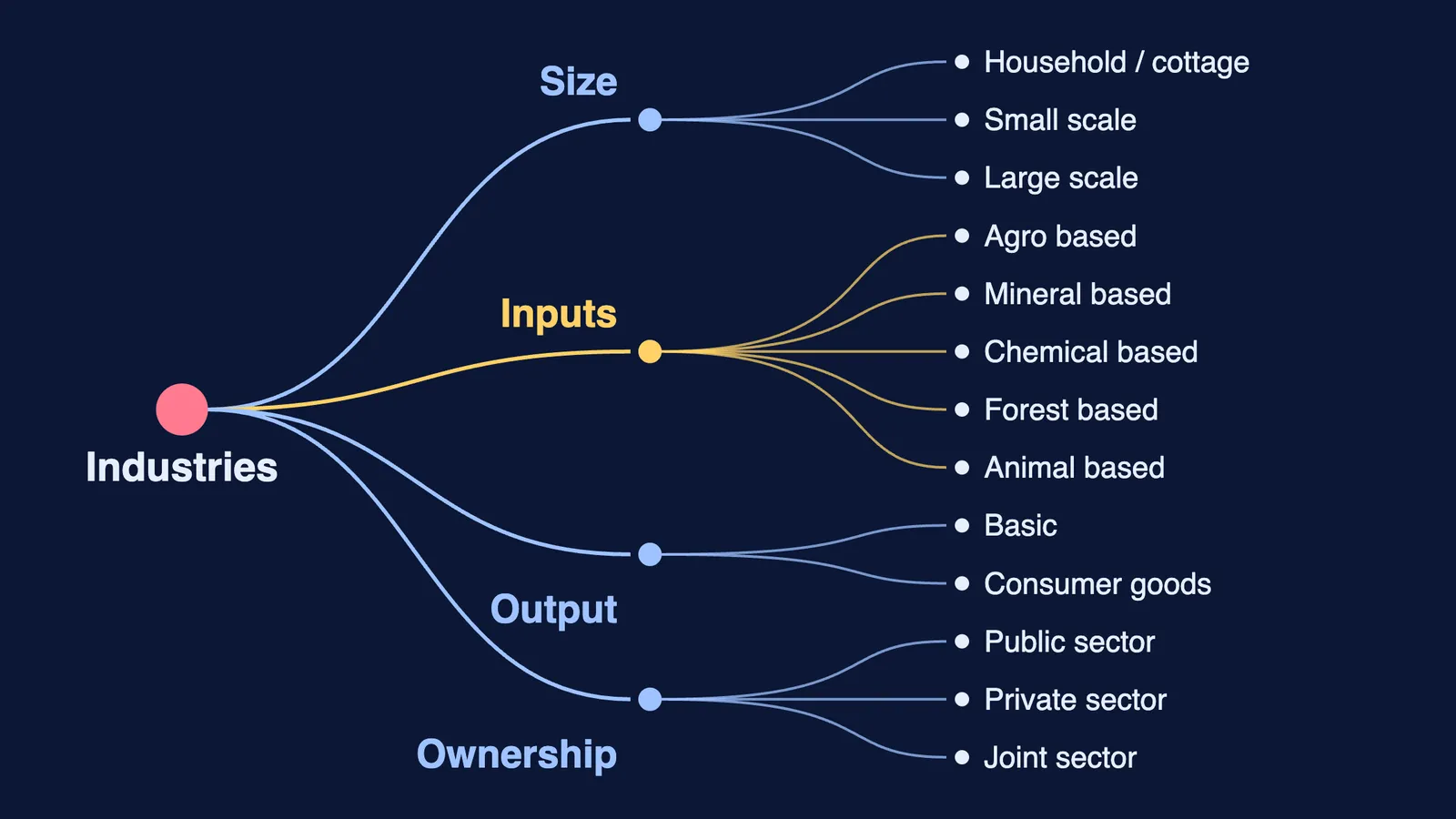
The diagram at the top shows NCERT's four bases.
Size (capital, workers, output): household units work at home with simple tools; small-scale units work in a workshop outside the home with basic powered machinery and semi-skilled workers, which India, China, Indonesia and Brazil use to create jobs; large-scale units need big markets, enormous energy and assembly lines.
Inputs: agro-based (sugar, textiles), mineral-based (iron and steel, aluminium, cement), chemical-based (petrochemicals, plastic), forest-based (furniture, paper, lac) and animal-based (leather, wool).
Output: basic industries make goods used to make other goods (iron and steel, then textile machines, then clothes); consumer goods industries make bread, soap or televisions.
Ownership: public, private and joint sector.
Agri-business, farming run at industrial scale, links back to plantations in primary activities for Class 12 geography.
What is a high-tech industry?
High-tech is the latest generation of manufacturing: intensive research and development producing goods of advanced scientific and engineering character (NCERT Chapter 5). White-collar professionals outnumber production workers. Examples include assembly-line robotics, computer-aided design and new pharmaceutical products.
Its landscape is low, spaced-out office-plant-lab buildings and planned business parks, not massive factory blocks. Regionally concentrated, self-sustained, highly specialised high-tech clusters are technopolies; NCERT names Silicon Valley near San Francisco and Silicon Forest near Seattle.
What practice questions should you try?
Our own, in the paper's formats:
(1 mark) Why is an aluminium plant usually built near a power source?
(3 marks) Distinguish household industries from small-scale manufacturing on three points.
(3 marks) What are agglomeration economies? Explain how linked industries save costs.
(5 marks) Explain basic and consumer goods industries using a chain of three products.
(5 marks) Describe the high-tech landscape and explain what makes a region a technopolis.
Where manufactured goods go next is in our notes on international trade for Class 12 geography.
If you are unsure where to start, Fermi's AI tutor can work out what you already know and build a plan for the session.