On this page
If you are preparing for JEE Main, NEET-UG or both, rotational motion is one unit you do not have to learn twice. The official syllabus text is the same for both exams. What changes is the question format and the depth of working each exam tends to ask for.
Is the rotational motion syllabus different for JEE Main and NEET?
No. Unit 5 of the NTA's JEE (Main) 2027 syllabus and Unit 5 of the NMC's updated syllabus for NEET (UG)-2026 list the same topics in the same order, with only small differences in wording and punctuation. Line by line:
Centre of mass: JEE Main says "centre of mass of a two-particle system", NEET "centre of the mass"; both add a rigid body.
Basics: both list moment of a force and "torque, angular momentum".
Conservation: both include "conservation of angular momentum and its applications".
Inertia: both list "the moment of inertia, the radius of gyration" and values for simple geometrical objects.
Theorems: both name "parallel and perpendicular axes theorems" and their applications.
Dynamics: both end with "equilibrium of rigid bodies", "equations of rotational motion" and "comparison of linear and rotational motions".
No sub-topic appears in one and not the other. Two details matter for both exams. Neither unit names rolling motion; the only "rolling" in either syllabus is "rolling friction" in the laws of motion unit. And the NCERT Class 11 chapter (Reprint 2026-27) gives Table 6.1 of moments of inertia but says the derivations "are beyond the scope of this textbook", and does not state the axes theorems, even though both syllabi list them.
How is the question format different?
Here the exams do differ, and the bulletins are specific.
The JEE (Main) 2027 Information Bulletin says each subject has Section A with 20 multiple-choice questions and Section B with 5 questions answered as a numerical value. Section B answers are entered on an on-screen keypad and "rounded off to the nearest integer". Both sections carry +4 for a correct answer and -1 for a wrong one. Paper 1 is a computer-based test.
The NEET (UG)-2026 Information Bulletin, the latest NTA has published, says the paper has 180 compulsory multiple-choice questions with four options and a single correct answer, 45 of them in Physics, in 180 minutes. A correct answer earns +4 and a wrong one -1. The bulletin set NEET (UG)-2026 in pen-and-paper mode.
So a JEE Main candidate must be able to produce a number with no options to check against, while a NEET candidate must pick one of four options at a steady pace across the whole paper.
How does the style of questions differ?
These are tendencies you will notice when you work through official past papers, not rules.
NEET questions on this unit tend to be short and close to NCERT statements: a ratio of moments of inertia, which quantity is conserved, the direction of a torque. Many can be settled in a line or two.
JEE Main questions tend to chain two or three steps: convert units, find I, then apply τ = Iα or conservation of angular momentum. Numerical-value questions punish a slipped factor of 2π because there are no options to rescue you.
What does each exam's version of a question look like?
Both questions are original, and the numbers were checked in Python.
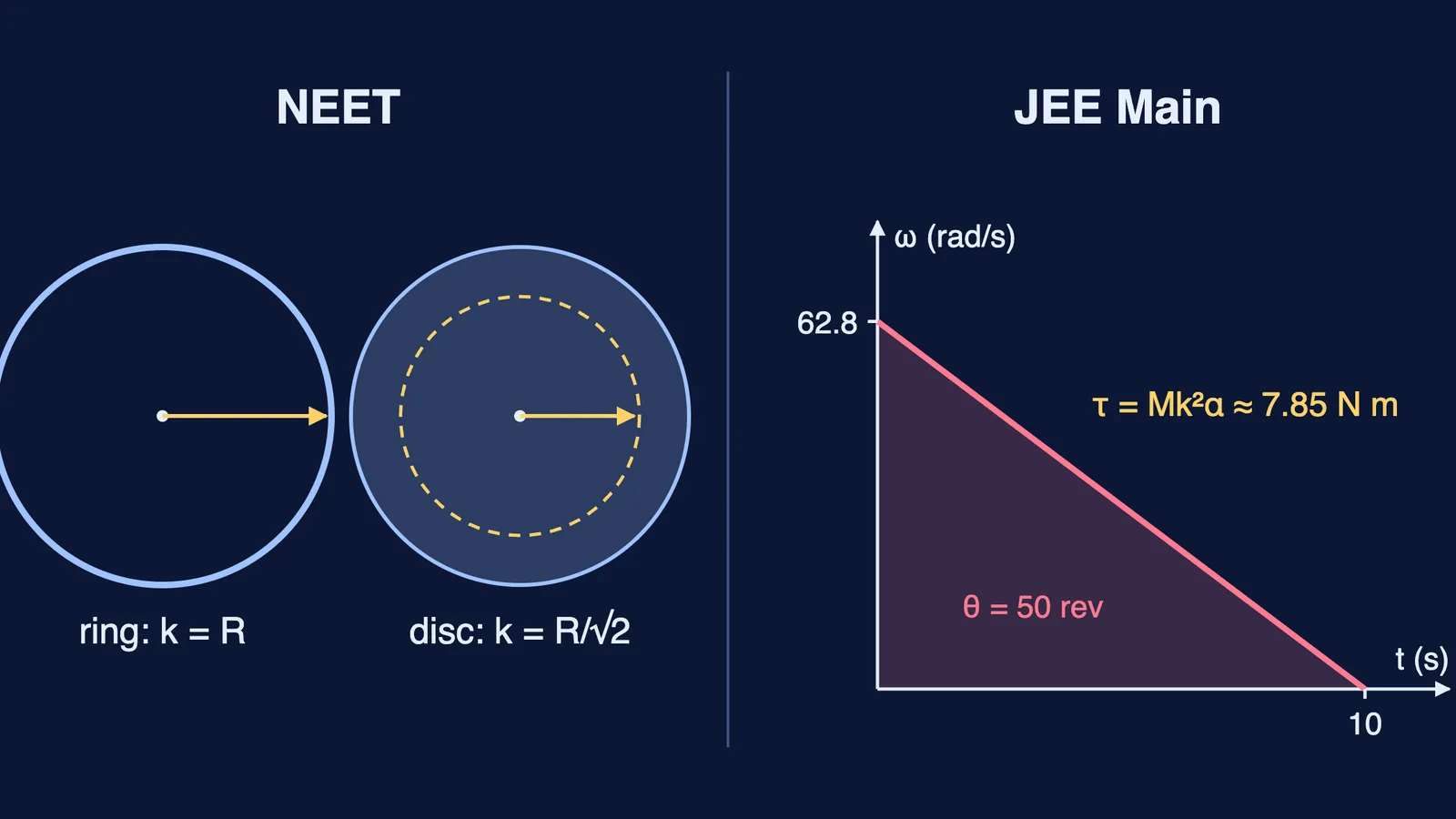
NEET-style (single correct). A thin ring and a uniform disc have the same mass and the same radius. Each rotates about an axis through its centre, perpendicular to its plane. The ratio of the radius of gyration of the ring to that of the disc is
(A) 1 : 1 (B) √2 : 1 (C) 2 : 1 (D) 1 : √2
Answer: (B). From NCERT Table 6.1, the ring has I = MR² and the disc has I = MR²/2. Since I = Mk², k(ring) = R and k(disc) = R/√2, so the ratio is √2 : 1. Option (C) is the ratio of the moments of inertia, not of k.
JEE Main-style (numerical value). A flywheel of mass 20 kg has a radius of gyration of 0.25 m about its axis. It turns at 600 rpm and is brought to rest uniformly in 10 s by a constant braking torque. Find the torque in N m, to the nearest integer.
I = Mk² = 20 × 0.25² = 1.25 kg m².
ω₀ = 600 × 2π/60 = 62.8 rad/s.
α = ω₀/t = 6.28 rad/s².
τ = Iα = 1.25 × 6.28 = 7.85 N m, which rounds to 8.
Forgetting the 2π in step 2 gives 1.25 N m, entered as 1, and the -1 penalty applies. As a check, the flywheel turns through ω₀t/2 = 314 rad, or 50 revolutions, while stopping.
How to prepare for both
Learn the unit once from NCERT. The topic list is identical, so one set of notes on rotational motion for NEET serves JEE Main too.
Memorise Table 6.1 and k for each body. NEET questions reward instant recall of ring, disc, rod, cylinder and sphere values.
Learn the axes theorems from outside NCERT. Both syllabi list them, but the current NCERT chapter does not state them; practise using them to rebuild table values.
For JEE Main, drill unit conversions and full numericals. rpm to rad/s and τ = Iα chains are where integer answers go wrong; see the JEE Main rotational motion guide.
Time your practice to each format. Do NEET-style sets against the clock, and JEE Main sets where you write a final integer without looking at options.
Check your method, not only your answer. Stuck on which axis or which formula applies? The Fermi Problem Library has worked problems with a step-by-step solver that explains the reasoning rather than printing an answer.