On this page
Eight new JEE Advanced-style rotational mechanics questions, easy to hard, with worked solutions and traps. Take g = 10 m/s².
The official JEE (Advanced) 2026 syllabus lists every topic used here, from the axes theorems and rolling without slipping to collisions of point masses with rigid bodies. New to the chapter? Start with our guide on how to prepare rotational mechanics for JEE Advanced.
How should you use this practice set?
Allow 35 minutes. Answer before reading solutions.
Labels: single-correct, one or more correct, or numerical-value. Judge each option on its own; see our note on JEE Advanced question types.
Write the axis and the conserved quantity before any number.
Easy: axes theorems, rolling and angular momentum
Q1 (easy, single-correct). A uniform 4 kg disc of radius 0.4 m has a hole of radius 0.2 m cut out, centred 0.2 m from the disc's centre (4 kg is the mass before cutting). Find the remaining plate's moment of inertia about the perpendicular axis through the rim point diametrically opposite the hole.
(A) 0.94 kg m² (B) 0.78 kg m² (C) 0.58 kg m² (D) 0.26 kg m²
Answer: (C). The hole is a quarter of the area, so 1 kg. Full disc about the rim axis, by the parallel axis theorem: ½(4)(0.4)² + 4(0.4)² = 0.96 kg m². The hole's centre is 0.6 m from that axis: ½(1)(0.2)² + 1(0.6)² = 0.38 kg m². Remaining: 0.58 kg m². Trap: (B) measures the hole's offset from the disc's centre instead of from the axis.
Q2 (easy, one or more options correct). A solid cylinder of radius R rolls without slipping on a level floor at speed v. Which are correct?
(A) The topmost point moves at 2v. (B) A rim point level with the centre moves at √2 v. (C) One third of its kinetic energy is rotational. (D) The contact point has zero acceleration.
Answer: (A), (B), (C). Each point moves at v plus a rotational ωR = v in its own direction. Rotational energy is ¼Mv² of ¾Mv². The contact point is momentarily at rest but accelerates at v²/R towards the centre. Trap: (D), confusing zero velocity with zero acceleration.
Q3 (easy, numerical-value). A uniform solid sphere of mass 2 kg and radius 0.1 m rolls without slipping at 3 m/s on a level floor. Find its angular momentum about a floor point in its plane of motion, in 10⁻² kg m² s⁻¹.
Answer: 84. About a floor point, L = MvR + (2/5)MR²ω, both in the same sense: 0.60 + 0.24 = 0.84 kg m² s⁻¹. Trap: 24 counts only the spin.
Medium: equilibrium, the falling cylinder, pivot force
Q4 (medium, single-correct). A uniform 5 m, 20 kg ladder leans on a smooth wall, its foot 3 m out. What least floor friction coefficient lets a 60 kg painter reach the top safely?
(A) 0.38 (B) 0.56 (C) 0.66 (D) 1.17
Answer: (C). The top is 4 m up; the floor carries 800 N and friction equals the wall's push F. Moments about the foot: 4F = 200 × 1.5 + 600 × 3, so F = 525 N and μ = 525/800 ≈ 0.656, so 0.66. Trap: (D) swaps the 3 m and 4 m lever arms.
Q5 (medium, one or more options correct). A light string wound round a uniform solid cylinder of mass M has its free end tied to the ceiling. The cylinder is released from rest with the string vertical. Which are correct?
(A) The cylinder's centre accelerates at 2g/3. (B) The tension is Mg/3. (C) After the centre falls h, its speed is √(2gh). (D) Its rotational KE is always half its translational KE.
Answer: (A), (B), (D). Mg − T = Ma and TR = ½MR²(a/R) give a = 2g/3 and T = Mg/3. Then v² = 2ah = 4gh/3. With ω = v/R, ¼Mv² is half of ½Mv². Trap: (C) treats the fall as free.
Q6 (medium, numerical-value). A uniform 8 kg rod is pivoted on a frictionless horizontal axle through a point a third of its length from one end. Released from rest horizontal, what force (in N) does the pivot exert just after release?
Answer: 60. I = ML²/12 + M(L/6)² = ML²/9. Torque Mg(L/6) gives α = 3g/2L, so the centre accelerates down at g/4. Then 80 − N = 8 × 2.5 = 20, so N = 60 N. Trap: 80, the force before release.
Hard: collisions and rolling on a moving surface
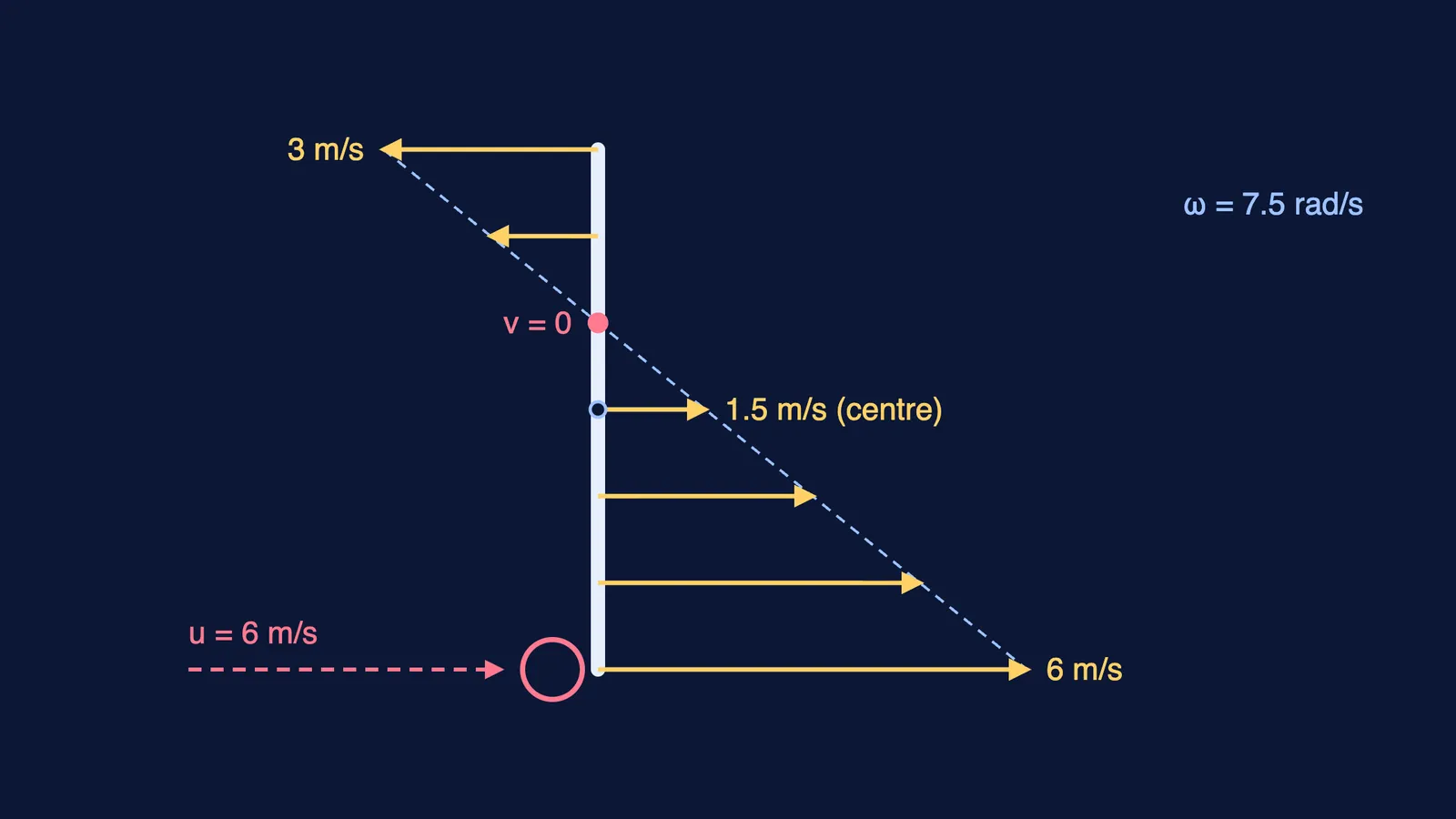
Q7 (hard, one or more options correct). A uniform 4 kg rod, 1.2 m long, lies on a smooth table. A 1 kg ball sliding at 6 m/s perpendicular to it hits one end elastically. Just after impact, which are correct?
(A) The ball is at rest. (B) The rod's centre moves at 1.5 m/s. (C) The rod point 0.2 m from its centre, away from the impact, is momentarily at rest. (D) The rod's KE splits equally between translation and rotation.
Answer: (A), (B), (C). Conserve linear momentum, angular momentum about the centre (I = 0.48 kg m²) and energy: ball 0, V = 1.5 m/s, ω = 7.5 rad/s. On the far side, 1.5 − 7.5x = 0 at x = 0.2 m. The rod's energy is 4.5 J translational and 13.5 J rotational. Trap: (D), assuming an even split.
Q8 (hard, numerical-value). A 2 kg uniform solid cylinder rests on a 2 kg plank on a frictionless floor. The plank is pulled horizontally with 12 N and the cylinder rolls on it without slipping. Find the plank's acceleration in m/s².
Answer: 4.5. Friction f pushes the cylinder forward: f = 2a_c and fR = ½(2)R²α. No slipping: a_p = a_c + αR = 3f/2. Plank: 12 − f = 2a_p = 3f, so f = 3 N, a_p = 4.5 m/s² and a_c = 1.5 m/s². This needs μ ≥ 0.15. Trap: 3 treats cylinder and plank as one rigid block.
What should you do after this set?
Sort your misses: axis slips (Q1, Q3, Q6), a missing equation for one body (Q4, Q5, Q8), or the wrong conserved quantity (Q7). For friction's direction in Q8, see which way friction acts when a rolling body slips.
For more practice, the Fermi Problem Library has worked problems with a step-by-step solver that explains the reasoning rather than printing an answer.