On this page
Rooftop Gardening is Chapter 2 of Kaushal Vikas, the NCERT Skill Education textbook for Grade 9 (code 0916, First Edition, April 2026). It is a choice chapter in Unit I, Work with Life Forms: your school picks this vocation or another from the unit, and you take a small garden from first plan to harvest.
What does the Rooftop Gardening chapter cover?
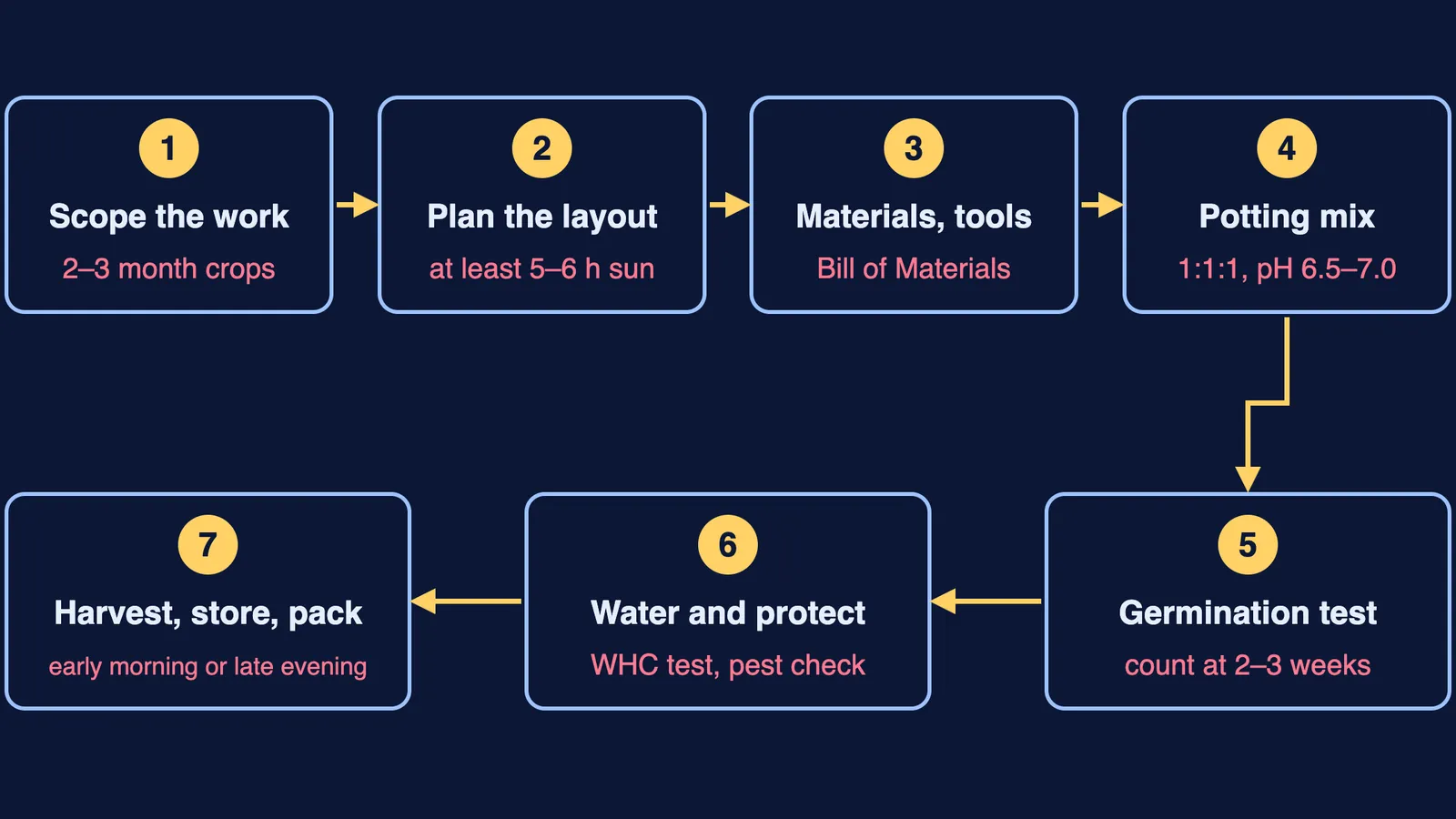
The chapter runs one project end to end: choose crops, visit a working rooftop garden, draw a process chart, design the layout, pick materials and tools, write a Bill of Materials, mix the growing medium, test seeds, sow, water, protect, then harvest, store and pack.
Even 1 square metre of roof can yield about 10 kg of vegetables a year, says the NCERT chapter. It asks you to pick crops with a 2–3 month life cycle that need little water.
The CBSE 2026-27 Vocational Education curriculum lists rooftop gardening as an example vocation under Work with Life Forms, with 26 suggestive hours for vocation-specific themes. It does not name chapters, so this guide follows the NCERT book and maps it to that unit.
How do you plan a rooftop garden layout safely?
The chapter's layout checks are space between pots, at least 5–6 hours of direct sun, weight, drainage, shade and wind. Heavy containers go near the roof edges or over beams, which carry more load. Pots sit on trays, tiles or stands so water does not seep into the roof.
A practice sum with made-up numbers. The book's caselet quotes a contractor's 150 kg per square metre; we reuse it only as an exercise figure. Take a 3 m × 2 m section.
Area = 3 × 2 = 6 m², limit 6 × 150 = 900 kg.
Potting mix: 200 kg. Water it holds at 30% WHC: 200 × 0.30 = 60 kg.
Twenty pots at 2 kg each: 40 kg. Trays, bamboo and cans: 50 kg.
Total = 200 + 60 + 40 + 50 = 350 kg, about 39% of the made-up limit, with 550 kg to spare.
How do you make the potting mix and test seeds?
Garden soil alone packs down when wet, drains badly and adds weight, so the chapter uses cocopeat, vermiculite or perlite with compost and soil in a 1:1:1 ratio. The book says 1 L of cocopeat, compost and perlite weighs around 290 g, but about 700 g if soil replaces the perlite. Test the pH and bring it to 6.5–7.0: garden lime if it is below 6.0, sulphur or organic manure if above 8.5.
For the germination test, sow a counted batch, water it and count seedlings after 2–3 weeks. In our example, 34 of 40 seeds sprout: 34 ÷ 40 × 100 = 85%. Compare that with the packet's figure.
How much water does a rooftop garden need?
Potted roots cannot reach deeper water and extra water cannot soak away, so you measure the Water Holding Capacity (WHC) of your mix: WHC = 100 × (wet weight − dry weight) ÷ dry weight, as set out in the NCERT chapter.
Our example: the mix weighs 220 g dry and 286 g after draining, so WHC = 66 ÷ 220 × 100 = 30%. The book multiplies WHC by the mass of mix for a rough maximum water need, not a daily amount.
For pests, the book combines physical (pick off larvae and sick leaves), chemical (organic sprays) and biological (helpful insects) methods. Its table links aphids to deformed leaves, treated with neem or chilli-garlic spray.
Harvest in the early morning or late evening, cut rather than pull, keep leafy greens cool and damp, and leave tomatoes at room temperature until ripe. For a soil-free comparison, see how hydroponics works.
How is Kaushal Vikas Rooftop Gardening assessed?
The CBSE assessment guidelines for Kaushal Vikas Class IX, 2026-27 set five parts: paper-pencil test 40%, demonstration and viva 20%, site visit report 10%, portfolio 20% and teacher observations 10%. These figures are for the whole subject, not this chapter. In the 40-mark test, "Plan and Prepare" (layout, tools, Bill of Materials) carries 14 marks. The guidelines mention no board exam; your school runs this assessment.
Keep your layout sketch, Bill of Materials, potting-mix record and site notes for the portfolio.
Practice questions (marks are our suggestion)
(1 mark) Which part of a roof can carry heavier pots, and why?
(2 marks) A mix weighs 300 g dry and 375 g wet. Find its WHC.
(3 marks) Of 50 okra seeds, 41 sprout. Find the germination percentage and compare it with a packet claim of 90%.
(4 marks) The east side of your roof is shaded after noon. Place tomatoes, mint and spinach, with one reason each.
(4 marks) Your basil leaves are spotted. List your steps before spraying anything.
Answers: Q2 is 25%; Q3 is 82%, 8 points below the packet's 90%.
Not sure which step to revise first? Fermi's AI tutor works out what you already know and builds a plan for the session. For the water side of a roof, read how rooftop rainwater harvesting works.