On this page
Rights is Chapter 5 of NCERT's Class 11 Political Theory. This guide follows the current NCERT chapter (Reprint 2026-27). It covers the idea of rights; the Fundamental Rights belong to the other Class 11 book.
How many marks is Rights in Class 11 for 2026-27?
The CBSE 2026-27 Political Science curriculum gives Rights 4 marks on its own. Political Theory as a whole carries 40 of the 80 theory marks.
It lists five sub-topics: what rights are, where rights come from, legal rights and the state, kinds of rights, and rights and responsibilities. Its additional reference material, which CBSE says is not assessed in the board exam, adds a note on human rights, dated to the UN declaration of 1948, which it says lists 30 rights.
What makes a claim a right?
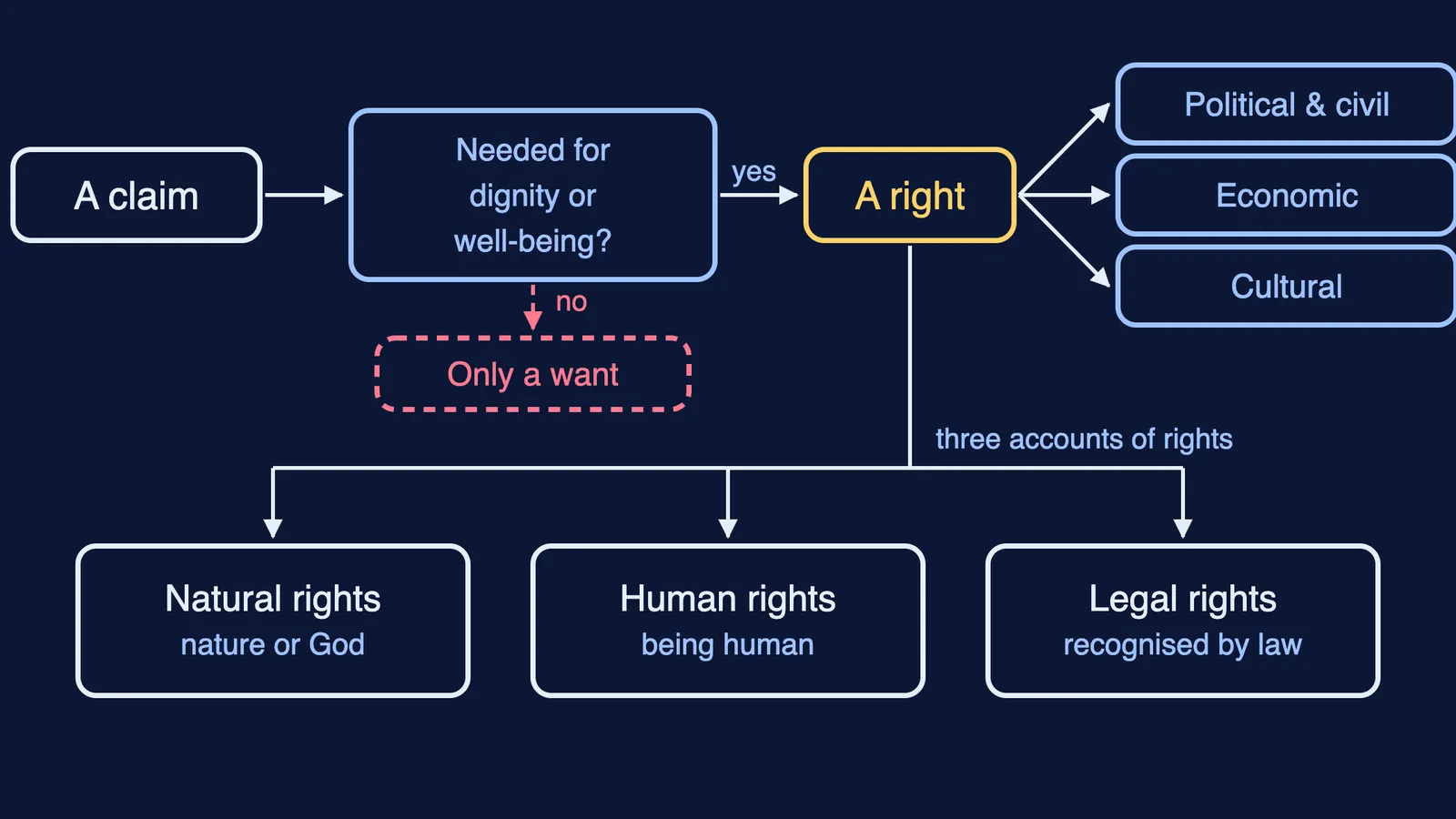
NCERT defines a right as an entitlement or a justified claim that society must recognise as legitimate. NCERT's own example: wanting to wear your own clothes to school instead of the uniform is a want, not a right.
Two grounds turn a claim into a right:
Dignity. The claim is needed for a life of respect and self-respect. A livelihood gives economic independence; free expression lets you be creative.
Well-being. The claim helps you develop your talents. Education builds your capacity to reason.
Something that injures your health and others' cannot be claimed as a right, which is why NCERT says smoking or taking banned drugs is not one.
What is the difference between natural rights and legal rights?
Natural rights. Theorists of the seventeenth and eighteenth centuries argued that rights come from nature or God, not from a ruler. We are born with them, so no one can take them away. They named three: life, liberty and property.
Human rights. Today this term is used more, since a law laid down by nature seems unacceptable to many. You are entitled to certain things just because you are human. NCERT links this to Immanuel Kant, for whom every person has dignity and must never be treated only as a means to someone else's ends. The UN General Assembly adopted the Universal Declaration of Human Rights on 10 December 1948.
Legal rights. Moral appeals succeed mostly when the law backs them. Many constitutions carry a Bill of Rights; in India these are the Fundamental Rights, including a ban on untouchability. NCERT's point to remember: a law gives a right extra standing, but a right is not claimed because a law exists.
Rights also bind the state in two directions. The right to life tells the state what it must do: make laws that protect you. The right to liberty tells it what it must not do: arrest you at will. That is why police need an arrest warrant.
What are the kinds of rights in Class 11?
Political rights: equality before law and taking part in politics, such as voting, contesting elections and forming parties.
Civil liberties: a free and fair trial, free expression, protest and dissent.
Economic rights: food, shelter, clothing and health, because political rights mean little to someone struggling to survive. NCERT cites India's rural employment guarantee scheme.
Cultural rights: primary education in your mother tongue, and setting up institutions to teach your language and culture.
Sort four claims we made up. Riya is barred from contesting the school council election because she is a girl: political. A man is jailed for months with no hearing: civil liberty. A labourer in a drought-hit district asks for paid work: economic. A Santali-speaking community wants a school that teaches in Santali: cultural.
What responsibilities come with rights?
NCERT names four. Rights ask you to protect the common good, such as clean air and forests for future generations. They require you to respect others' equal rights, so free speech never covers inciting violence. You must balance rights in conflict, like expression against privacy. And you must stay alert when governments limit civil liberties in the name of national security.
Practice questions you can try
Our own questions, in the 1, 2, 4 and 6-mark formats the curriculum's question paper design sets out for the Class 12 board paper.
(1 mark) Name the three natural rights that early modern theorists identified.
(2 marks) Why is wanting to skip school uniform not a right? Use the definition of a right.
(4 marks) Explain with one example each how rights tell the state what it must do and what it must not do.
(6 marks) "A claim becomes a right only when the state recognises it." Do you agree? Argue using natural, human and legal rights.
For question 4, show that a law adds standing but is not why a right exists.
Next, read our guide to rights in the Indian Constitution for Class 11, and our Freedom Class 11 guide on negative and positive liberty.
If you don't know where to begin, Fermi's AI tutor can work out what you already know and build a plan for the session, so you sit down to a clear next step.