On this page
Map Scale is Chapter 2 of NCERT's Class 11 book Practical Work in Geography Part I (NCERT, 2026-27 reprint). The CBSE 2026-27 Geography curriculum lists Map Scale with a weightage of 4 in the practical book, whose total is 30. Its content list has two topics: methods and construction of scales, and conversion of scale.
What is a map scale?
A map scale is the relationship between a distance on the map and the same distance on the ground (NCERT, Chapter 2).
The chapter uses two systems of measurement:
Metric: 1 km = 1,000 m, 1 m = 100 cm, 1 cm = 10 mm.
English: 12 inches make a foot, 3 feet make a yard, 220 yards make a furlong, and 8 furlongs make a mile.
Two numbers follow that you will use in almost every sum: 1 km = 100,000 cm, and 1 mile = 8 × 220 × 3 × 12 = 63,360 inches.
What are the three methods of showing scale?
Statement of scale. Written in words, such as "1 cm represents 10 km". Simplest, but readers of the other system may not follow it, and it fails if the map is resized.
Graphical (bar) scale. A line divided into primary and secondary divisions. It reads in one system only, but stays correct when the map is resized, because the bar changes with it.
Representative fraction (R.F.). A ratio such as 1 : 50,000 that holds in any unit of length: one unit on the map stands for 50,000 of the same unit on the ground. Because readers of either system can use it, NCERT calls it universal.
How do you convert a statement of scale into R.F.?
Write both sides in the same unit, then drop the unit:
2 cm represents 5 km. First reduce to 1 cm: 1 cm represents 2.5 km. Then 2.5 km = 2.5 × 100,000 = 250,000 cm. R.F. = 1 : 250,000.
1 inch represents 3 miles. 3 × 63,360 = 190,080 inches. R.F. = 1 : 190,080.
The common slip is not bringing the map side to 1 first.
How do you convert R.F. into a statement of scale?
Read the R.F. in centimetres (metric) or inches (English), then divide by the size of the unit you want:
1 : 250,000 in km. 1 cm represents 250,000 cm; 250,000 ÷ 100,000 = 2.5. Statement: 1 cm represents 2.5 km.
1 : 63,360 in miles and furlongs. 1 inch represents 63,360 inches = 1 mile. One furlong is 220 × 36 = 7,920 inches, so the same inch is 63,360 ÷ 7,920 = 8 furlongs.
One R.F., two systems. 1 : 45,000 reads as 1 cm represents 450 m (45,000 ÷ 100), or 1 inch represents 1,250 yards (45,000 ÷ 36).
How do you draw a graphical scale?
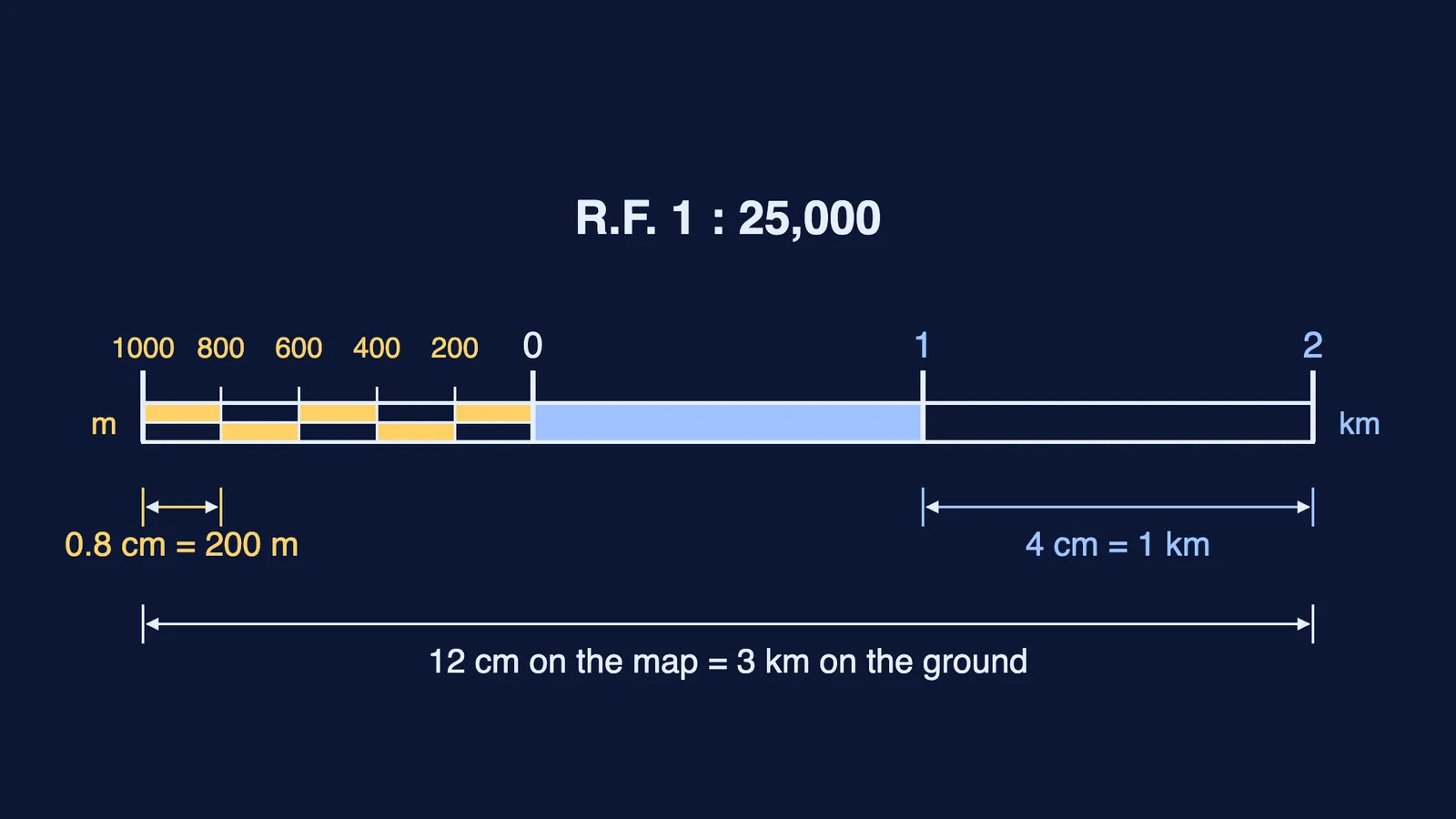
The diagram above is a bar scale for R.F. 1 : 25,000, built with NCERT's method (Chapter 2):
Start from about 15 cm, NCERT's conventional length for a metric bar. At 1 : 25,000, 15 cm represents 15 × 25,000 = 375,000 cm = 3.75 km.
Pick a round number near 3.75 km. Take 3 km.
Find its length: 3 km = 300,000 cm, and 300,000 ÷ 25,000 = 12 cm.
Draw 12 cm and divide it into 3 primary divisions of 4 cm, each worth 1 km. Put 0 at the end of the first division and label 1 and 2 km to its right.
Split the leftmost division into secondary parts. Five parts of 0.8 cm give 200 m each, labelled 200 to 1,000 m leftwards from 0.
For an awkward length, NCERT divides the line with slanting guide lines whose equal steps are joined back to the bar.
Scales return on toposheets; see how to prepare for the ICSE geography toposheet question. For theory map work, see the Drainage System Class 11 guide.
Practice questions on map scale
(1 mark) Which method of scale stays correct when a map is reduced on a photocopier?
(1 mark) Convert "4 cm represents 1 km" into an R.F.
(2 marks) Convert 1 : 200,000 into a statement of scale in kilometres.
(5 marks) Construct a graphical scale for R.F. 1 : 40,000 reading kilometres and metres. Show your calculation.
Answers to check: 2 is 1 : 25,000; 3 is 1 cm represents 2 km; in 4, 15 cm represents 6 km, so a 15 cm bar with six 1 km divisions works.
If the unit changes keep slipping, Fermi's AI tutor can work out what you already know and build a plan for the session.