On this page
Political Theory: An Introduction is Chapter 1 of NCERT's Class 11 Political Theory book. It asks what politics is, what political theory studies, and why students should care. This guide follows the current NCERT chapter (Reprint 2026-27) and ends with our own practice questions.
How many marks is Political Theory: An Introduction for 2026-27?
The CBSE 2026-27 Political Science curriculum gives this chapter 4 marks on its own. Part B, Political Theory, carries 40 of the 80 theory marks, and project work adds 20 more.
Its four sub-topics match the chapter's four sections: what politics is, what political theory studies, putting it into practice, and why study it.
What is politics, according to NCERT?
The chapter first lays out conflicting images. Leaders may call it public service; many link it with false promises, defections and scams.
Then NCERT widens the view: every society needs some way to organise itself and reach decisions together. Government policies on the economy and education change daily life, so people form associations, campaign, negotiate and protest.
So politics works at two levels: what governments do, and how people struggle to influence decisions. It arises because people disagree about what is just and good for themselves and their society.
What do we study in political theory?
Political theory looks systematically at the ideas behind constitutions, governments and everyday social life. It makes the meaning of freedom, equality, justice, democracy and secularism clearer, and asks why rule of law, judicial review and the separation of powers matter.
It examines thinkers' arguments. Among those NCERT names, Rousseau argued for freedom as a fundamental right, Marx held that equality mattered as much as freedom, Gandhi discussed swaraj in Hind Swaraj, and Ambedkar argued that the scheduled castes needed special protection as a minority. These ideas reached the Preamble, the abolition of untouchability and the Directive Principles.
Why do these questions stay alive in a free India? NCERT gives three reasons:
Political equality can exist while social and economic inequality remains.
Rights keep being reinterpreted. Courts have read the right to life to include the right to livelihood, and a new law granted the right to information.
New technology brings new freedoms and new threats, such as privacy online.
A side box shows Socrates, in Plato's Republic, testing a simple definition of justice against a hard case until it fails. NCERT's point is that reason can expose the limits of a view people have long accepted.
How does political theory work in practice? A worked example
NCERT uses equality to show why political concepts, unlike a triangle, have many definitions. Here is the method on our own case.
Your school canteen has one long lunch queue.
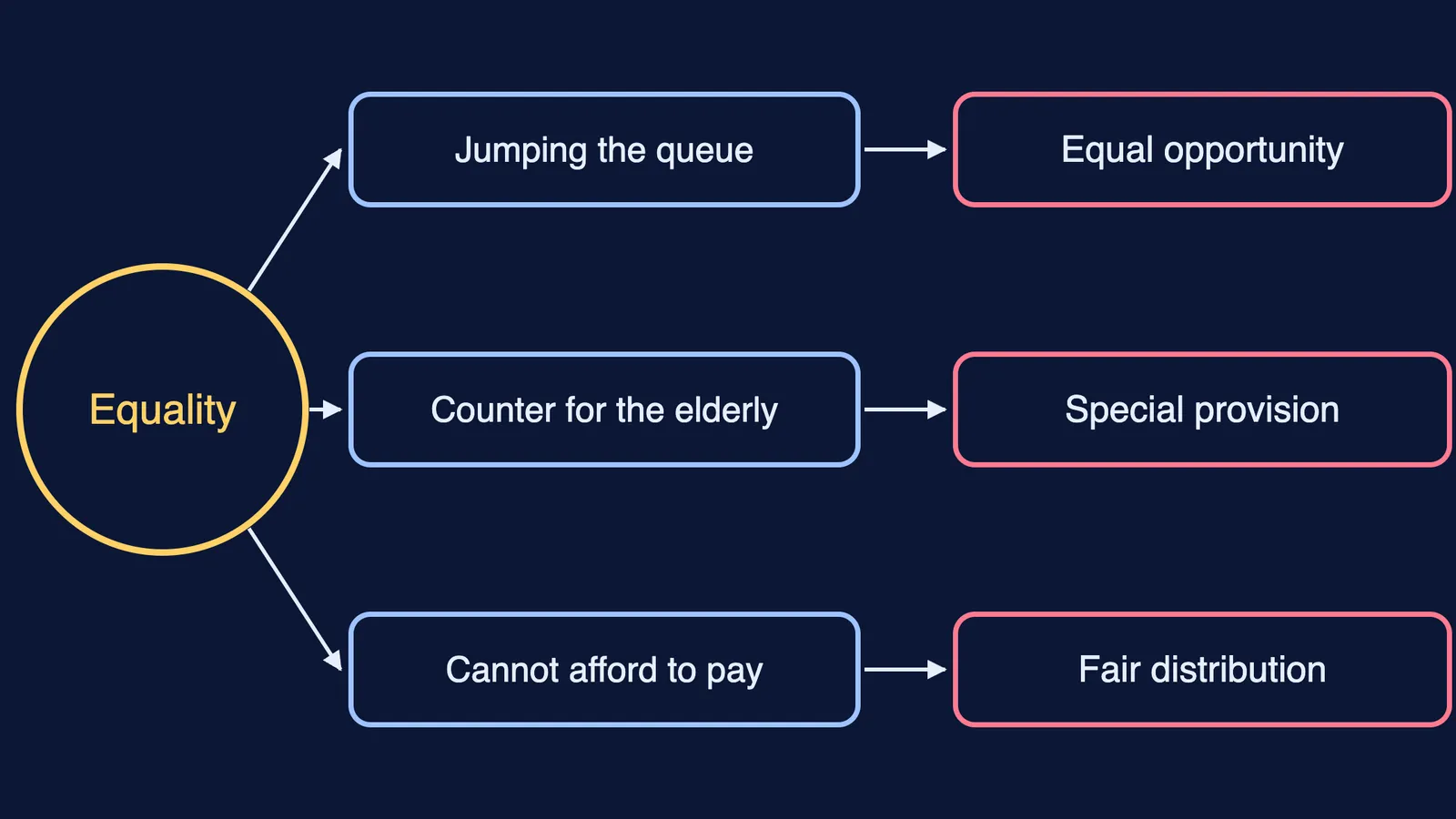
Ordinary use. Someone pushes in and you feel cheated. Equality here means equal opportunity: same line, same rules.
Test a hard case. A student on crutches is given a separate counter. Most people accept this, so equality can allow special treatment.
Widen the circle. Some classmates skip lunch because they cannot pay. A fair queue does not help them, so equality may need fair distribution, like a subsidised meal.
Ask the policy question. How far, and for how long, should special help go? NCERT poses the same kind of question about midday meals.
The meaning changed with the context. Theorists start from how a word is used in ordinary language, then sort its meanings systematically. The diagram above maps NCERT's own version: a queue, a counter for the elderly, and people who cannot pay.
Why should we study political theory?
NCERT gives four reasons:
It matters to future politicians, officials, lawyers, judges and journalists, and you may become one; you learn maths without becoming a mathematician.
You will be a voting citizen. Like a knowledgeable audience at a concert, an informed public pushes those in politics to be more public-spirited.
It helps you examine your own prejudices about caste, religion, gender or class, which can make your views more moderate.
It trains you to back your opinions with reasons, a skill for debates and after school.
Practice questions you can try
These are our own questions, written in the 1, 2, 4 and 6-mark question types shown in the curriculum's question paper design.
(1 mark) Name the right that courts have read into the right to life, as mentioned in the chapter.
(2 marks) Your school council votes on whether to move sports day to a weekend. Give two reasons why this counts as politics in the chapter's broad sense.
(4 marks) A housing society debates whether elderly residents should get the lift first in the morning rush. Show how a political theorist would analyse the meaning of equality in this case.
(6 marks) "Questions of freedom and equality did not end with independence." Explain with three reasons from the chapter.
Next, read our guide to Constitution: why and how, then rights in the Indian Constitution for Class 11 to see these ideas in the Constitution.
If you don't know where to begin, Fermi's AI tutor can work out what you already know and build a plan for the session, so you sit down to a clear next step.