On this page
Freedom is Chapter 2 of NCERT's Class 11 Political Theory. It asks what freedom means and how to tell a fair limit on it from an unfair one. This guide follows the current NCERT chapter (Reprint 2026-27) and ends with practice questions we wrote for you.
How many marks is Freedom in Class 11 for 2026-27?
The CBSE 2026-27 Political Science curriculum groups Freedom with Equality for 12 marks together; it gives no separate figure for Freedom alone. Political Theory as a whole carries 40 of the 80 theory marks.
It lists four sub-topics: the ideal of freedom, sources of constraints, the harm principle, and negative and positive liberty.
What is freedom in Class 11 political science?
The chapter gives freedom two sides. The first is the absence of external constraints, so you can decide and act on your own. The second is the presence of conditions in which you can develop your talents and abilities.
NCERT opens with two lives. Nelson Mandela spent twenty-seven years in jail fighting apartheid, and Aung San Suu Kyi's book of essays is titled Freedom from Fear. The Indian idea closest to freedom is Swaraj, from Tilak's "Swaraj is my birth right" to Gandhi's Hind Swaraj of 1909.
Constraints can come from force or unjust laws, and also from caste or extreme economic inequality, which Subhas Chandra Bose's 1929 Lahore address, quoted in the chapter, asked India to remove.
What is the difference between negative and positive liberty?
Negative liberty is "freedom from". It asks: over what area am I the master? It defends a minimum area of non-interference that no outside authority may enter.
Positive liberty is "freedom to". It asks: who governs me? The ideal answer is "I govern myself".
Positive liberty looks at conditions outside that area: freedom from poverty and unemployment, a say in decision making, and access to education.
Take Meera. No one forbids her from applying to college: negative liberty. But her family cannot pay the fees, so she still cannot go: that gap is what positive liberty addresses. The two usually support each other, though NCERT notes tyrants have invoked positive liberty.
What is J.S. Mill's harm principle?
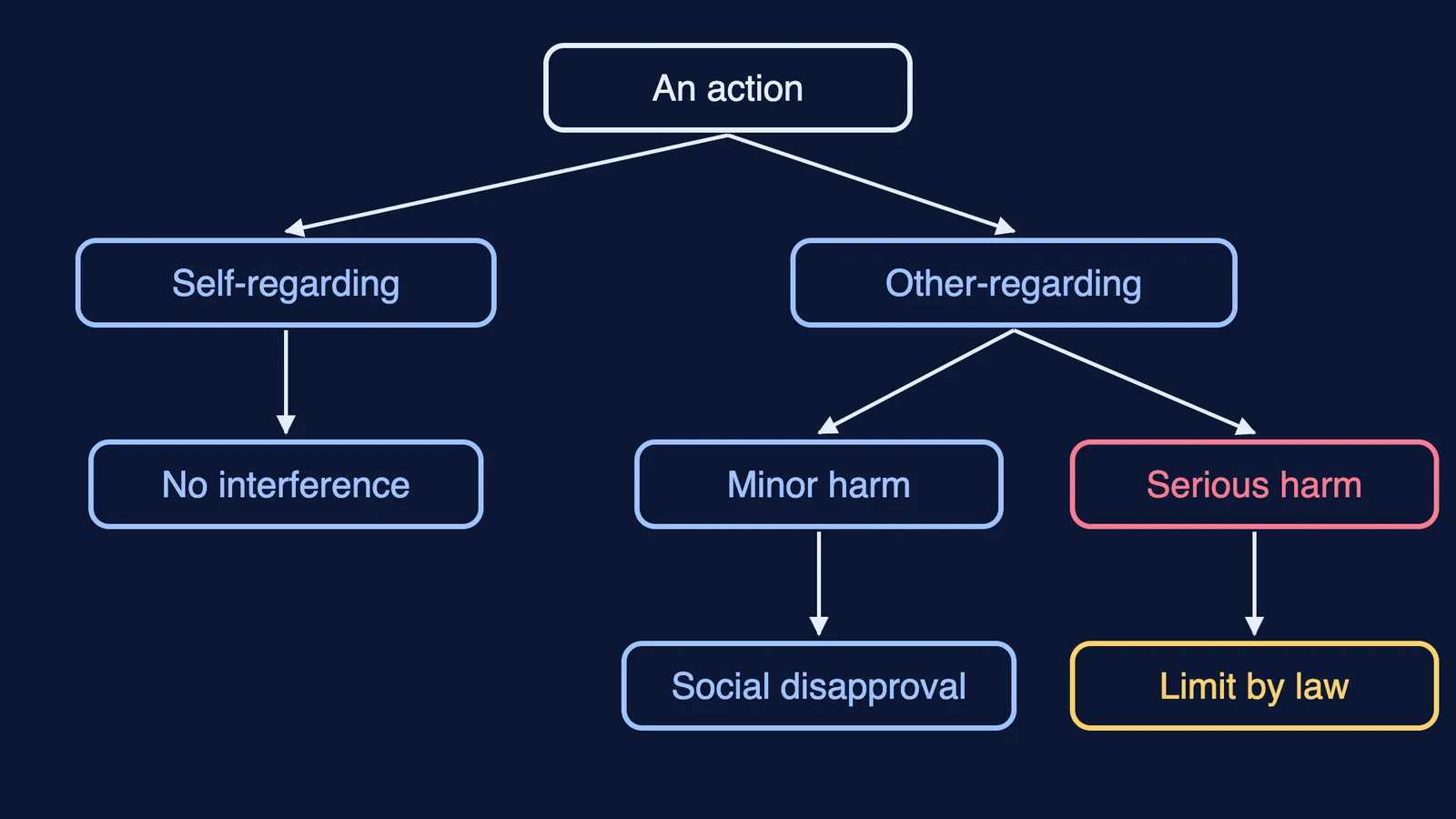
In On Liberty, Mill separates self-regarding actions, which affect only you, from other-regarding actions, which affect others. The state has no business in the first kind. In the second, it may step in, but only when the harm is serious; for minor harm Mill recommends social disapproval, not law. NCERT's example: loud music in an apartment block deserves disapproval, not the police.
The diagram covers steps 1 and 2; the chapter's points on who imposes a limit and whether it is excessive add steps 3 and 4:
Does the action affect anyone besides the person doing it?
If it does, is the harm minor or serious?
Who imposes the limit: the state, a community body, or a rule you chose?
Is the limit in proportion to the harm?
Three cases we made up: Dyeing your own hair blue on a holiday is self-regarding, so no one should interfere. A group chat that mocks a classmate's accent causes harm, but probably minor harm, so peers should push back. Posts urging people to attack a community are serious harm, so a proportionate legal limit is justified.
What are reasonable restrictions in India?
NCERT says Indian constitutional discussions call justified constraints "reasonable restrictions": they must be defensible by reason, not excessive, and in proportion to the action restricted.
The Rights in the Indian Constitution chapter lists the freedoms under the Right to Freedom, including speech and expression, assembling peacefully, forming associations and moving freely across India. These are not absolute: NCERT's examples are limits on speech for public order, peace and morality, and assembly that must be peaceful and unarmed.
The Freedom chapter tests this with bans. Deepa Mehta's film on widows could not be made in Varanasi after protests, and books such as The Satanic Verses were banned. NCERT warns that banning meets a short-term demand but builds a habit of banning.
Practice questions you can try
These are our own questions, written in the 1, 2, 4 and 6-mark formats of the curriculum's question paper design, set out for Class 12.
(1 mark) Which kind of liberty answers the question "Who governs me?"
(2 marks) Give one difference between self-regarding and other-regarding actions, with an example of each.
(4 marks) A housing society bans residents from drying clothes on balconies. Apply the harm principle and say whether the rule is a reasonable restriction.
(6 marks) "Removing constraints is not enough to make people free." Discuss with reference to negative and positive liberty, using one Indian example.
For question 4, define both, show one existing without the other, and bring in caste or economic inequality.
Next, read our guide to rights in the Indian Constitution for Class 11, then Constitution: why and how on why limits on government matter.
If you don't know where to begin, Fermi's AI tutor can work out what you already know and build a plan for the session, so you sit down to a clear next step.