On this page
Citizenship is chapter 6 of NCERT's Class 11 Political Theory. The CBSE Political Science curriculum for 2026-27 prints 8 marks shared between Citizenship and Nationalism, out of 40 for Political Theory; it gives no separate figure for Citizenship. It keeps all six parts of the chapter. This guide follows the current NCERT chapter (reprint 2026-27).
What is citizenship in Class 11 Political Science?
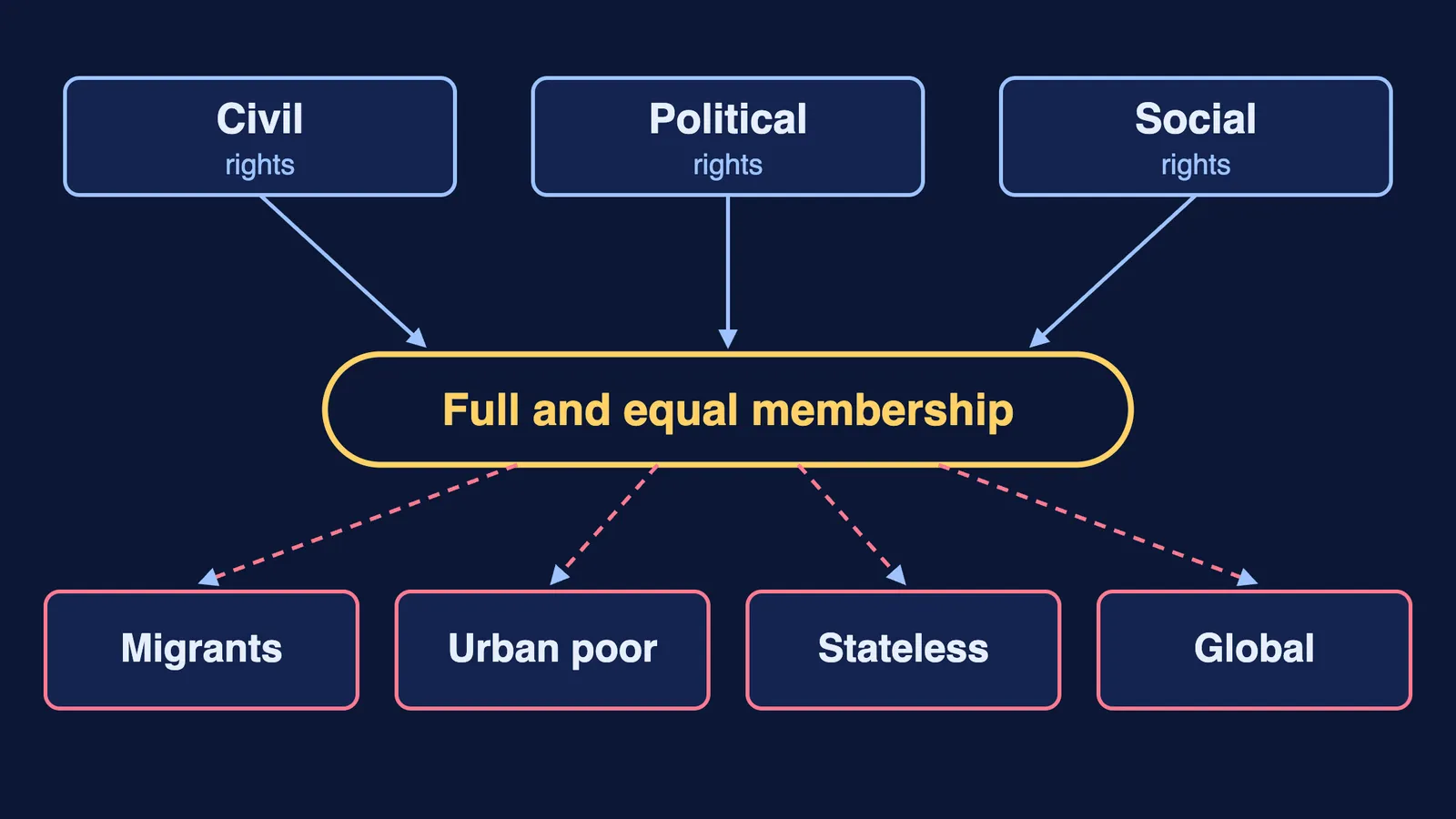
In the NCERT chapter, citizenship is full and equal membership in a political community.
Membership gives a shared political identity and rights. Most democracies grant political rights such as voting, civil rights such as free speech or freedom of belief, and some socio-economic rights such as a minimum wage or education. Equality of rights and status is itself a basic right of citizenship.
Citizenship also carries obligations: legal ones, and a moral duty to take part in the shared life of the community.
Every right was won through struggle, from the French Revolution of 1789 to black South Africans' fight for equal citizenship, which went on until the early 1990s.
What does full and equal membership mean for migrants?
Freedom of movement matters most to workers, who migrate for jobs: NCERT's examples include IT workers moving to Bangalore and nurses from Kerala working across India.
The tension: when jobs are scarce, local residents may resent "outsiders", even fellow citizens, and demand that jobs go to people from the state or who speak its language. The chapter asks whether freedom of movement includes the right to settle and take a job in any part of India, and whether poor, unskilled migrants get the same welcome as skilled ones.
NCERT's answer is about method, not a side: citizens may protest, organise or go to court, but disputes should be resolved through discussion and negotiation, not force.
What rights do the urban poor have as citizens?
Slum-dwellers do useful work, as hawkers or domestic workers, yet often lack water and sanitation. Even voting is hard: the voter list needs a fixed address.
Key facts from the chapter:
In January 2004 a national policy for urban street vendors set out to protect them from harassment as long as they followed regulations.
NCERT asks you to look up the Street Vendors (Protection of Livelihood and Regulation of Street Vending) Act, 2014.
In the Olga Tellis case against the Bombay Municipal Corporation (1985), the Supreme Court read the right to life in Article 21 to include the right to livelihood, so evicted pavement dwellers should first get alternative accommodation.
The key point: equal rights need not mean uniform policies, because groups have different needs. See our guide to equality in Class 11 on that idea, and rights in the Indian Constitution for Article 21.
How is citizenship granted in India and other countries?
Nation states tie national identity to a shared culture and history, so some groups identify with the state more easily than others. NCERT's examples are France, where some schools barred turbans and headscarves, and Germany, where Turkish workers sought automatic citizenship for children born there.
In India, citizenship provisions are in Part Two of the Constitution and later laws. Indian citizenship comes by birth, descent, registration, naturalisation and inclusion of territory, and the state should not discriminate against citizens only because of their religion, race, caste, sex or place of birth. NCERT calls democratic citizenship a project still being worked on.
What are universal and global citizenship?
Universal citizenship promises that everyone belongs to some state. Refugees and stateless people break it: they may live in camps, unable to work legally or own property. The UN has a High Commissioner for Refugees. India sheltered the Dalai Lama and those who followed him in 1959, but many who enter India stay stateless for years, and relatively few are granted citizenship.
Global citizenship rests on an interconnected world, such as the help sent after the 2004 tsunami. It could ease cross-border problems like refugees. NCERT's conclusion is balanced: national citizenship still matters, but may need to be supplemented by an awareness of global links.
Practice questions you can try
CBSE publishes no Class 11 sample paper, so the mark values are our suggestion:
(2 marks) Using Marshall's three kinds of rights, give one example each of a civil and a political right.
(4 marks) A state reserves most private-sector jobs for people born there. Use the idea of full and equal membership to give one argument for and one against.
(4 marks) How did the Olga Tellis judgment widen the meaning of the right to life?
(6 marks) "National citizenship is enough to protect stateless people." Evaluate, with reference to refugees and global citizenship.
If you are unsure where to start revising, Fermi's AI tutor works out what you already know and builds a plan for the session, so you sit down to a clear next step.