On this page
Geography as a Discipline is Chapter 1 of NCERT's Class 11 book Fundamentals of Physical Geography (NCERT, Reprint 2026-27). In the CBSE 2026-27 Geography curriculum it is Unit I on its own, worth 3 marks out of 35 for this book, with no map items. The curriculum keeps five topics: what geography is, geography as an integrating discipline (spatial and temporal synthesis), the systematic and regional approaches, the branches, and physical geography and its importance.
What is geography, and what questions does it ask?
The word was coined by the Greek scholar Eratosthenes (276-194 BC), from geo (earth) and graphos (description), so geography is the description of the earth (NCERT, Chapter 1).
Because both natural and cultural features vary from place to place, NCERT says geography came to be seen as the study of areal differentiation.
Geography asks three sets of questions:
What? Identifying the patterns of natural and cultural features.
Where? Their distribution and location over the surface.
Why? The cause-and-effect links between features and processes.
What and where alone give an inventory; geography became scientific only once why was added. NCERT's example: cropping patterns differ by region because soils, climate, market demand, the farmer's capacity to invest and technology differ.
Because people adapt to and modify nature, NCERT speaks of humanised nature and naturalised human beings.
Why is geography called an integrating discipline?
Geography draws data from the natural and social sciences and combines them (NCERT, Chapter 1). The key line to learn: geography attempts spatial synthesis, while history attempts temporal synthesis.
NCERT's Indian example: the Himalayas gave protection, but their passes let migrants and invaders in from Central Asia.
Time matters too. NCERT's example: two places 1,500 km apart can also be described as two hours apart by plane, or seventeen hours by a fast train. Space can be written as time and time as space, which is why time is called the fourth dimension of geography.
What is the difference between the systematic and regional approach?
The core comparison (NCERT, Chapter 1).
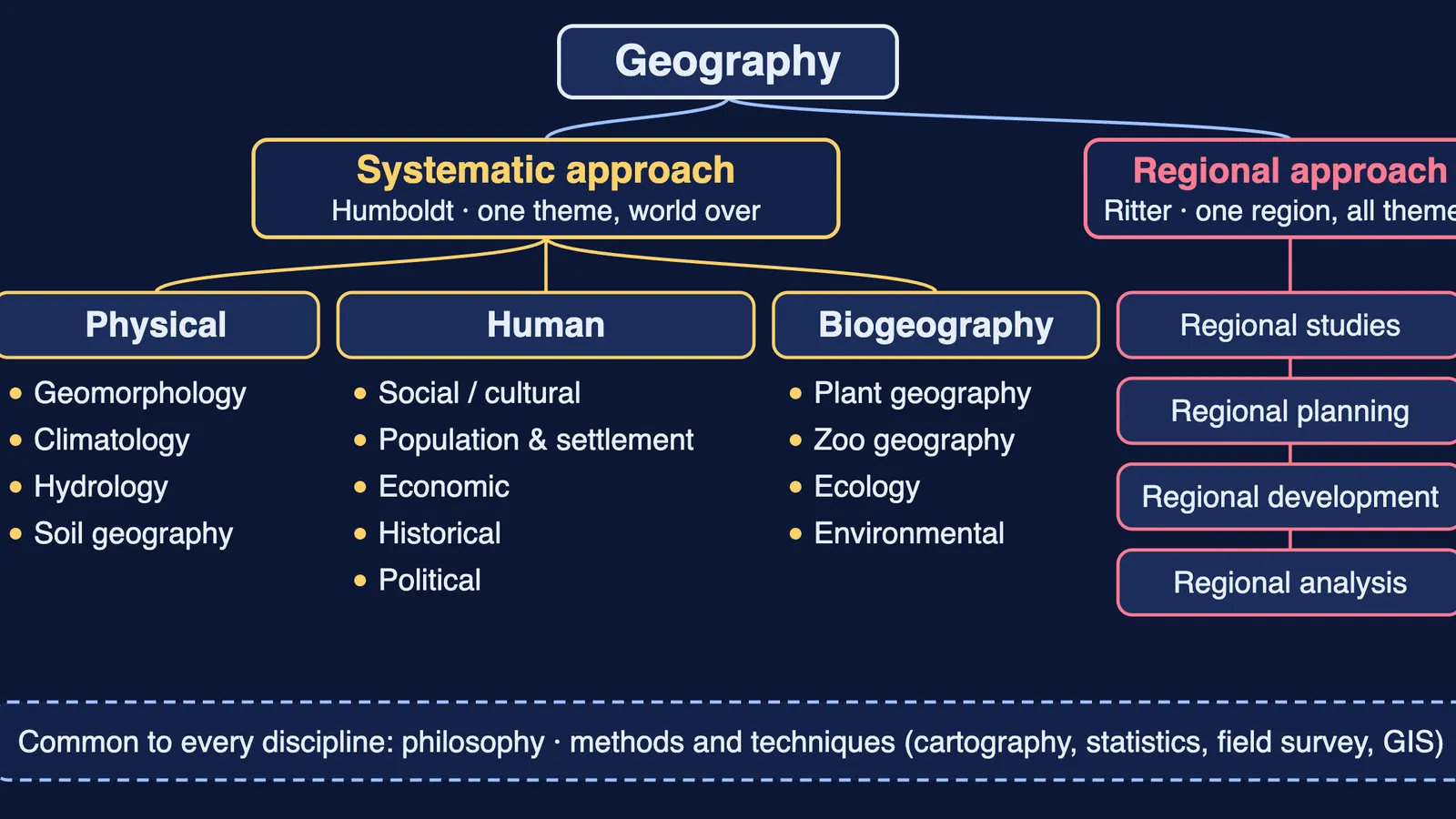
Systematic approach. Also called general geography. Introduced by the German geographer Alexander von Humboldt (1769-1859). One phenomenon is studied across the world first, then grouped into types or spatial patterns. NCERT's example is natural vegetation: study it worldwide, then identify types such as equatorial rain forests or monsoon forests.
Regional approach. Developed by Karl Ritter (1779-1859), also German and Humboldt's contemporary. The world is split into regions at several levels (natural, political or designated), and all phenomena in one region are studied together, looking for unity in diversity.
Remember it as: systematic is one theme, whole world; regional is one region, every theme. NCERT also calls dualism, an emphasis on either physical or human geography, one of the subject's main characteristics since its start.
What are the branches of geography?
Branches based on the systematic approach (NCERT, Chapter 1):
Physical geography: geomorphology (landforms), climatology, hydrology and soil geography.
Human geography: social/cultural, population and settlement, economic, historical and political geography.
Biogeography, the interface of the two: plant geography, zoo geography, ecology/ecosystem and environmental geography.
Branches based on the regional approach: regional studies (macro, meso and micro), regional planning (country/rural and town/urban), regional development and regional analysis.
Two aspects are common to every discipline: philosophy (geographical thought, land and human interaction) and methods and techniques (cartography, statistical techniques, field surveys and geo-informatics such as remote sensing, GIS and GPS). In Class 12 the same two approaches return in Human geography: nature and scope.
Why is physical geography important?
Physical geography studies the lithosphere, atmosphere, hydrosphere and biosphere (NCERT, Chapter 1). Plains are farmed, plateaus give forests and minerals, mountains give pastures and rivers, and in India the monsoon sets the farming rhythm. NCERT says physical geography is becoming a discipline for evaluating and managing natural resources, needed for sustainable development as fast resource use causes ecological imbalance. The book's next chapter, origin and evolution of the Earth, starts that study.
Practice questions for Geography as a Discipline
The CBSE question paper design sets 41% for remembering and understanding, 37% for application and 22% for analysing, evaluating and creating. These questions are our own:
(1 mark) Which approach, systematic or regional, was developed by Karl Ritter?
(1 mark) Name the branch of physical geography that studies landforms.
(3 marks) A student studies rainfall across every continent and groups it into types. Another studies the relief, crops and towns of Kerala. Name each approach and give one feature of each.
(3 marks) Why did geography become scientific only after the why question was added? Use one example.
If you are not sure where to start with the rest of the book, Fermi's AI tutor can work out what you already know and build a plan for the session, so you sit down to a clear next step.