

On this page
Chapter 1 of NCERT's Class 12 book *Fundamentals of Human Geography* asks one question: how much does nature decide how people live, and how much do people decide? Answer it with three definitions, three ideas and two examples, and you have the chapter. Everything below comes from the NCERT chapter, Human Geography: Nature and Scope.
What is human geography? The three definitions to learn
The NCERT chapter says human geography studies “the relationship between the physical/natural and the human worlds, the spatial distributions of human phenomena and how they come about, the social and economic differences between different parts of the world” (NCERT).
It then gives three definitions, each with a keyword:
Ratzel: “Human geography is the synthetic study of relationship between human societies and earth’s surface.” Keyword: synthesis.
Ellen C. Semple: “Human geography is the study of the changing relationship between the unresting man and the unstable earth.” Keyword: dynamism.
Paul Vidal de la Blache: a “conception resulting from a more synthetic knowledge of the physical laws governing our earth and of the relations between the living beings which inhabit it.” Keyword: interrelationships.
The chapter’s exercise asks you to define human geography in about 30 words: write one definition with its author, then add its keyword.
What is the nature of human geography?
Human geography studies how the physical environment (landforms, soils, climate, water, vegetation) interacts with what people build on it: houses, cities, roads, farms and ports. In NCERT’s words, “technology loosens the shackles of environment on human beings” (NCERT). The three ideas below are three stages of that loosening.
Determinism, possibilism and neo-determinism: what is the difference?
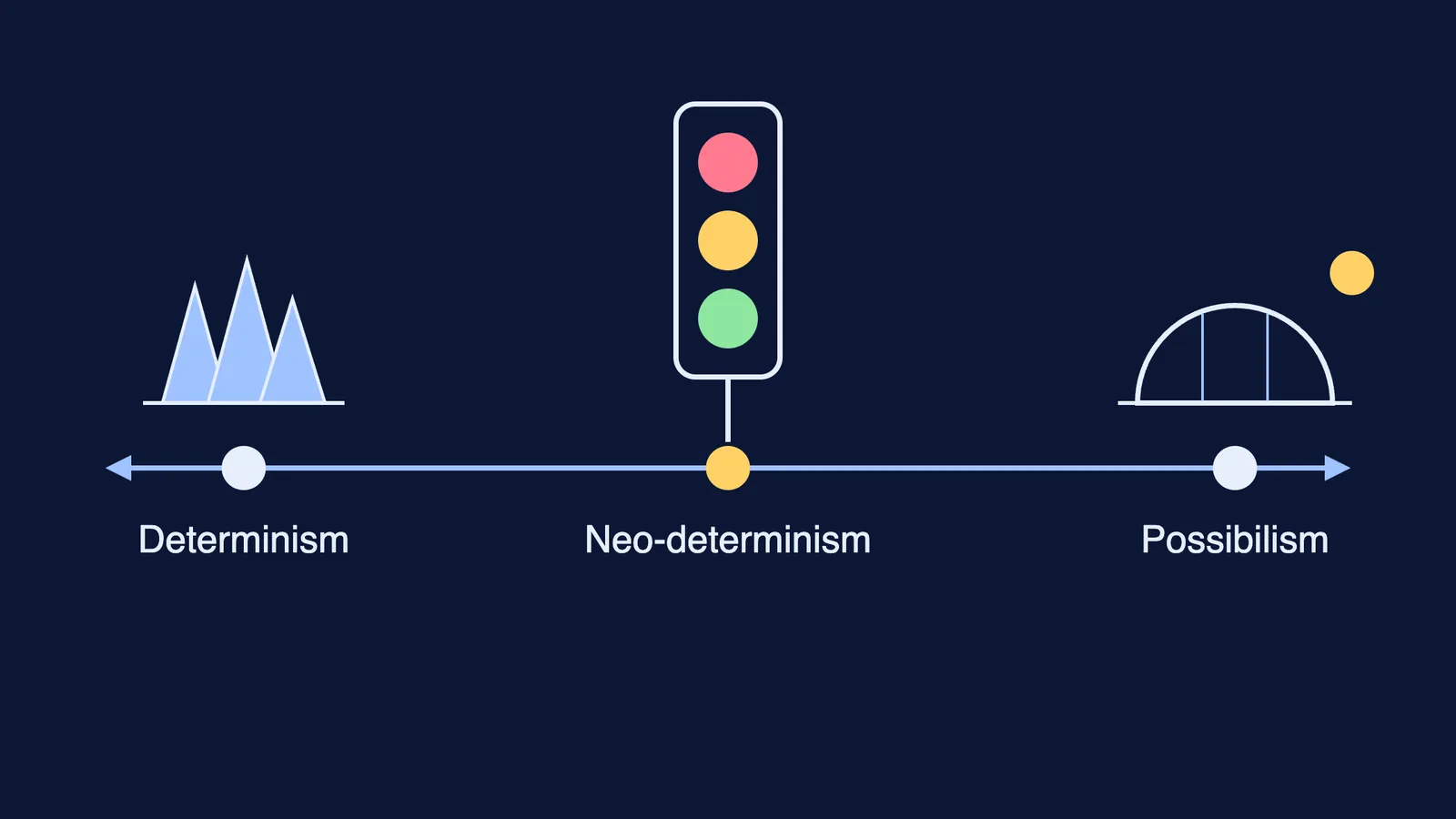
Environmental determinism is the stage where technology is very low and people adapt to the dictates of nature. The NCERT chapter calls this person a “naturalised human” and gives the example of Benda, who lives in the Abujh Maad area of central India, practises shifting cultivation and depends directly on the forest.
Possibilism is the stage where people understand nature better, build better technology and “move from a state of necessity to a state of freedom.” Nature offers opportunities, people use them, and nature gets “humanised.” NCERT’s example is Kari in Trondheim, Norway: dark, snowy winters, yet her office is heated to 23 degrees Celsius, her university campus sits under a huge glass dome, and she eats bananas and kiwis flown in from warmer areas.
Neo-determinism, introduced by the geographer Griffith Taylor, is the middle path. He also called it “stop and go determinism.” Red means stop, amber means get set, green means go: people can develop when nature permits, but must stop at nature’s red lights. NCERT says the “free run” that developed economies attempted has already resulted in the greenhouse effect, ozone layer depletion, global warming, receding glaciers and degrading lands.
How do you sort an example into the right idea?
Ask three questions in order:
Is technology very low, so people simply follow what nature allows? Then it is determinism.
Is technology letting people overcome a natural limit and create new possibilities? Then it is possibilism.
Are people developing, but stopping where nature sets a limit to avoid damage? Then it is neo-determinism.
Try it on three cases. A forest community that clears small patches by burning is determinism (this is Benda). A heated, domed campus in a dark Norwegian winter is possibilism (this is Kari). A hill town that stops building on slopes after landslides, and builds again only where the ground is stable, is neo-determinism: stop, then go.
What is the scope of human geography?
NCERT says human geography has a “highly inter-disciplinary nature,” because it works closely with its sister disciplines in the social sciences. Table 1.2 of the chapter pairs each field with a partner:
Social geography: sociology (sub-fields include behavioural geography with psychology, cultural with anthropology, historical with history)
Urban geography: urban studies and planning
Political geography: political science (electoral geography with psephology)
Population geography: demography
Settlement geography: urban and rural planning
Economic geography: economics (sub-fields include agriculture, industries, tourism and international trade)
For the exercise “Write a note on the scope of human geography” (not more than 150 words), use a four-part plan: a definition (about 30 words), the inter-disciplinary point (20 words), five or six field and partner pairs (70 words), and a closing line on why the links matter (30 words).
How should you revise this chapter?
Try making a mind map for revision, one chapter at a time. If the vocabulary feels new, human environment: settlement, transport and communication is a quick Class 7 refresher, and how the Human Development Index is calculated shows the welfare side of human geography in numbers.
If you are not sure where to start across the whole syllabus, Fermi's AI tutor can work out what you already know and build a plan for the session, so you sit down to a clear next step.


