On this page
Chapter 2 of NCERT's Class 11 Fundamentals of Physical Geography tells four stories: how the universe began, how planets formed, how the Earth got its layers, and how its air and oceans appeared. Here is each one in exam language, with a timeline you can redraw from memory.
What is the nebular hypothesis?
The nebular hypothesis says the planets formed out of a cloud of material around a young, slowly rotating Sun (NCERT, The Origin and Evolution of the Earth). NCERT credits an early version to the German philosopher Immanuel Kant, and says the mathematician Laplace revised it in 1796.
In 1950, Otto Schmidt and Carl Weizsäcker revised it again: the Sun was surrounded by a solar nebula of mostly hydrogen, helium and dust. Friction and collisions between particles flattened it into a disc, and the planets grew by accretion, small pieces sticking together into bigger ones.
What does the Big Bang theory say?
The Big Bang theory, also called the expanding universe hypothesis, is NCERT's account of where the universe came from (NCERT Chapter 2). The chapter says Edwin Hubble provided evidence in 1920 that the universe is expanding; his paper relating the distances and speeds of galaxies was published in 1929 (Hubble, PNAS). Write the textbook's date in the exam. The chapter gives three stages:
All matter existed as a “tiny ball” (singular atom) with tiny volume, infinite temperature and infinite density.
It exploded violently 13.7 billion years ago; within the first three minutes the first atom began to form.
Within 300,000 years the temperature dropped to 4,500 K, atomic matter formed and the universe became transparent.
The rival idea was Hoyle's steady state theory, which said the universe looks roughly the same at any time. NCERT also notes that its balloon demonstration is only partly right: the space between galaxies grows, but the galaxies themselves do not. That caveat makes a strong last line in a 150-word answer.
In 2013, data from the European Space Agency's Planck mission put the age of the universe at 13.82 billion years (ESA).
How did stars and planets form?
Small differences in density in the early universe caused differences in gravity, which pulled matter into galaxies (NCERT Chapter 2). Inside a galaxy, a hydrogen cloud called a nebula develops clumps that grow into stars, which NCERT dates to some 5 to 6 billion years ago. Planets then formed in three stages:
Gravity pulls a gas clump into a core, with a rotating disc of gas and dust around it.
The cloud condenses and the matter around the core forms small rounded objects, which stick together into planetesimals.
Planetesimals collide and accrete into a few large bodies, the planets.
How did the Earth get its layers and atmosphere?
The young Earth was barren, rocky and hot, with a thin atmosphere of hydrogen and helium (NCERT Chapter 2). Its layers came from differentiation: heavier materials such as iron sank towards the centre and lighter ones rose, giving the crust, mantle, outer core and inner core you met in Inside our Earth for Class 7. The giant impact that formed the Moon heated the Earth further; NASA says Apollo samples suggest the Moon formed around 60 million years after the solar system began to form (NASA).
The atmosphere evolved in three stages:
Solar winds stripped away the original hydrogen and helium.
Degassing: the cooling interior and volcanoes released water vapour, nitrogen, carbon dioxide, methane and ammonia, with very little free oxygen. Rain filled depressions, forming oceans within 500 million years of the Earth's formation.
Photosynthesis, which evolved 2,500 to 3,000 million years ago, added oxygen to the oceans and then, about 2,000 million years ago, to the air.
How today's air is arranged is covered in our guide to the layers of the atmosphere.
A timeline to redraw before the exam
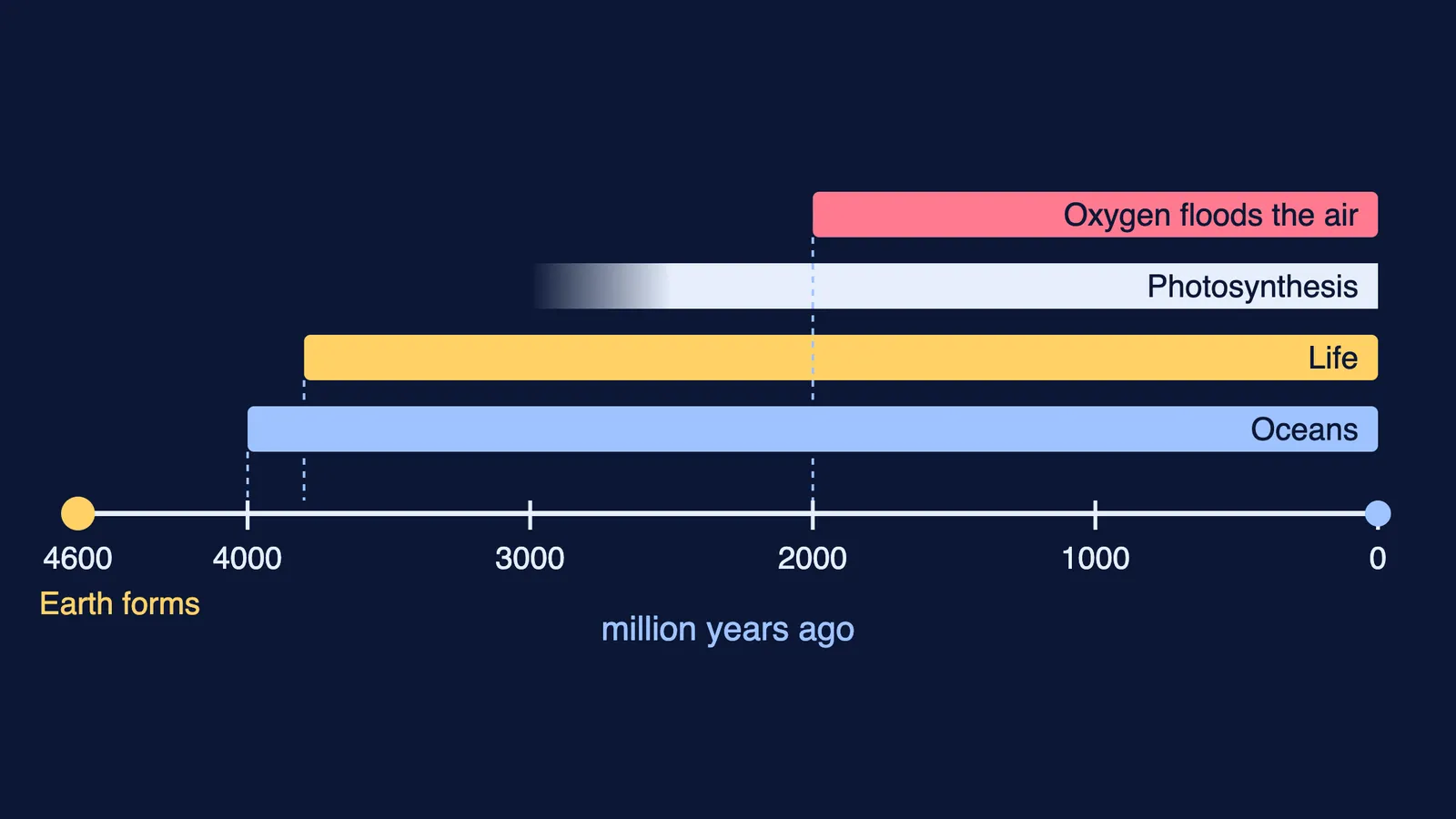
Every date below is from the NCERT chapter. Draw a line, mark six points, cover the page and redraw it:
13,700 million years ago: the Big Bang.
About 4,600 million years ago: the Earth forms.
4,000 million years ago: oceans exist.
3,800 million years ago: life begins.
3,000 to 2,500 million years ago: photosynthesis evolves.
2,000 million years ago: oxygen floods the atmosphere.
Geologist Brent Dalrymple's 2001 review says the measured age of the Earth in wide use is 4.54 billion years, a value found by Tera in 1980 (Geological Society, 2001).
Three traps in the end-of-chapter questions:
The Earth is 4.6 billion years old, not 4.6 million.
Life appeared about 3.8 billion years ago, not 3.8 million.
Differentiation built the layers, not the air; solar winds, degassing and photosynthesis shaped the atmosphere.
For the 150-word question on the stages of the Earth's evolution, use three headings in order: lithosphere, atmosphere and hydrosphere, then life. If gravity and density still feel like words rather than ideas, the Fermi Concept Library gives each physics concept its own lesson.
Next, read India's location and physiography, where the moving Indian plate carries the story forward.