On this page
Nationalism is Chapter 7 of NCERT's Class 11 Political Theory. It asks what makes strangers a nation, what nations claim, and how a democracy holds many identities together. This guide follows the current NCERT chapter (Reprint 2026-27) and ends with practice questions we wrote for you.
How many marks is Nationalism in Class 11 for 2026-27?
The CBSE 2026-27 Political Science curriculum groups Nationalism with Citizenship for 8 marks together; it gives no separate figure for Nationalism alone. Political Theory as a whole carries 40 of the 80 theory marks.
The curriculum lists four sub-topics: introducing nationalism, nations and nationalism (shared beliefs, history and national identity), national self-determination, and nationalism and pluralism. Its supplementary notes add multiculturalism, the "salad bowl" in which groups keep distinct identities within one nation.
What is a nation, according to NCERT?
A nation is not a family or a clan: you may never meet most of your fellow nationals, nor share descent with them, yet the nation is real to you.
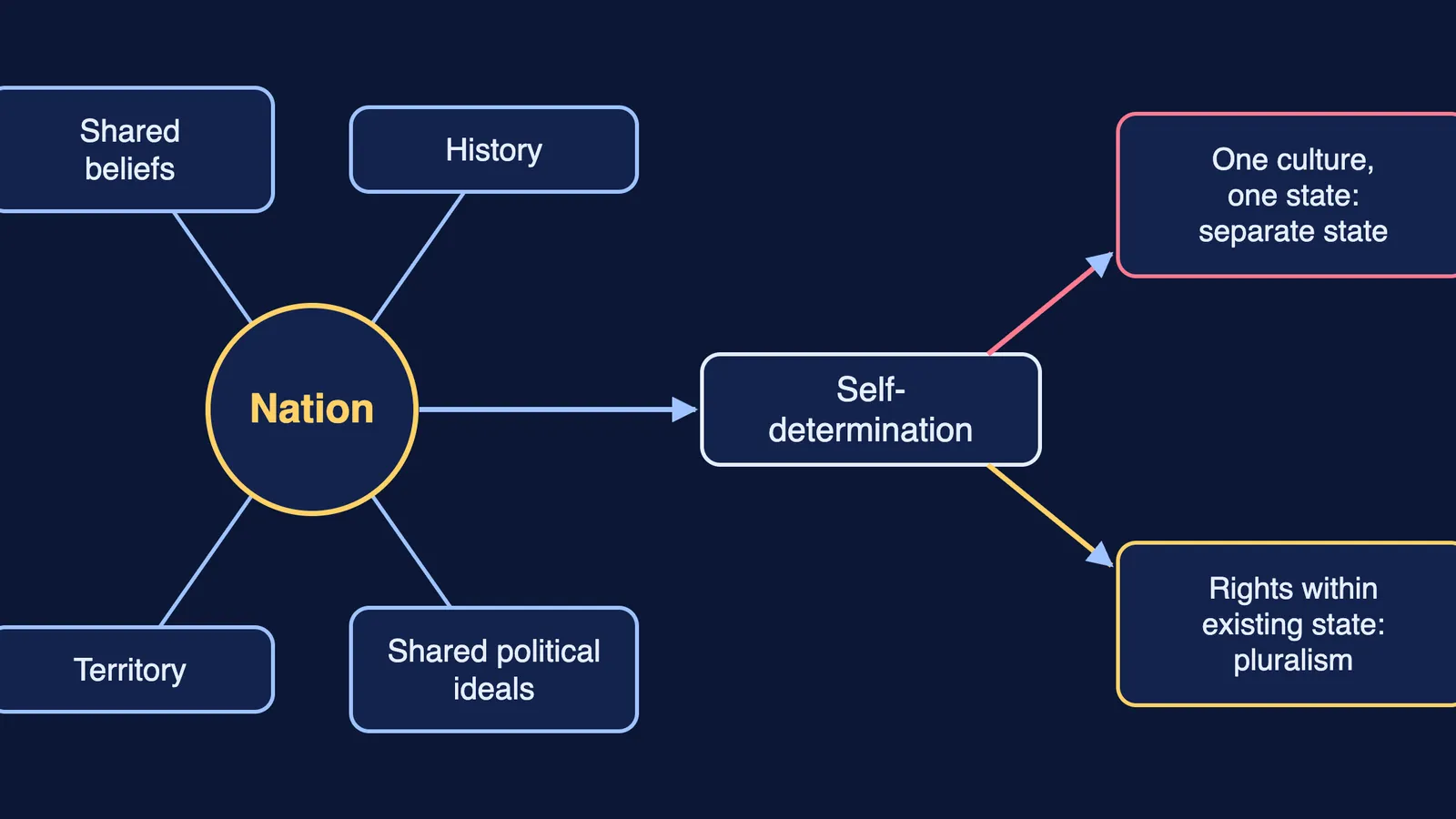
NCERT's key point: no single feature, such as language, religion or descent, is present in every nation. Canada has English and French speakers; India has many languages. So the chapter calls a nation largely an "imagined" community, held together by what its members believe about the whole.
It names four assumptions people make about a nation:
Shared beliefs. A nation exists when its members believe they belong together, much as a team exists because players see themselves as one side.
History. Nations see themselves stretching back into the past and forward into the future. Indian nationalists drew on ancient civilisation and heritage; the chapter cites Jawaharlal Nehru's The Discovery of India on unity beneath diversity.
Territory. Living on a land over time creates a sense of homeland.
Shared political ideals. A shared vision of the state they want, with values such as democracy, secularism and liberalism, is what separates a nation from other groups.
NCERT argues a democracy should define the nation in political, not cultural, terms. Religions are internally diverse, so forcing one religious identity risks oppression; and most societies are mixed, so imposing one religion or language excludes some citizens. Democracies should expect loyalty to constitutional values, not to one religion, race or language.
What is the right to national self-determination?
Nations, unlike other groups, claim the right to govern themselves and want international recognition.
Europe. In the nineteenth century the idea of "one culture, one state" spread. Once World War I ended, the Versailles treaty set up several small new states, but it could not satisfy every demand. Redrawn borders displaced millions and led to communal violence, and the new states still held minorities.
Asia and Africa. Anti-colonial movements claimed self-determination for dignity and independence. Not every cultural group could get a state, so border wars and migration followed.
The chapter's case study is the Basque region of Spain, which has autonomy within Spain while some of its leaders want a separate country. NCERT gives both sides and asks you to judge.
Its conclusion: the right is now often read as democratic rights for a nationality within an existing state, not a separate state for every group.
How does nationalism fit with pluralism?
Without "one culture, one state", many cultures must flourish inside one country. NCERT notes that the Indian Constitution protects religious, linguistic and cultural minorities. Group rights elsewhere can include representation in legislatures.
Rabindranath Tagore, the chapter notes, opposed colonial rule but warned that a narrow nationalism rejecting the west could turn into hostility to influences long present in India. Each person has many identities, of gender, caste, religion, language or region, and in a democracy citizenship should make room for all of them.
Worked example: plan a 6-mark answer
Question: "Nationalism has built states and also broken them apart. Assess this view with examples from the chapter."
Suggested mark split (ours, not CBSE's):
Define (1 mark): nationalism as a political creed built on a shared sense of belonging.
Built (2 marks): nineteenth-century unification of Germany and Italy; India's freedom struggle against colonial rule.
Broken (2 marks): break-up of the Austro-Hungarian and Russian empires; separatist movements, such as the Basques and the Kurds named in the chapter, that seek to divide existing states.
Conclude (1 mark): NCERT's answer is to make existing states more democratic and inclusive.
If you get stuck working out where to start, Fermi's AI tutor can work out what you already know and build a plan for the session.
Practice questions
Why does NCERT call a nation an "imagined" community? (2 marks)
Give two reasons the chapter offers for defining a nation in political rather than cultural terms. (4 marks)
Explain how the "one culture, one state" idea created new minority problems after World War I. (4 marks)
Why is the right to self-determination now often understood as rights within a state? (2 marks)
Examine how a democracy can respond to demands for self-determination. Use the Basque case. (6 marks)
For linked chapters, read our guides to Secularism in Class 11 Political Science and Constitution: why and how, Class 11.