On this page
Equality is chapter 3 of NCERT's Class 11 Political Theory. The CBSE Political Science curriculum for 2026-27 prints 12 marks shared between Freedom and Equality, out of 40 for Political Theory, and lists four topics: why equality matters, three dimensions, feminism and socialism, and how to promote equality. This guide follows the current NCERT chapter (reprint 2026-27).
What does equality mean in Class 11 Political Science?
In the NCERT chapter, equality means every human being has equal worth and deserves equal respect because of a shared humanity.
That does not mean identical treatment: a prime minister's special rank does not break equality, as long as the privileges are not misused. It rules out treatment fixed by birth, such as religion, race, caste or gender.
Equality of opportunities is the core idea: the worry is unequal access to education, health care and safe housing.
Natural vs social inequalities. Natural inequalities come from inborn abilities; social ones from unequal opportunity or exploitation. NCERT warns the line blurs: women were long called "the weaker sex", a view now seen as a product of power. So many theorists instead separate inequality from choice from inequality due to circumstances of birth, and target the second.
Take two cricketers. One skips training and is not selected: choice. The other never reaches trials because her village has no ground: circumstance.
What are the three dimensions of equality?
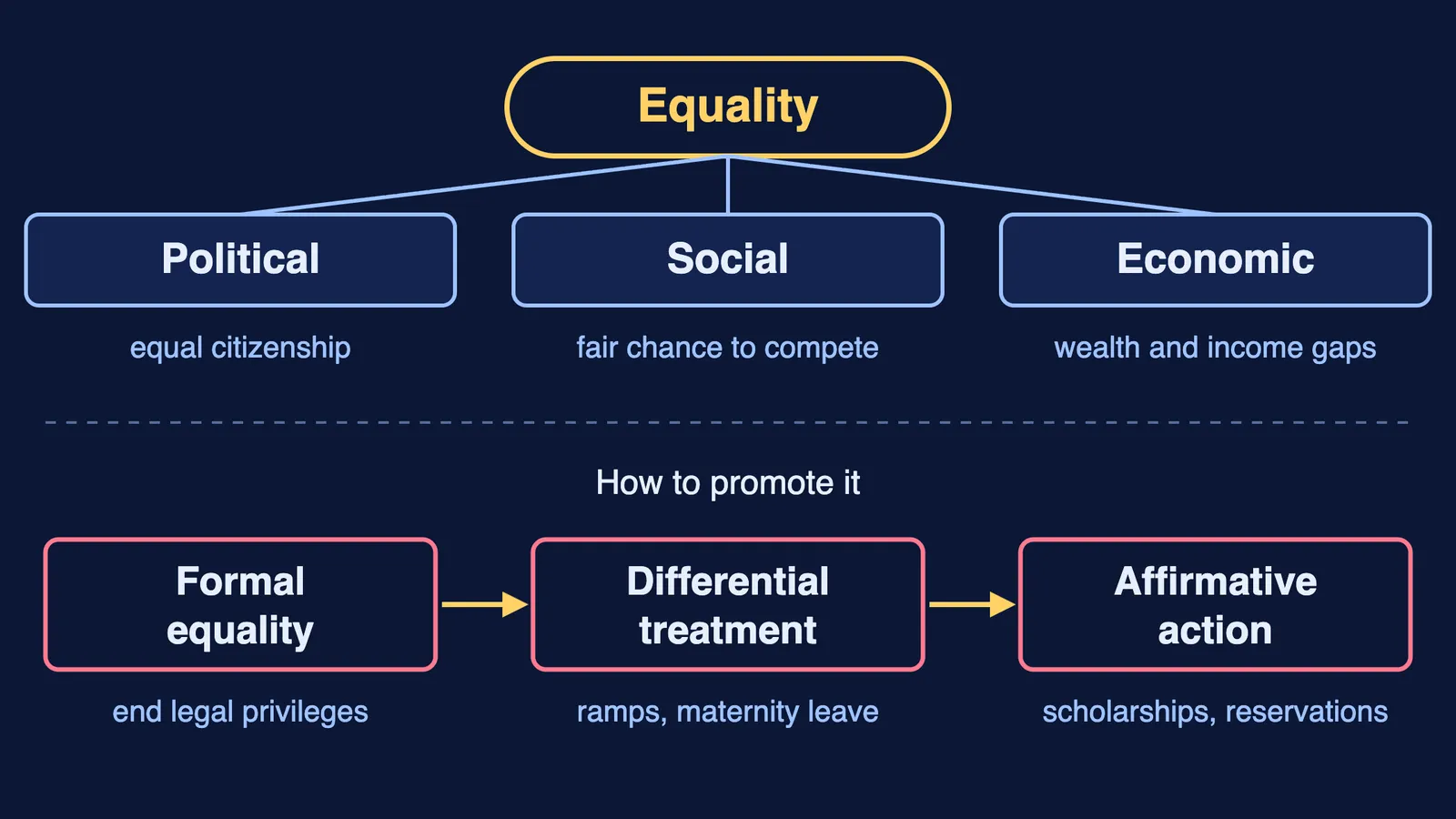
NCERT names political, social and economic equality, and says a just society must address all three.
Political: equal citizenship, with rights to vote, expression, movement, association and belief. Necessary, not sufficient.
Social: a fair chance to compete, which needs minimum conditions of life such as health care, good education, nourishment and a minimum wage. In India, customs in some groups, such as unequal inheritance rights for women, also block opportunity.
Economic: significant gaps in wealth, property or income. Measures: the richest-poorest gap, or people below the poverty line. Inequality persisting across generations is more dangerous.
How do feminism, socialism, Marxism and liberalism see equality?
The curriculum names feminism and socialism; NCERT adds Marxist and liberal views, each as one viewpoint.
Feminism: a political doctrine that women and men should have equal rights. Feminists trace inequality between them to patriarchy, separate "sex" (biology) from "gender" (social roles), and point to the "double burden" of paid work plus housework.
Socialism: not wholly against the market, but in favour of some government regulation and planning in key sectors like health care and education. Rammanohar Lohia named five inequalities to fight together (gender, skin colour, caste, colonial rule, economic) and added two more revolutions, for civil liberties and non-violence: his Sapta Kranti.
Marxism: Marx argued that private ownership of key resources such as land, oil and forests is the root of entrenched inequality, so Marxists seek public control of them. NCERT calls this debatable.
Liberalism: liberals hold that free, fair competition is the most just way to distribute rewards, and that each sphere of inequality needs its own remedy.
How can we promote equality: formal equality or affirmative action?
The NCERT chapter discusses three approaches.
Formal equality: end legal privileges. India's Constitution bars discrimination by religion, race, caste, sex or birthplace and abolishes untouchability (see our Rights in the Indian Constitution Class 11 guide).
Equality through differential treatment: formal equality is not enough. Ramps for the disabled, protection for women on night shifts, and maternity leave and crèches help people use the same rights as others: an enhancement of equality, not a breach.
Affirmative action: positive measures to correct the cumulative effect of past inequality, from scholarships and hostels to reserved seats in education and jobs. India relies on reservations (for reserved constituencies in legislatures, see our Election and representation Class 11 guide).
Supporters say excluded groups cannot compete on equal terms at once, and the help is meant to be temporary. Critics call quotas reverse discrimination that may reinforce caste or racial prejudice. Most theorists, NCERT notes, dispute the means (economic or caste criteria for deprivation), not the goal of equal opportunity.
How should you write a long answer on Equality?
The curriculum's question paper design uses 1, 2, 4 and 6-mark questions, with 4-mark passage, map or cartoon items. For a 6-mark answer:
Define equality as equal worth, not identical treatment.
Distinguish the pair the question names, such as formal vs differential.
Illustrate each point with your own Indian example.
Balance any debate with one argument on each side.
Close with the callout's test.
Practice questions:
(2 marks) Why is political equality alone not enough to build an equal society?
(4 marks) Distinguish natural from social inequality, and explain why the distinction is hard to apply.
(4 marks) How did Lohia's view of inequality differ from that of many socialists of his time?
(6 marks) "Treating people differently can promote equality." Examine with examples and both sides of the affirmative action debate.
Revising several chapters? Fermi's AI tutor can work out what you already know and build a plan for the session, so you sit down to a clear next step.