On this page
Take any region of the complex plane without holes: a half-plane, a strip, the inside of a jagged snowflake. The Riemann mapping theorem says you can reshape it onto the unit disc while keeping every small angle. Below: the statement, three maps built by hand, and why the whole plane is the one exception.
What does the Riemann mapping theorem say?
The theorem, as stated in the Wikipedia article on the Riemann mapping theorem, says: if U is a non-empty, simply connected, open subset of the complex plane and U is not the whole plane, then there is a biholomorphic map f from U onto the open unit disc D = {z : |z| < 1}. Biholomorphic means f is a holomorphic bijection whose inverse is also holomorphic, so f is conformal: it preserves angles, rotating and scaling tiny shapes without reflecting them.
Riemann stated the theorem in his 1851 PhD thesis, assuming a piecewise smooth boundary. His argument rested on the Dirichlet principle, which Weierstrass found was not universally valid (Wikipedia, History). William Fogg Osgood gave the first rigorous proof in 1900, in the Transactions of the American Mathematical Society. Carathéodory gave another proof in 1912 using normal families, the method that became standard in textbooks.
What does simply connected mean?
Informally, a simply connected region has no holes: every closed loop drawn inside it can be shrunk to a point without leaving the region. One equivalent test, listed in the Wikipedia proof section, is that the complement of the region in the extended plane (the plane plus a point at infinity) is connected.
Simply connected: a disc, a half-plane, a strip, a quadrant, the plane with one ray removed, the inside of the Koch snowflake.
Not simply connected: a ring (annulus), a punctured disc, the plane with a point removed.
The snowflake's boundary is a fractal of infinite length, yet its inside still maps conformally onto the disc (Wikipedia, Importance).
How do you map a half-plane, a strip and a quadrant onto the disc?
The theorem proves a map exists but gives no formula. For simple shapes you can build one by hand.
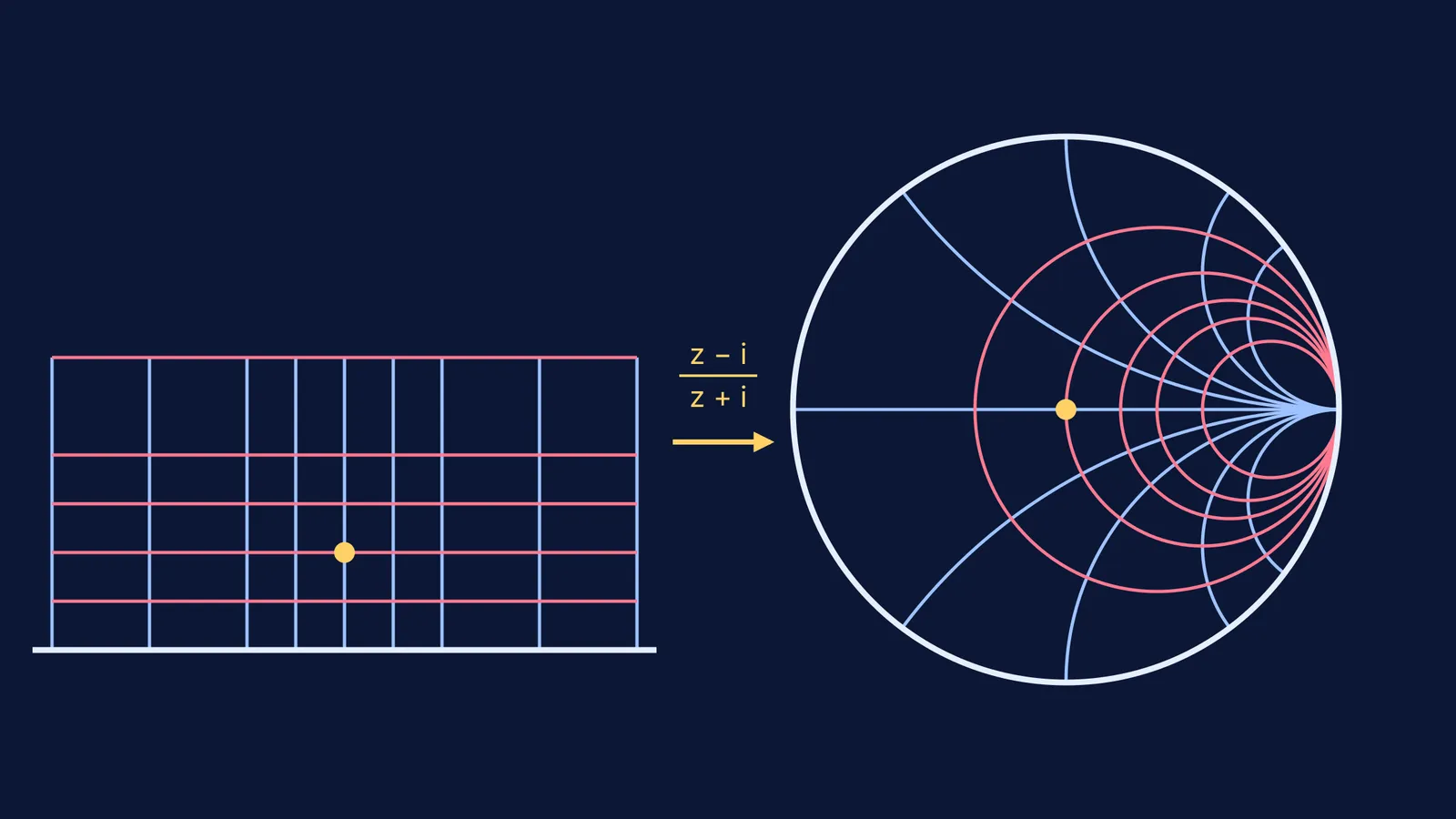
Upper half-plane, Im z > 0. Use the Cayley transform w = (z − i)/(z + i), described in the Wikipedia entry on the Cayley transform. For real x, the points x − i and x + i are mirror images, so |w| = 1: the real line lands on the unit circle. The point i goes to 0, inside the disc, so the whole half-plane lands inside.
Horizontal strip, 0 < Im z < π. Apply e^z first. For z = x + iy, e^z has modulus e^x and angle y. As y runs over (0, π) and x over all reals, you reach every point of the upper half-plane exactly once. So f(z) = (e^z − i)/(e^z + i) maps the strip onto the disc.
First quadrant, Re z > 0 and Im z > 0. Squaring doubles angles, so angles in (0, π/2) become angles in (0, π): z² sends the quadrant onto the upper half-plane. Then f(z) = (z² − i)/(z² + i). Check: z = e^(iπ/4) gives z² = i and f = 0.
Each derivative is non-zero inside the region (for z² it is 2z, zero only at the corner), which is why angles are kept.
More on the last step: how Möbius transformations map circles and keep angles. On why holomorphic maps keep angles: the Cauchy–Riemann equations, with examples.
Why is the Riemann map unique up to three real numbers?
Poincaré proved that once you choose a point z0 in U to go to 0 and fix the angle of f′(z0), there is exactly one such f (Wikipedia). The point z0 needs two real numbers and the angle one, so the freedom is three real parameters. Equivalently, two Riemann maps differ by a self-map of the disc, w ↦ e^(iθ)(w − a)/(1 − āw), fixed by a inside the disc and the angle θ.
Why is the whole plane excluded?
A holomorphic map from the plane onto the disc would be an entire function with |f(z)| < 1 everywhere. Liouville's theorem says every bounded entire function is constant (Wikipedia, Liouville's theorem)), and a constant cannot be a bijection. So no such f exists. For the proof, see Liouville's theorem and bounded entire functions.
How to practise conformal maps: a checklist
Is the region open, simply connected and not the whole plane? If not, the theorem does not apply.
Straighten corners (a power), strips (e^z) and circular arcs (a Möbius map).
Once you reach a half-plane, apply the Cayley transform.
Test that a boundary point lands on |w| = 1 and an interior point lands inside.
Check the derivative is non-zero throughout.
If words like holomorphic or simply connected still feel shaky, the Fermi Concept Library covers every concept in mathematics, physics, chemistry, biology and computing. When your map lands in the wrong place, the Fermi Problem Library has a step-by-step solver that explains the reasoning.