

On this page
Liouville's theorem is often where a complex analysis course first shows how rigid complex-differentiable functions are: a function smooth everywhere in the plane cannot stay inside a fixed circle unless it is constant. Here is the statement, the proof, two uses, and the mistake that costs marks.
What does Liouville's theorem say?
Liouville's theorem states that every bounded entire function must be constant (Wikipedia: Liouville's theorem)). Two words carry all the weight:
Entire means holomorphic (complex-differentiable) at every point of the complex plane C. Polynomials, e^z, sin z and cos z are entire; 1/z and tan z are not.
Bounded means there is one number M with |f(z)| ≤ M for every complex z, not only for real z.
The theorem is named after Joseph Liouville, but Cauchy proved it first, in 1844; what Liouville proved, in 1847, was that a non-constant elliptic function cannot be defined on the whole plane (Wikipedia)).
How is Liouville's theorem proved from Cauchy's estimate?
Cauchy's estimate says that if f is holomorphic on a disc of radius r centred at a, and |f| ≤ M on that disc, then |f⁽ⁿ⁾(a)| ≤ n! M / rⁿ (Wikipedia: Cauchy's estimate). It comes straight from Cauchy's integral formula for the derivative.
Now the proof, in four steps:
Let f be entire with |f(z)| ≤ M for all z, and pick any point z₀.
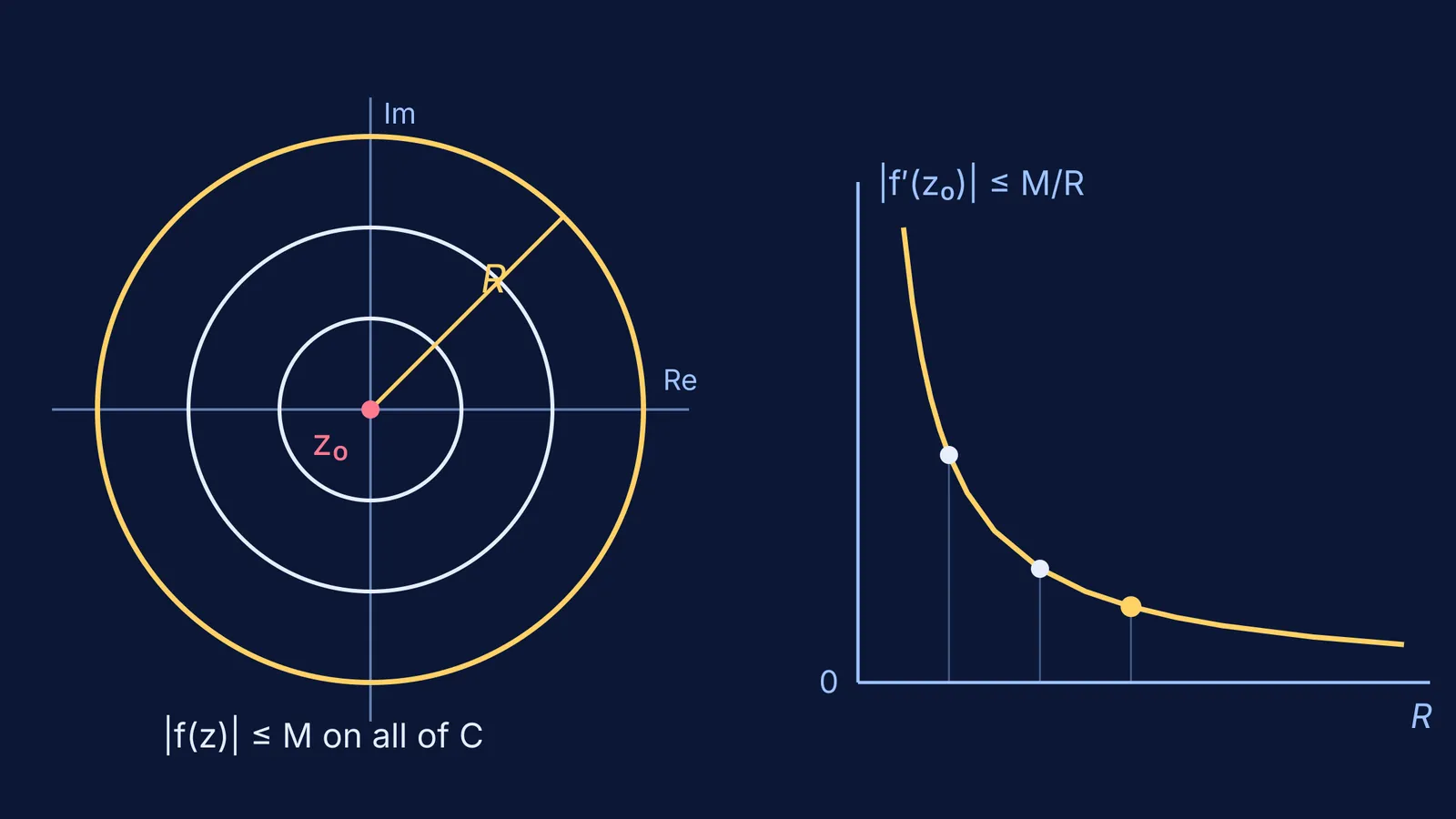
Because f is holomorphic everywhere, the estimate holds on a disc of any radius R around z₀. With n = 1 it gives |f′(z₀)| ≤ M/R.
R can be as large as you like, and M does not change, so M/R can be made smaller than any positive number. Hence f′(z₀) = 0.
z₀ was arbitrary, so f′ is zero everywhere and f is constant.
Why does it prove the fundamental theorem of algebra in two lines?
The claim, which follows as a simple corollary (MathWorld): every non-constant polynomial p has a complex root.
Suppose p has no root. Then 1/p is entire. Since |p(z)| grows like |z|ⁿ, 1/p tends to 0 far from the origin, and it is continuous on the closed disc that remains, so 1/p is bounded. By Liouville, 1/p is constant, so p is constant: a contradiction.
Divide out that root and repeat: a polynomial of degree n has n roots counted with multiplicity.
Why is sin z unbounded on C when sin x stays between -1 and 1?
On the real axis, |sin x| ≤ 1. But sin z is entire and not constant, so Liouville says it cannot be bounded on C. Here is where it escapes. Using sin z = (e^{iz} − e^{−iz})/(2i) with z = iy:
sin(iy) = (e^{−y} − e^{y})/(2i) = i sinh y.
So |sin(10i)| = sinh 10 = (e¹⁰ − e⁻¹⁰)/2, which is about 11,013. Up the imaginary axis, sine grows exponentially. Bounded on the real line tells you nothing about the plane.
When does Liouville's theorem not apply?
A common mistake is applying it to a function with poles. Take f(z) = 1/(1 + z²). On the real line it never exceeds 1, so it looks bounded. But it has poles at z = i and z = −i, so it is not entire, and near those poles it is not bounded either. Liouville says nothing about it, nor about 1/z or tan z. Non-constant elliptic functions, by Liouville's own 1847 result, cannot be entire either (Wikipedia)).
Before you write "by Liouville's theorem", tick three boxes:
Holomorphic at every point of C: no poles, no branch cuts (log z and √z fail here).
The bound holds for all complex z, not just real z or a disc.
One constant M works everywhere; it may not depend on z.
That extension is proved on the same page as the main theorem (Wikipedia)).
How can you practise using it?
Try this before reading the answer: f is entire and Re f(z) ≤ 0 for every z. Show that f is constant.
The trick is to build a bounded entire function from f. Let g = e^f. Then g is entire and |g(z)| = e^{Re f(z)} ≤ e⁰ = 1, so g is bounded, hence constant by Liouville. Then g′ = f′e^f = 0, and e^f is never zero, so f′ = 0 and f is constant.
The pattern recurs: compose with e^z, 1/(f − w) or another map to turn the condition into a bound, then apply the theorem. If Cauchy's integral formula behind the estimate still feels shaky, the Fermi Concept Library has a lesson for every mathematics concept with its place in the map. For more practice, the Fermi Problem Library has worked problems with a step-by-step solver that explains the reasoning rather than printing an answer.


