

On this page
Write a complex function as f(z) = u(x, y) + i v(x, y), with z = x + iy, and it looks like two ordinary real functions of x and y. The Cauchy–Riemann equations are the catch: they are the two partial differential equations that characterise when f has a complex derivative (Cauchy–Riemann equations, Wikipedia).
If you picture complex numbers as points in a plane, as in our guide to testing points for collinearity with complex numbers, this is the matching calculus. If partial derivatives feel shaky, refresh continuity and differentiability key terms first.
What are the Cauchy–Riemann equations?
For f = u + iv, the Cauchy–Riemann equations are uₓ = v_y and u_y = −vₓ, where a subscript means a partial derivative (MIT OpenCourseWare 18.04, Topic 2 notes).
They first appeared in the work of Jean le Rond d'Alembert; Euler later connected them to analytic functions, Cauchy built his theory of functions on them, and Riemann's dissertation appeared in 1851 (Wikipedia).
Where do uₓ = v_y and u_y = −vₓ come from?
The complex derivative is defined just like the real one: f′(z) is the limit of (f(z + Δz) − f(z))/Δz as Δz → 0. The difference is that Δz can approach 0 from any direction, and the limit must be the same for all of them (MIT 18.04, Topic 2). Test two directions:
Horizontal, Δz = Δx: the quotient becomes uₓ + i vₓ.
Vertical, Δz = iΔy: dividing by i turns it into v_y − i u_y.
Both equal f′(z), so match real and imaginary parts: uₓ = v_y and vₓ = −u_y.
The converse holds too: if u and v satisfy the equations and have continuous partial derivatives on a region, f is differentiable there (same MIT notes).
Do z² and e^z pass the test?
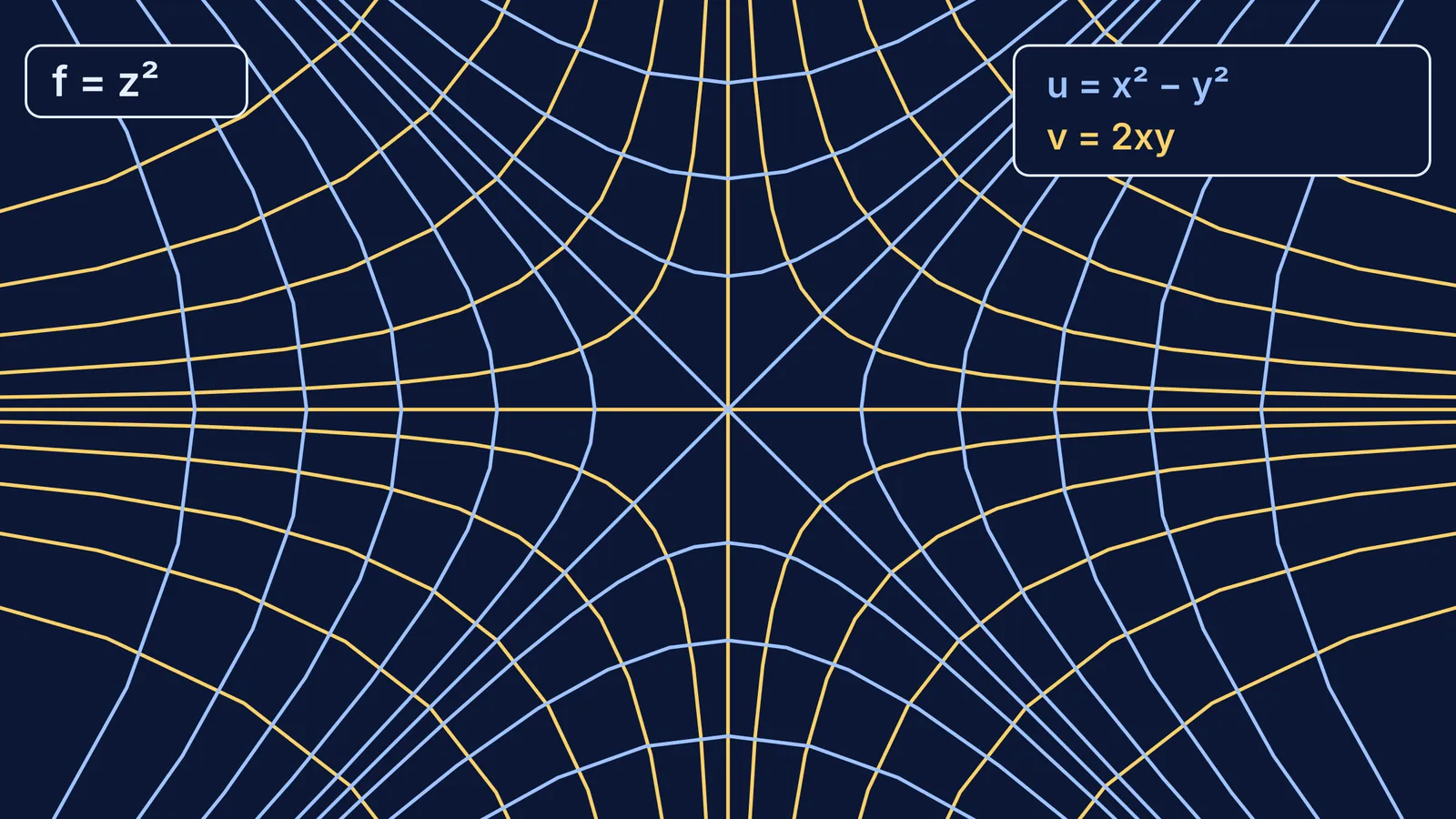
Take f(z) = z². Expanding (x + iy)² gives u = x² − y² and v = 2xy. Then uₓ = 2x and v_y = 2x, while u_y = −2y and −vₓ = −2y. Both equations hold at every point, and f′(z) = uₓ + i vₓ = 2x + 2iy = 2z.
For e^z, write e^(x + iy) = eˣ cos y + i eˣ sin y, so u = eˣ cos y and v = eˣ sin y. Then uₓ = eˣ cos y = v_y and u_y = −eˣ sin y = −vₓ, so e^z is differentiable, and its derivative uₓ + i vₓ is e^z itself (MIT 18.04, Example 2.11).
Why is z̄ not differentiable anywhere?
The conjugate f(z) = z̄ = x − iy has u = x and v = −y. So uₓ = 1 and v_y = −1 at every point, and the first equation fails everywhere (MIT 18.04, Example 2.12).
The equations can also be written in one line as ∂f/∂z̄ = 0, which says, informally, that f does not depend on z̄ (Wolfram MathWorld).
A common trap: for f(z) = |z|² = x² + y², u = x² + y² and v = 0. The equations need 2x = 0 and 2y = 0, which hold only at the origin. So |z|² can be differentiable at z = 0 at most, and it is not analytic anywhere, because analytic needs a whole disc.
How do you find a harmonic conjugate?
Differentiate the equations once more: uₓₓ = v_yx and u_yy = −vₓy, so uₓₓ + u_yy = 0. A function that satisfies this Laplace equation is called harmonic, and the real and imaginary parts of an analytic function are both harmonic (MIT 18.04, Topic 5 notes). Such a u and v are called harmonic conjugates, and on a simply connected region every harmonic u is the real part of some analytic function (same notes).
Worked example: find v for u = x³ − 3xy².
Check that u is harmonic: uₓₓ = 6x and u_yy = −6x, so their sum is 0.
Use uₓ = v_y: v_y = 3x² − 3y², so v = 3x²y − y³ + g(x).
Use u_y = −vₓ: u_y = −6xy, and vₓ = 6xy + g′(x), so g′(x) = 0 and g is a constant C.
Assemble: u + iv = (x³ − 3xy²) + i(3x²y − y³) + iC, which is z³ + iC. Expand (x + iy)³ to confirm.
Run the same steps on u = x² − y² and you get v = 2xy + C, the pair drawn at the top of this post.
If partial derivatives keep slipping, the Fermi Concept Library has a lesson for every concept in mathematics, each with its place in the map. For practice, the Fermi Problem Library has worked problems with a step-by-step solver that explains the reasoning rather than printing an answer.
Next, run the four-step check on z³ + z̄ and on 1/z (for z ≠ 0). Which passes?


