On this page
Continuity and Differentiability is Chapter 5 of the NCERT Class 12 Mathematics Part I textbook, and the CBSE 2026-27 Mathematics syllabus lists it first in Unit III, Calculus. Here are its key terms in our own words, checked against the 2026-27 reprint, each with a short example. For answer-writing and a revision plan, see our continuity and differentiability board answer guide.
Rolle's theorem and the mean value theorem do not appear in the 2026-27 reprint of this chapter or in the 2026-27 syllabus, so they are left out. Derivatives in parametric form and second order derivatives are in both, so they stay.
What does continuity mean in Class 12?
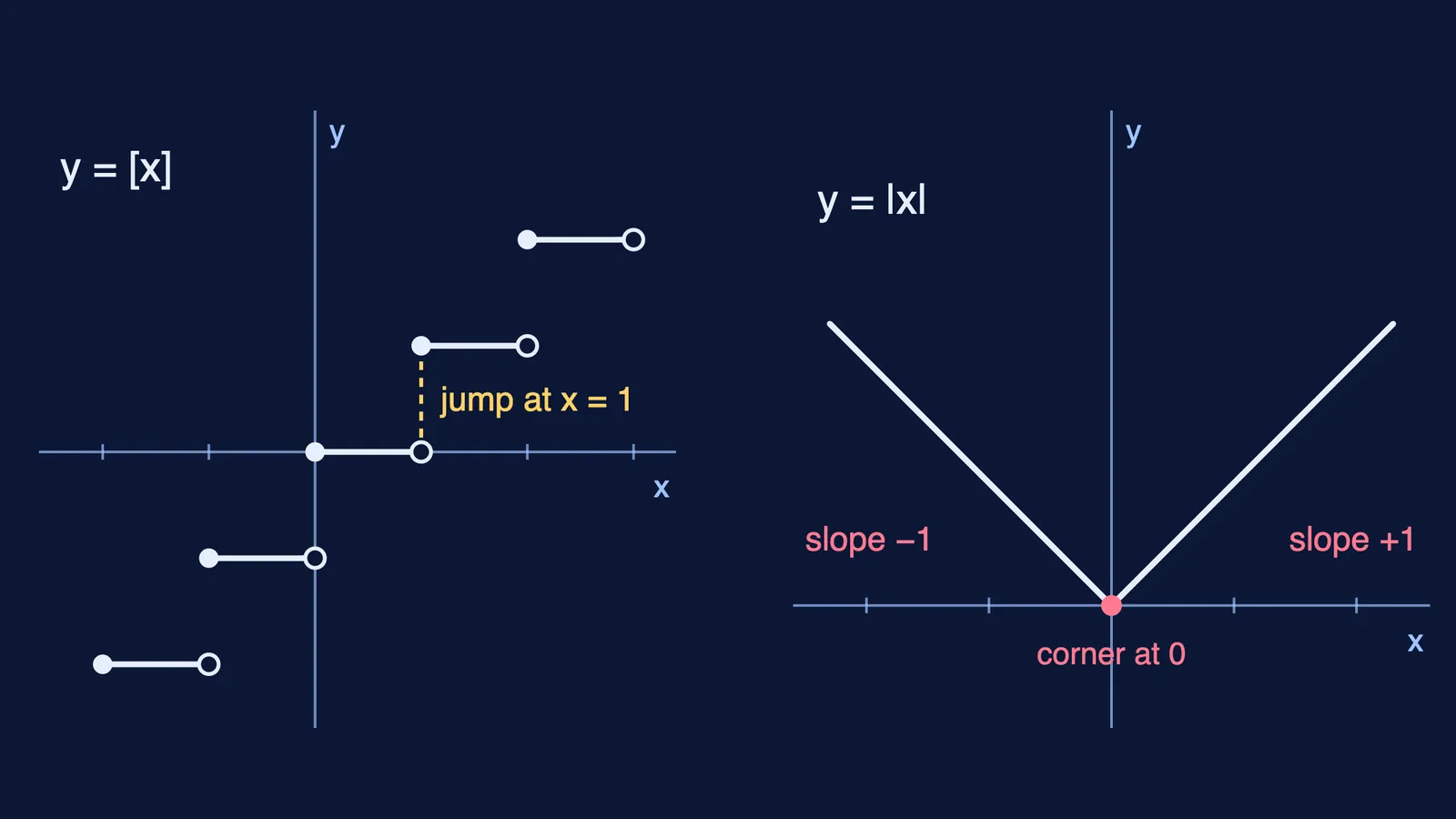
Left hand limit: the value f(x) approaches as x nears c from values below c. Example: for the greatest integer function [x], it is 0 at x = 1.
Right hand limit: the value f(x) approaches as x nears c from values above c. Example: for [x], it is 1 at x = 1.
Limit at a point: when both one-sided limits at c exist and are equal, their common value. Don't confuse with: f(c), which can differ or be undefined.
Continuous at a point: f is continuous at c in its domain if lim x→c f(x) = f(c). Example: x² at 2, where both sides approach 4 and f(2) = 4.
Point of discontinuity: a point of the domain where f is not continuous. Example: [x] at every integer c, where the limits are c − 1 and c.
Continuous function: continuous at every point of its domain. Example: 1/x, since 0 is not in its domain. Don't confuse with: a point of discontinuity, which must lie inside the domain.
Continuity at end points: on [a, b], only the right hand limit is used at a and only the left hand limit at b.
Algebra of continuous functions: if f and g are continuous at c, so are f + g, f − g, f·g, and f/g when g(c) ≠ 0. Example: every rational function.
Continuity of a composite: if g is continuous at c and f at g(c), then f∘g is continuous at c. Example: sin(x²).
When is a function differentiable?
Derivative at a point: f′(c) = lim h→0 [f(c + h) − f(c)]/h, if this limit exists. Example: for x² at 3 the ratio is 6 + h, so f′(3) = 6.
Differentiation: finding the derivative f′(x), also written dy/dx or y′, wherever the limit exists.
Left and right hand derivatives: that ratio's limits as h → 0⁻ and h → 0⁺. Example: −1 and 1 for |x| at 0.
Differentiable: at c, both one-sided derivatives are finite and equal; in an interval, at every point of it.
Theorem 3: if f is differentiable at c, it is continuous at c. Don't confuse with: the converse, which is false; |x| is continuous but not differentiable at 0.
Rules for combined and hidden functions
Algebra of derivatives: (u ± v)′ = u′ ± v′; product (Leibnitz) rule (uv)′ = u′v + uv′; quotient rule (u/v)′ = (u′v − uv′)/v², where v ≠ 0.
Composite function: one function applied to another's output, f = v∘u. Example: (2x + 1)³ with inner 2x + 1 and outer t³.
Chain rule: if f = v∘u and t = u(x), then df/dx = (dv/dt)·(dt/dx), when both exist. Example: d/dx (2x + 1)³ = 6(2x + 1)².
Explicit function: y written directly as f(x). Example: y = x − π.
Implicit function: y given by an equation in x and y that is not written as y = f(x), often because it is hard to solve for y. To differentiate, differentiate both sides, treating y as a function of x. Example: x² + y² = 25 gives dy/dx = −x/y for y ≠ 0.
Inverse trigonometric derivatives: sin⁻¹x gives 1/√(1 − x²) and cos⁻¹x gives −1/√(1 − x²) on (−1, 1); tan⁻¹x gives 1/(1 + x²) for all real x. Don't confuse with: (sin x)⁻¹, which is 1/sin x.
What are exponential and logarithmic functions?
Exponential function: y = bˣ with b > 1; domain all reals, range positive reals, passes through (0, 1), always increasing.
e: the sum 1 + 1/1! + 1/2! + …, between 2 and 3. The natural exponential function eˣ is its own derivative.
Logarithm: for b > 1, log_b a = x means bˣ = a. Example: log₂ 8 = 3.
Natural logarithm: base e; in this chapter log x means base e. Defined only for x > 0, with derivative 1/x. Don't confuse with: the common logarithm, base 10.
Log properties: log pq = log p + log q, log(x/y) = log x − log y, and log_a p = log_b p / log_b a.
Logarithmic, parametric and second order derivatives
Logarithmic differentiation: for y = [u(x)]^v(x), take logs, log y = v(x)·log u(x), then differentiate; f(x) and u(x) must be positive. Example: y = xˣ gives dy/dx = xˣ(1 + log x).
Parametric form: x = f(t), y = g(t), with t the parameter. Example: x = a cos θ, y = a sin θ.
Parametric derivative: dy/dx = g′(t)/f′(t), provided f′(t) ≠ 0. Example: x = at², y = 2at gives dy/dx = 1/t.
Second order derivative: the derivative of dy/dx, written d²y/dx², f″(x) or y″. Example: x³ gives 6x. Don't confuse with: (dy/dx)².
How to learn these terms
Sketch [x] and |x| side by side and label their one-sided limits and derivatives. Together they show discontinuity, continuity and the failed converse of Theorem 3.
Learn terms in pairs: left and right hand limit, explicit and implicit, sin⁻¹x and (sin x)⁻¹, second derivative and (dy/dx)².
Write the domain beside every formula, such as (−1, 1) for sin⁻¹x and x > 0 for log x.
Keep one tiny example per method: (2x + 1)³ for the chain rule, x² + y² = 25 for implicit, xˣ for logarithmic. Our guide to implicit and logarithmic differentiation has more practice.
If a term stays vague, the Fermi Concept Library gives every concept in mathematics its own lesson and its place in the map. The ideas return next in application of derivatives.