On this page
In Class 11 you learn that multiplying by i turns a point through 90° and adding a number slides it. Möbius transformations put those moves and one more, the reciprocal, into a single fraction that bends lines into circles without distorting angles. They are named in honour of August Ferdinand Möbius (Wikipedia). Engineers meet one in the Smith chart: the map (z − 1)/(z + 1) sends the right half of the normalised impedance plane to the unit disc of reflection coefficients (MathWorld).
What is a Möbius transformation?
A Möbius transformation is a function f(z) = (az + b)/(cz + d), where a, b, c, d are complex numbers with ad − bc ≠ 0 (MathWorld). If ad = bc, top and bottom are proportional and the fraction collapses to a constant.
It works on the extended plane, the complex numbers plus a point at infinity: when c ≠ 0, z = −d/c goes to ∞, and ∞ goes to a/c.
When c ≠ 0, a line of algebra gives f(z) = a/c + (bc − ad)/(c(cz + d)). So f is a translation, a rotation with scaling, the reciprocal 1/z, then another scaling and translation, the same split MathWorld describes.
Why do Möbius transformations map circles to circles?
Translations, rotations and scalings keep circles as circles and lines as lines. The reciprocal 1/z is inversion in the unit circle followed by a reflection in the real axis, and inversion sends circles and lines to circles and lines, as our explainer on inversion in a circle shows. So the whole chain does too.
As Wikipedia puts it, Möbius transformations map every straight line to a line or circle, and every circle to a line or circle. Note the "or": a line is a circle through ∞, and the two kinds can swap. Below, the real axis becomes the unit circle.
Why are Möbius transformations conformal?
Conformal means angle-preserving, and MathWorld states that a linear fractional transformation defines a conformal mapping of the extended complex plane. The derivative f′(z) = (ad − bc)/(cz + d)² is never zero where f is finite, so near each point f acts like multiplying by one complex number: a rotation plus a scaling, which keeps angles. The Cauchy–Riemann equations are the usual check that f is complex-differentiable.
Three points fix the whole map: MathWorld says it is uniquely determined by the images of three distinct points, provided the images are distinct too. To send z₁, z₂, z₃ to 0, 1, ∞, use f(z) = (z − z₁)(z₂ − z₃) / ((z − z₃)(z₂ − z₁)).
Worked example: how does (z − i)/(z + i) map the upper half-plane to the unit disc?
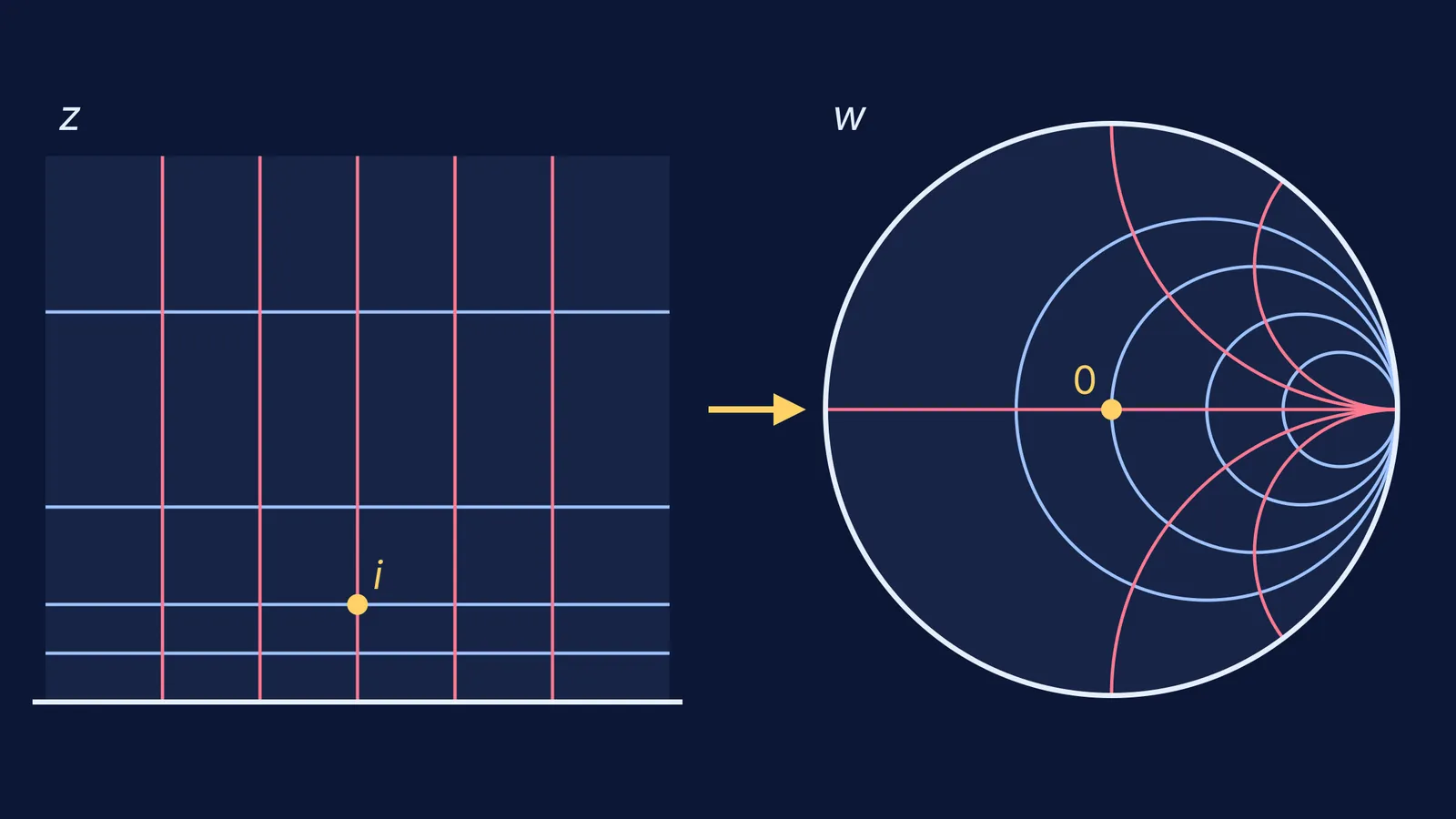
This map, w = (z − i)/(z + i), is the Cayley transform, which sends the upper half-plane to the unit disc (Wikipedia). Check it yourself:
Read |w| = |z − i| / |z + i| as the distance from z to i over the distance from z to −i.
A point above the real axis is nearer i than −i, so |w| < 1. On the real axis both distances are equal, so |w| = 1.
Push three easy points through: 0 goes to −1, 1 goes to −i, ∞ goes to 1. And i goes to 0, the centre.
Track a grid. The line Im z = t becomes the circle with centre t/(1 + t) and radius 1/(1 + t), touching the unit circle at 1. The line Re z = s becomes an arc of the circle with centre 1 − i/s and radius 1/|s|; for s = 0, the diameter from −1 to 1.
The two families still cross at right angles: conformality you can draw.
How does the matrix rule for composing Möbius maps work?
Write f(z) = (az + b)/(cz + d) as the matrix with rows (a, b) and (c, d). Take a second map g(z) = (pz + q)/(rz + s). Substitute g into f and multiply top and bottom by rz + s:
f(g(z)) = ((ap + br)z + (aq + bs)) / ((cp + dr)z + (cq + ds)).
Those four coefficients are the entries of f's matrix times g's matrix, so composing maps is multiplying matrices. The product's determinant is the product of the determinants, never zero, so the result is again a Möbius map. A non-zero multiple of a matrix gives the same map, which is why Wikipedia identifies the Möbius group with PGL(2, C).
Try it on the Cayley map. Its matrix has rows (1, −i) and (1, i), determinant 2i. Swap the diagonal and negate the other entries: rows (i, i) and (−1, 1), the inverse map z = i(1 + w)/(1 − w). The product of the two matrices is 2i times the identity, the map z ↦ z. Check: w = 0 gives z = i.
If an earlier idea such as modulus or argument is shaky, the Fermi Concept Library gives every concept in mathematics its own lesson and its place in the map. Then try complex numbers for collinear and concyclic points.