On this page
A Fourier series breaks a function into sines and cosines. Parseval's identity answers the next question: how much of the function sits in each piece? Square every coefficient, add them up, and you get the integral of the function squared. That turns an integral you can do into an infinite sum you could not, which is how it proves that 1 + 1/4 + 1/9 + … equals π²/6.
What does Parseval's identity say?
Take a real function f that is square-integrable on [−π, π], with Fourier coefficients aₙ = (1/π)∫f(x)cos(nx) dx and bₙ = (1/π)∫f(x)sin(nx) dx, both integrals over [−π, π]. MathWorld's statement of Parseval's theorem gives the identity in this normalisation:
(1/π)∫ f(x)² dx = a₀²/2 + Σ (aₙ² + bₙ²), with the sum over n = 1, 2, 3, …
The left side is often called the energy of f, and the result is also known as Rayleigh's energy theorem, according to Wikipedia's article on Parseval's theorem. The same article traces it to a 1799 theorem about series by Marc-Antoine Parseval, presented to the Académie des Sciences in Paris.
In complex form, with cₙ = (1/2π)∫f(x)e^(−inx) dx, the identity reads (1/2π)∫|f(x)|² dx = Σ|cₙ|², summed over all integers n (MathWorld). Watch the constants: books that put 1/2π in front of the integral, or define a₀ differently, move the factors around. Check your textbook's convention before plugging in.
How does Parseval's identity prove Σ1/n² = π²/6?
Let f(x) = x on [−π, π].
Cosine coefficients. x is odd and cos(nx) is even, so x·cos(nx) is odd and every aₙ = 0, including a₀.
Sine coefficients. x·sin(nx) is even, so bₙ = (2/π)∫₀^π x sin(nx) dx. Integrate by parts: ∫₀^π x sin(nx) dx = [−x cos(nx)/n] from 0 to π + (1/n)∫₀^π cos(nx) dx = −π cos(nπ)/n + 0 = π(−1)^(n+1)/n. So bₙ = 2(−1)^(n+1)/n.
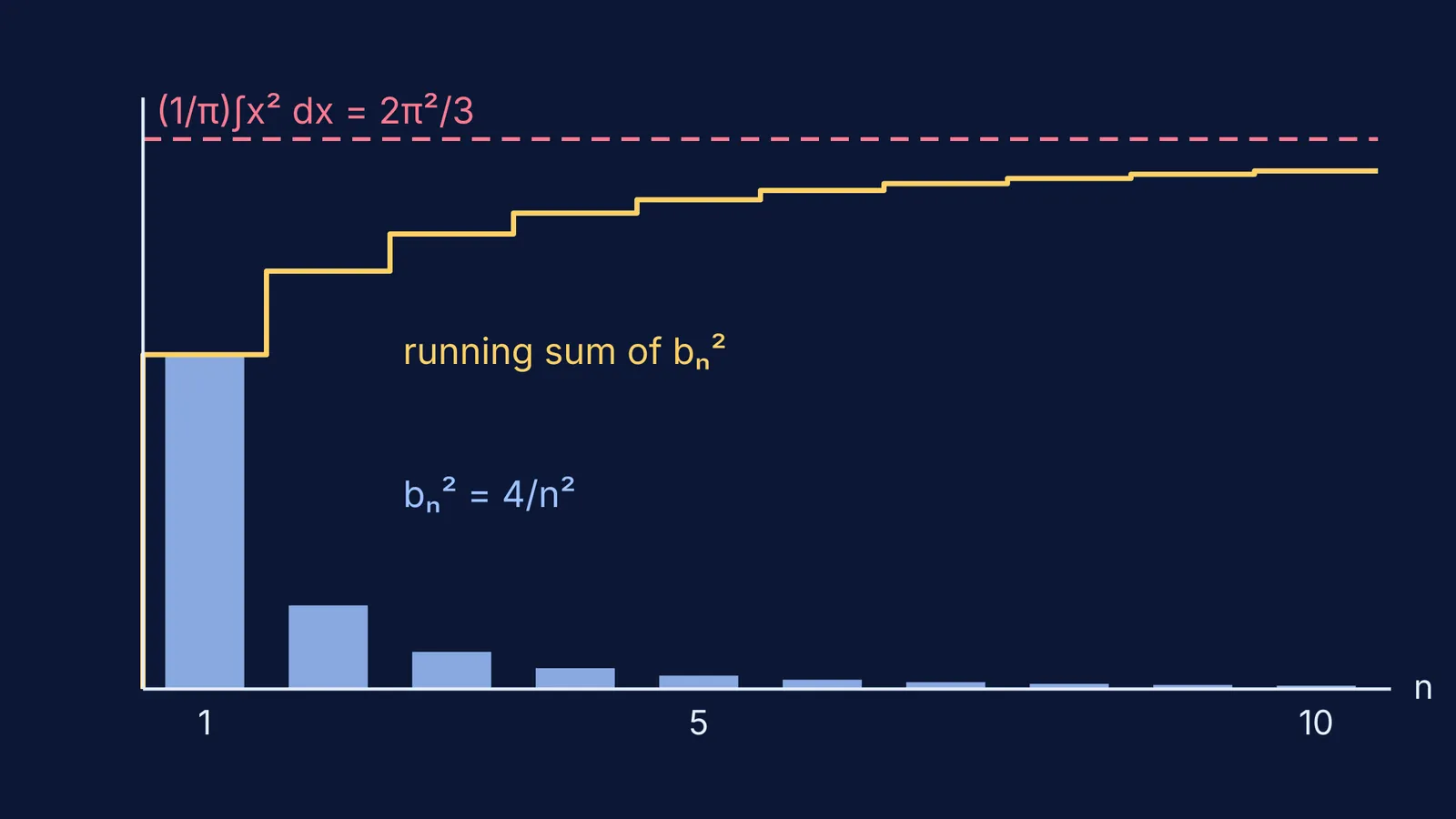
Square them. bₙ² = 4/n². The sign disappears.
The energy side. (1/π)∫ x² dx over [−π, π] = (1/π)·(2π³/3) = 2π²/3.
Set them equal. Σ 4/n² = 2π²/3, so Σ 1/n² = π²/6.
That is the Basel sum, reached by a different route from Euler's. Our post on why the sum of 1/n² is π²/6 tells Euler's original argument.
Why is Parseval's identity Pythagoras in infinite dimensions?
In 3D, a vector v = (x, y, z) has squared length x² + y² + z²: the sum of the squares of its components along three perpendicular unit vectors. That is Pythagoras.
The functions 1, cos x, sin x, cos 2x, sin 2x, … are mutually perpendicular: the integral of any two different ones multiplied together over [−π, π] is zero. Up to the normalising constants, the Fourier coefficients are the components of f along these directions, and ∫f² is its squared length. Wikipedia's article on Parseval's identity calls the result a generalized Pythagorean theorem for inner-product spaces: for an orthonormal basis, the sum of the squared components equals the squared norm. Our walk-through of the Gram–Schmidt process shows how such perpendicular directions are built.
What is Bessel's inequality, and how is it different?
Keep only some of the directions, say the first ten sine and cosine terms, and the sum of the squared coefficients can be at most the energy, because part of the function is left out. That is Bessel's inequality: a₀²/2 + Σ(aₙ² + bₙ²) ≤ (1/π)∫f² dx (MathWorld). It holds for any countable orthonormal family, complete or not.
Bessel derived a special case in 1828, and when the orthonormal family is complete, the inequality becomes an equality known as Parseval's identity (Wikipedia: Bessel's inequality). So Parseval is Bessel plus one extra fact: the sines and cosines leave nothing out.
In the example above, with only the first term, Σbₙ² = 4. With three terms, 4 + 1 + 4/9 ≈ 5.44. The total 2π²/3 ≈ 6.58 is never passed, only approached. This is also why a Fourier series builds a square wave better as you add terms, in the sense that the energy left out shrinks towards zero.
How should you practise Parseval's identity?
A checklist that catches most errors:
Use odd and even symmetry first; it often kills half the coefficients.
Square the coefficients before you sum, so signs like (−1)ⁿ vanish.
Compute ∫f² separately, with the same constant in front that your convention uses.
Test the final sum numerically with the first three or four terms.
If a step in a coefficient integral feels shaky, especially the integration by parts, the Fermi Concept Library covers every concept in mathematics, and the Fermi Problem Library has a step-by-step solver that explains the reasoning, so you can see where your working went off track.
Pick one function, work out its coefficients, and let Parseval give you a sum for free.