On this page
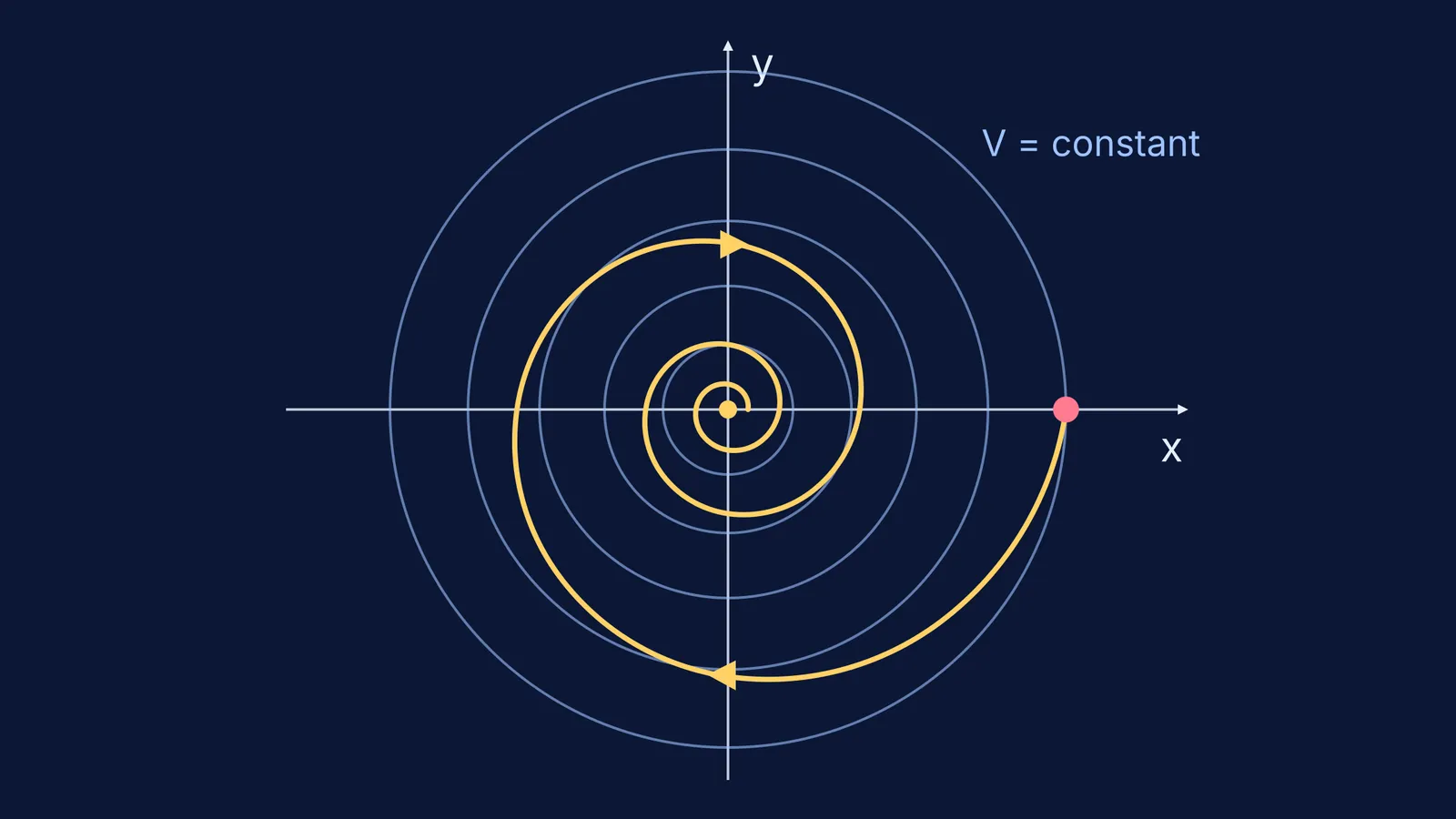
Plot a two-variable system, such as a circuit's voltage and current, as a point moving across a plane. The Poincaré–Bendixson theorem tells you where that point can end up. If it is trapped in a bounded region with no rest points, it must approach a closed loop.
What does the Poincaré–Bendixson theorem say?
For a differentiable system in the plane, every non-empty compact ω-limit set with finitely many fixed points is a fixed point, a periodic orbit, or fixed points joined by connecting orbits (Wikipedia, Poincaré–Bendixson theorem). The ω-limit set is where a trajectory ends up as time runs forward.
The working version: if a trajectory stays forever in a closed, bounded region R that contains no equilibrium points, then R contains a periodic orbit. Henri Poincaré had a weaker version in 1892; Ivar Bendixson gave the full proof in Acta Mathematica in 1901.
A limit cycle is a closed trajectory that at least one other trajectory spirals into (Wikipedia, Limit cycle).
How do you use a trapping region to find a limit cycle?
A trapping region is a closed region where the flow points inward along the whole boundary, so nothing inside can leave. MIT's nonlinear dynamics course uses this method to prove the van der Pol oscillator has a periodic orbit (MIT 18.385 lecture notes). The recipe:
Find every equilibrium.
Choose a region that leaves them out, usually a ring (annulus) around an unstable equilibrium.
Check that the flow enters the ring across both boundaries, all the way round.
Conclude that a closed orbit lies inside the ring.
New to linear phase portraits? Start with how to draw phase portraits for 2×2 linear systems.
Worked example: r′ = r(1 − r²)
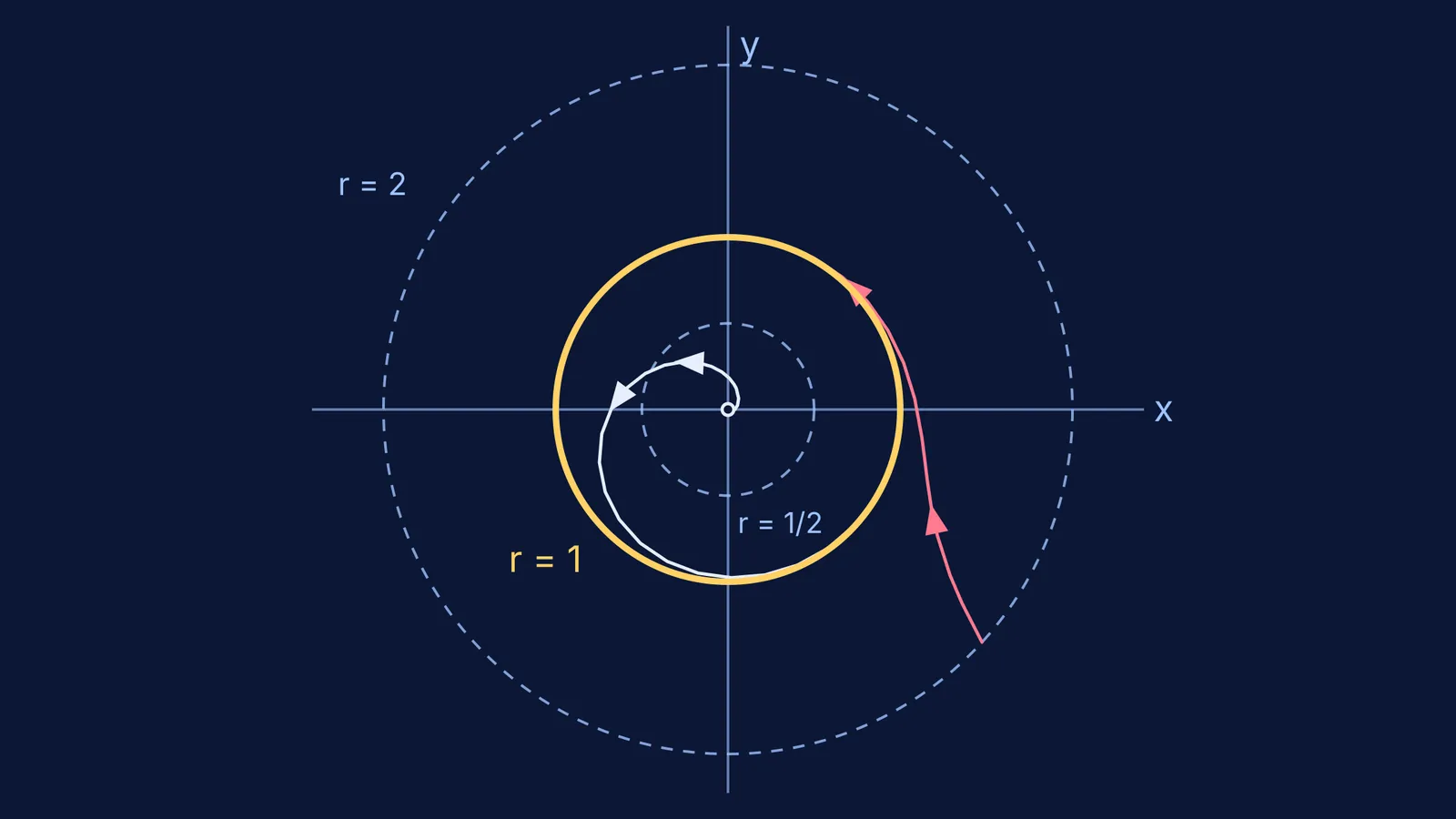
Take x′ = x − y − x(x² + y²) and y′ = x + y − y(x² + y²). With r² = x² + y², r r′ = x x′ + y y′ = r² − r⁴, so r′ = r(1 − r²). Similarly θ′ = (x y′ − y x′)/r² = 1: every point turns anticlockwise at unit rate.
Equilibria: θ′ never vanishes, so the only rest point is the origin.
Region: the ring ½ ≤ r ≤ 2 leaves the origin out.
Boundary: on r = ½, r′ = 3/8 > 0, so the flow enters the ring from the hole. On r = 2, r′ = −6 < 0, so the flow enters from outside. The ring traps.
Conclusion: a closed orbit lies in the ring. Here r′ = 0 at r = 1, so the circle r = 1 is the limit cycle.
Check with the exact solution. Put u = r²; then u′ = 2u(1 − u), a logistic equation, so r² = 1/(1 + (1/r₀² − 1)e^(−2t)). As t grows, r goes to 1 from any r₀ > 0.
Why does the van der Pol oscillator have a limit cycle?
The van der Pol equation is x″ − μ(1 − x²)x′ + x = 0. Balthasar van der Pol proposed it while working at Philips; he found stable oscillations in vacuum-tube circuits (Wikipedia, Van der Pol oscillator) and described them in "On relaxation-oscillations" (1926).
The damping changes sign. When |x| < 1 it pumps energy in, so small swings grow; when |x| > 1 it removes energy, so large swings shrink. With μ = 0 you get x″ + x = 0, the simple harmonic oscillator from second-order linear differential equations.
For every μ > 0, all trajectories except the equilibrium at the origin approach a unique stable limit cycle (Wikipedia, Van der Pol oscillator). The MIT notes get existence from a trapping region and note that uniqueness needs a separate argument. For large μ the cycle becomes a relaxation oscillation: slow build-up, sudden release.
Why does chaos need three dimensions?
In the plane, trajectories cannot cross, and a closed loop splits the plane into an inside and an outside. A bounded orbit has few long-run options, so a two-dimensional continuous system cannot have a strange attractor (Wikipedia, Poincaré–Bendixson theorem).
Edward Lorenz's 1963 convection model has three variables and is chaotic at σ = 10, ρ = 28 and β = 8/3 (Wikipedia, Lorenz system; Lorenz 1963020%3C0130:DNF%3E2.0.CO;2)). Drive the van der Pol oscillator with a sine wave and time becomes a third variable: the irregular noise van der Pol and van der Mark heard from a driven circuit in 1927 was later found to be deterministic chaos (Wikipedia, Van der Pol oscillator).
What mistakes do students make with Poincaré–Bendixson?
Leaving an equilibrium inside the region: then the theorem says nothing.
Claiming the cycle is unique or stable: the theorem gives existence only.
Applying it in three dimensions or to discrete maps.
If equilibria, stability or ω-limit sets feel shaky, the Fermi Concept Library gives every concept in mathematics its own lesson. Orbits are easier to see than to read, and the Fermi Simulation Lab has interactive simulations for ideas like these.