On this page
When a partner retires or dies, the remaining partners carry on with a new ratio and pay the outgoing partner (or their executor) what is owed. The chapter sits inside Unit 1, Accounting for Partnership Firms, which the CBSE Accountancy curriculum for 2026-27 prints at 36 marks.
What does the 2026-27 syllabus include for retirement and death?
The 2026-27 curriculum keeps these sub-topics:
the effect of retirement or death on the profit sharing ratio
treatment of goodwill (as per AS 26)
revaluation of assets and reassessment of liabilities
adjustment of accumulated profits, losses and reserves
capital adjustment, capital and current accounts, and the new balance sheet
the retiring partner's loan account
the deceased partner's profit till death, capital account and executor's account
The chapter to study is "Reconstitution of a Partnership Firm – Retirement/Death of a Partner" in NCERT Accountancy Part 1 (Reprint 2026-27). If you have done admission of a partner and its goodwill entries, most of it carries over.
What is the gaining ratio, and how do you find it?
The gaining ratio is the ratio in which the continuing partners take over the retiring or deceased partner's share, as defined in the NCERT chapter.
Gaining share = new share minus old share, worked out for each continuing partner.
If no new ratio is given, the continuing partners keep their old ratio between them, and that is also the gaining ratio.
How are goodwill and revaluation treated?
Per NCERT, the retiring partner is compensated for their share of goodwill by the gaining partners, in their gaining ratio:
Gaining Partners' Capital A/c Dr. (individually) To Retiring Partner's Capital A/c
If goodwill already appears in the books, it is first written off to all partners, including the one leaving, in the old ratio. Revaluation gain or loss and reserves also go to all partners in the old ratio. For a refresher on how the goodwill figure itself is calculated, see our guide to goodwill valuation methods.
Worked example: how much is due to the retiring partner?
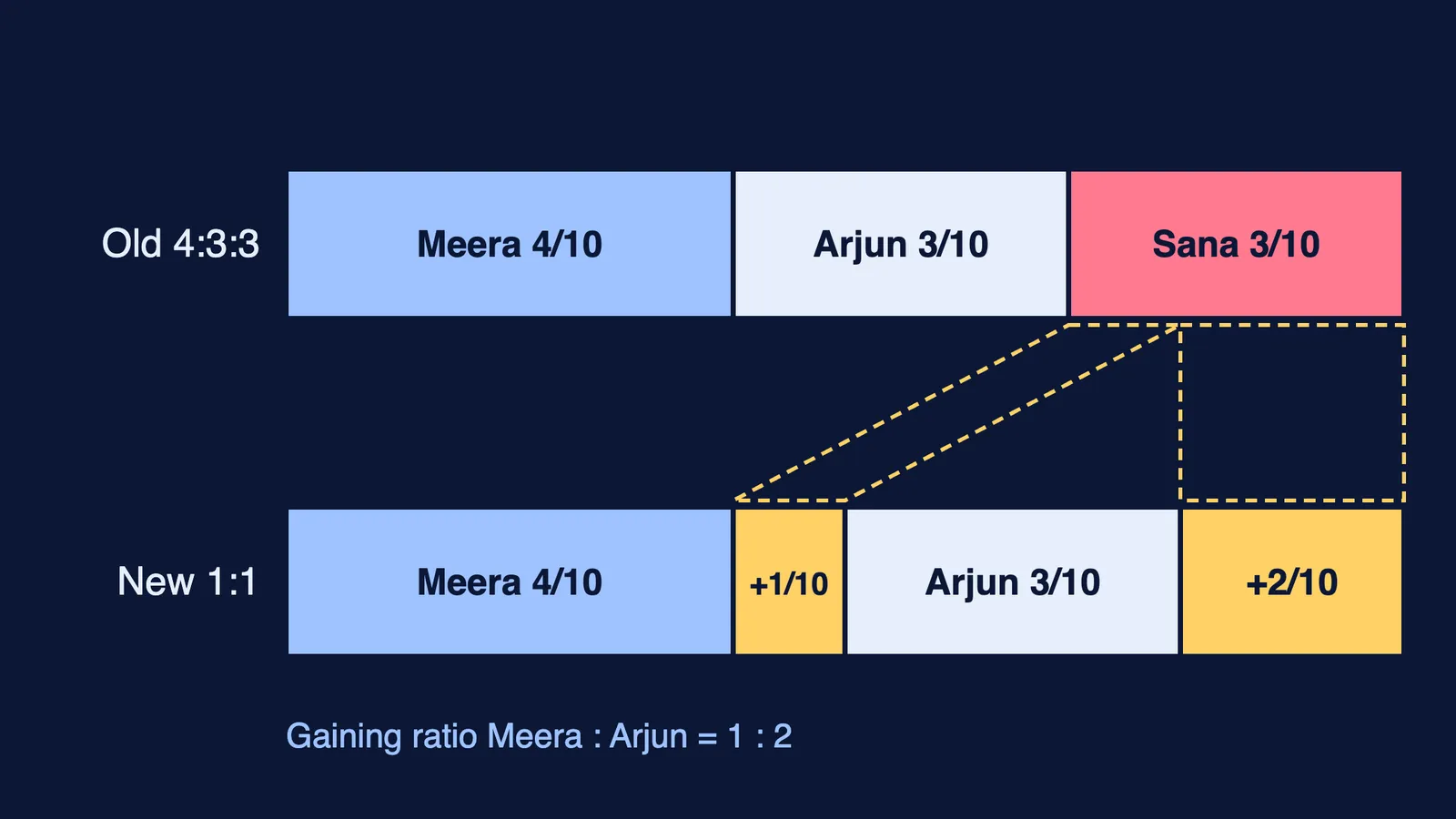
Our own practice problem. Meera, Arjun and Sana share profits 4:3:3. Sana retires on 31 March 2027, and Meera and Arjun will share future profits equally (1:1). On that date:
Sana's capital: ₹1,20,000
General Reserve: ₹40,000
Goodwill valued at ₹1,80,000 (not in the books)
Building is revalued up by ₹30,000, stock down by ₹6,000, and a new provision for doubtful debts of ₹2,000 is created
Step 1: gaining ratio. Meera: 5/10 − 4/10 = 1/10. Arjun: 5/10 − 3/10 = 2/10. Gaining ratio = 1:2. Check: 1/10 + 2/10 = 3/10, which is Sana's old share.
Step 2: goodwill. Sana's share = 3/10 × ₹1,80,000 = ₹54,000. Meera pays 1/3 of it (₹18,000) and Arjun pays 2/3 (₹36,000):
Meera's Capital A/c Dr. 18,000; Arjun's Capital A/c Dr. 36,000; To Sana's Capital A/c 54,000
Had you split it in the old ratio 4:3, Meera would wrongly bear about ₹30,857, even though she gains less.
Step 3: revaluation. Net gain = 30,000 − 6,000 − 2,000 = ₹22,000. Sana's 3/10 = ₹6,600.
Step 4: reserve. Sana's 3/10 of ₹40,000 = ₹12,000.
Step 5: amount due. 1,20,000 + 54,000 + 12,000 + 6,600 = ₹1,92,600.
If the firm pays ₹42,600 now, the remaining ₹1,50,000 goes to Sana's Loan A/c. Without an agreement, Section 37 of the Indian Partnership Act, 1932 lets the outgoing partner choose interest at 6% p.a. until payment or a share of profits earned with their money, as the NCERT chapter explains.
What changes when a partner dies?
The steps are the same, with two additions from NCERT. First, their share of profit from the last balance sheet date to the date of death, estimated from last year's profit (or an average) or from sales. Second, the final balance goes to the Executor's Account.
Suppose Sana instead died on 31 July 2027 and last year's profit was ₹1,50,000. Her share for April to July = 1,50,000 × 4/12 × 3/10 = ₹15,000, credited to her capital account. With the other figures unchanged, ₹2,07,600 goes to her executor.
The CBSE 2026-27 sample paper tests this chapter as goodwill payable to an executor (Q6), the order of retirement steps (Q13), an executor's account (Q22 B) and a retirement case where you rebuild the revaluation and capital accounts (Q25 B). Check your method against the marking scheme.
Which mistakes cost the most marks?
Using the old ratio for goodwill when a new ratio is given.
Not writing off goodwill already in the books.
Leaving the retiring partner out of revaluation and reserves.
Missing the deceased partner's profit up to death.
Not checking that gains add up to the outgoing share.
Once the five steps feel automatic, time yourself on the sample paper case. If you are not sure where to start, Fermi's AI tutor can work out what you already know and build a plan for the session, so you sit down to a clear next step.