On this page
Respiration in Plants is Chapter 12 of the rationalised NCERT Class 11 Biology textbook (Reprint 2026-27), and the CBSE 2026-27 Biology syllabus covers gas exchange, glycolysis, fermentation, the TCA cycle, ETS, ATP counts, amphibolic pathways and respiratory quotient. Below are about 30 key terms in that order, in our own words. NCERT's list of rationalised content for Class 11 drops nothing from this chapter.
For the full walkthrough and practice questions, read our Respiration in Plants Class 11 chapter guide.
What do the basic terms of respiration mean?
These follow the opening and section 12.1 of the NCERT chapter.
Cellular respiration: oxidising food molecules inside cells, breaking C-C bonds so energy is released in small enzyme-controlled steps. Don't confuse with: combustion, which releases the energy in one go, mostly as heat.
Respiratory substrate: any compound a cell oxidises in respiration. Example: glucose is the favoured one; some plants can also use fats, proteins or organic acids under certain conditions.
ATP: the energy currency of the cell; energy from oxidation is stored in ATP and released wherever work needs doing.
Stomata and lenticels: openings for gas exchange, since plants have no breathing organs; stomata are mostly on leaves, lenticels in the bark of woody stems.
Facultative and obligate anaerobes: facultative anaerobes can live with or without oxygen; obligate anaerobes need conditions without oxygen.
Which terms belong to glycolysis and fermentation?
Sections 12.2 and 12.3 of the NCERT chapter cover these.
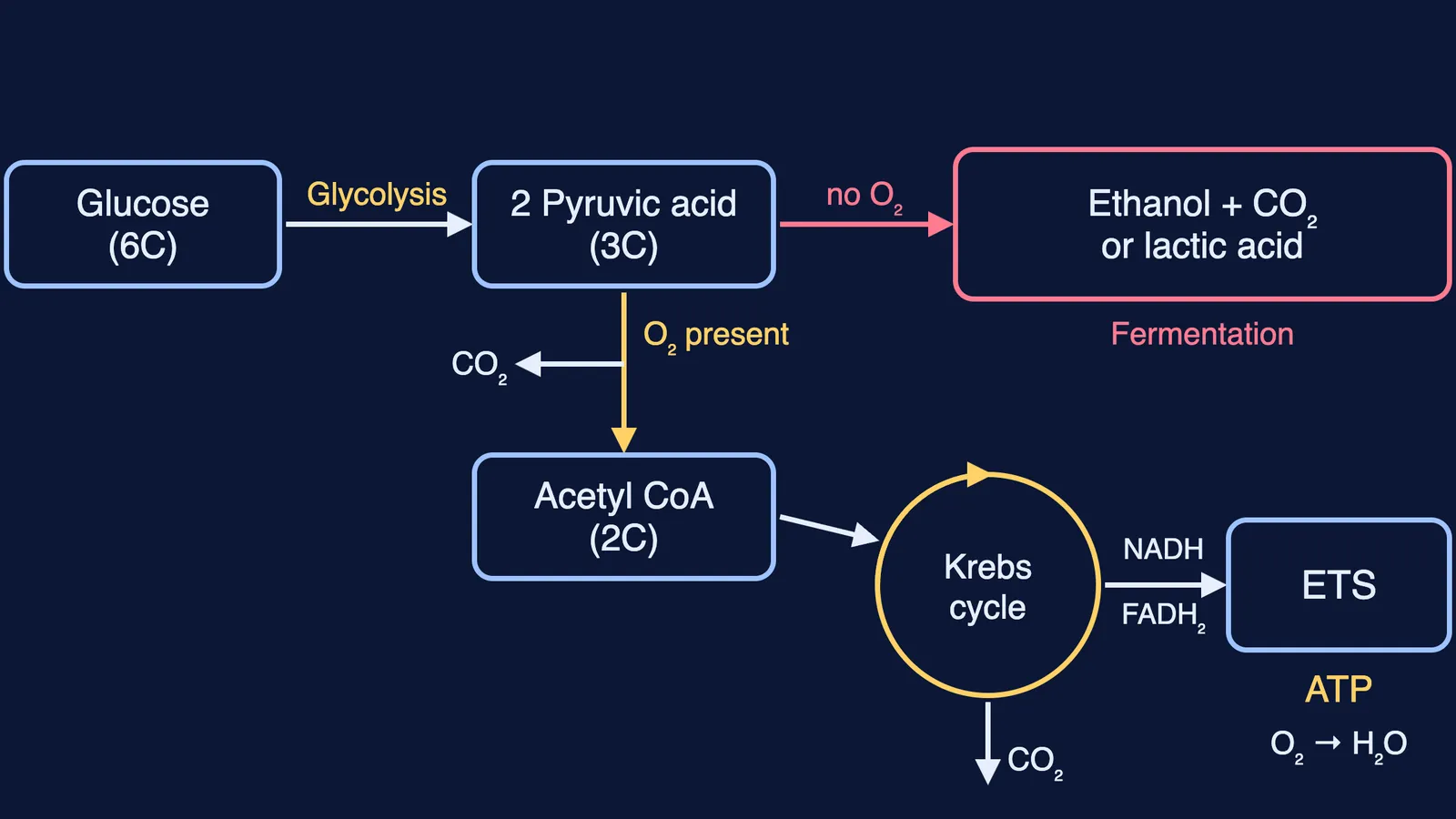
Glycolysis: the partial oxidation of one glucose into two pyruvic acid molecules in the cytoplasm, through a chain of ten enzyme-controlled reactions. It happens in all living organisms and is the only respiratory process in anaerobes. Don't confuse with: fermentation, which is what happens to pyruvate afterwards when oxygen is short.
EMP pathway: another name for glycolysis, after Embden, Meyerhof and Parnas, who worked out its scheme.
Invertase: splits sucrose into glucose and fructose.
Hexokinase: adds a phosphate to glucose, making glucose-6-phosphate and using one ATP.
PGAL (3-phosphoglyceraldehyde): a 3-carbon sugar phosphate from the split of fructose 1,6-bisphosphate; its oxidation to BPGA turns NAD+ into NADH + H+.
Pyruvic acid: the 3-carbon end product of glycolysis; its fate depends on the cell's needs.
Alcoholic fermentation: in yeast, without oxygen, pyruvic acid becomes ethanol and CO2, using pyruvic acid decarboxylase and alcohol dehydrogenase.
Lactic acid fermentation: pyruvic acid is reduced to lactic acid by lactate dehydrogenase. Example: some bacteria, and muscles during exercise when oxygen runs short.
What happens in aerobic respiration and the Krebs cycle?
From section 12.4 of the NCERT chapter:
Aerobic respiration: the complete oxidation of food to CO2 and water using oxygen, releasing far more energy than fermentation; in eukaryotes it happens in mitochondria.
Oxidative decarboxylation: the matrix step where pyruvic acid loses CO2 and hydrogen, catalysed by pyruvate dehydrogenase with NAD+ and coenzyme A.
Acetyl CoA: the 2-carbon product of that step; it carries carbon into the Krebs cycle.
Krebs cycle (TCA or citric acid cycle): the cycle in the mitochondrial matrix that fully oxidises acetyl CoA, named after Hans Krebs.
Oxaloacetic acid (OAA): the 4-carbon acid that combines with acetyl CoA to start the cycle and is regenerated at its end.
Citrate synthase: the enzyme that joins acetyl CoA and OAA to make citric acid.
Substrate-level phosphorylation: making ATP or GTP directly in a reaction step, without the ETS. Example: GTP forms when succinyl-CoA becomes succinic acid. Don't confuse with: oxidative phosphorylation.
NADH + H+ and FADH2: reduced carriers holding the energy from oxidation. Inside the mitochondrion, one glucose yields 8 NADH + H+ and 2 FADH2.
What is the electron transport system?
These follow section 12.4.2 of the NCERT chapter.
Electron transport system (ETS): the carrier chain on the inner mitochondrial membrane passing electrons from NADH and FADH2 to oxygen.
Complexes I to IV: NADH dehydrogenase (I), the FADH2 entry point (II), cytochrome bc1 complex (III) and cytochrome c oxidase (IV).
Ubiquinone and cytochrome c: electron carriers. Ubiquinone sits within the inner membrane; cytochrome c, a small mobile protein, shuttles electrons from complex III to IV.
Oxidative phosphorylation: making ATP using energy from oxidation-reduction in the ETS. Don't confuse with: photophosphorylation, where light energy builds the proton gradient.
ATP synthase (complex V): the enzyme that makes ATP. Its F0 part is the proton channel in the membrane and its F1 headpiece holds the ATP-making site; 4 H+ pass through for each ATP.
Terminal acceptor: oxygen, the final hydrogen acceptor, which is reduced to water. Oxidising one NADH gives 3 ATP and one FADH2 gives 2 ATP.
What are the balance sheet, amphibolic pathway and RQ?
Sections 12.5 to 12.7 of the NCERT chapter:
Respiratory balance sheet: the theoretical count of ATP from one glucose, which gives a net gain of 38 ATP in aerobic respiration. It assumes one orderly pathway, glycolysis NADH entering mitochondria, no intermediates withdrawn and only glucose respired, never fully true in a living cell.
Amphibolic pathway: a pathway used both to break molecules down (catabolism) and to build them (anabolism). Example: acetyl CoA is formed when fatty acids are respired and withdrawn when fatty acids are made. Don't confuse with: a purely catabolic pathway, the traditional label for respiration.
Respiratory quotient (RQ): the volume of CO2 released divided by the volume of O2 used. It is 1.0 for carbohydrates, about 0.7 for fats (tripalmitin) and about 0.9 for proteins.
How to learn these terms
Draw the pathway from glucose to ETS from memory, marking where each step happens: cytoplasm, matrix or inner membrane.
Learn the "Don't confuse with" pairs together, then answer NCERT's own differentiate questions, such as respiration versus combustion.
Write the carbon count beside each molecule (6C, 3C, 2C, 4C) to track where CO2 leaves.
Test yourself with our assertion-reason questions on photosynthesis and respiration.
If a term still feels shaky, the Fermi Concept Library gives every biology concept its own lesson and its place in the map.