On this page
The CBSE Biotechnology (045) curriculum for 2026-27 puts Recombinant DNA Technology first in Unit V, Protein and Gene Manipulation. The unit carries 40 of the 70 theory marks, shared with two other chapters; there is no separate figure for this one. We found no official PDF of CBSE's prescribed *A Text Book of Biotechnology* (Class XII), so we follow the curriculum's topic list with NCERT Biotechnology XII (Reprint 2025-26) as reference.
What does the curriculum list for this chapter?
Tools, making rDNA, putting it into hosts, identifying recombinants, PCR and DNA sequencing. Taking core Biology? Our Class 12 Biology guide to biotechnology principles and processes covers the core chapter. The elective asks for more tools and methods:
Enzymes beyond cutting and joining (NCERT Chapter 3): alkaline phosphatase strips the 5′ phosphate; polynucleotide kinase puts one back; terminal transferase builds a tail on the 3′ end with no template; reverse transcriptase makes cDNA from RNA. T4 ligase joins blunt as well as cohesive ends.
Vector checklist (NCERT Chapter 2): small size with room for a large insert, an ori for autonomous replication, unique restriction sites, and at least one selectable marker.
Ways into a host (Chapter 3): chemical routes (calcium chloride with heat shock, lipofection) and physical routes (electroporation, microinjection, the gene gun firing DNA-coated gold, nickel or tungsten particles).
How do you identify recombinants?
NCERT (Chapter 3) contrasts direct selection on an antibiotic with insertional inactivation, which it calls more efficient. In its version the insert sits inside ampR. Colonies grow on a tetracycline master plate, are copied onto an ampicillin replica plate, and the recombinants are the ones missing from the replica.
Worked example (our numbers). A tetracycline master plate shows 64 colonies. On the ampicillin replica, 52 grow.
Untransformed cells die on tetracycline, so every master colony carries a plasmid.
A colony that also grows on ampicillin has an intact ampR, so no insert: 52 non-recombinants.
Recombinants = 64 − 52 = 12, or 18.75% of 64.
Check: 12 + 52 = 64. Do not count the 52 replica colonies as recombinants.
How does PCR copy DNA, and how many copies do you get?
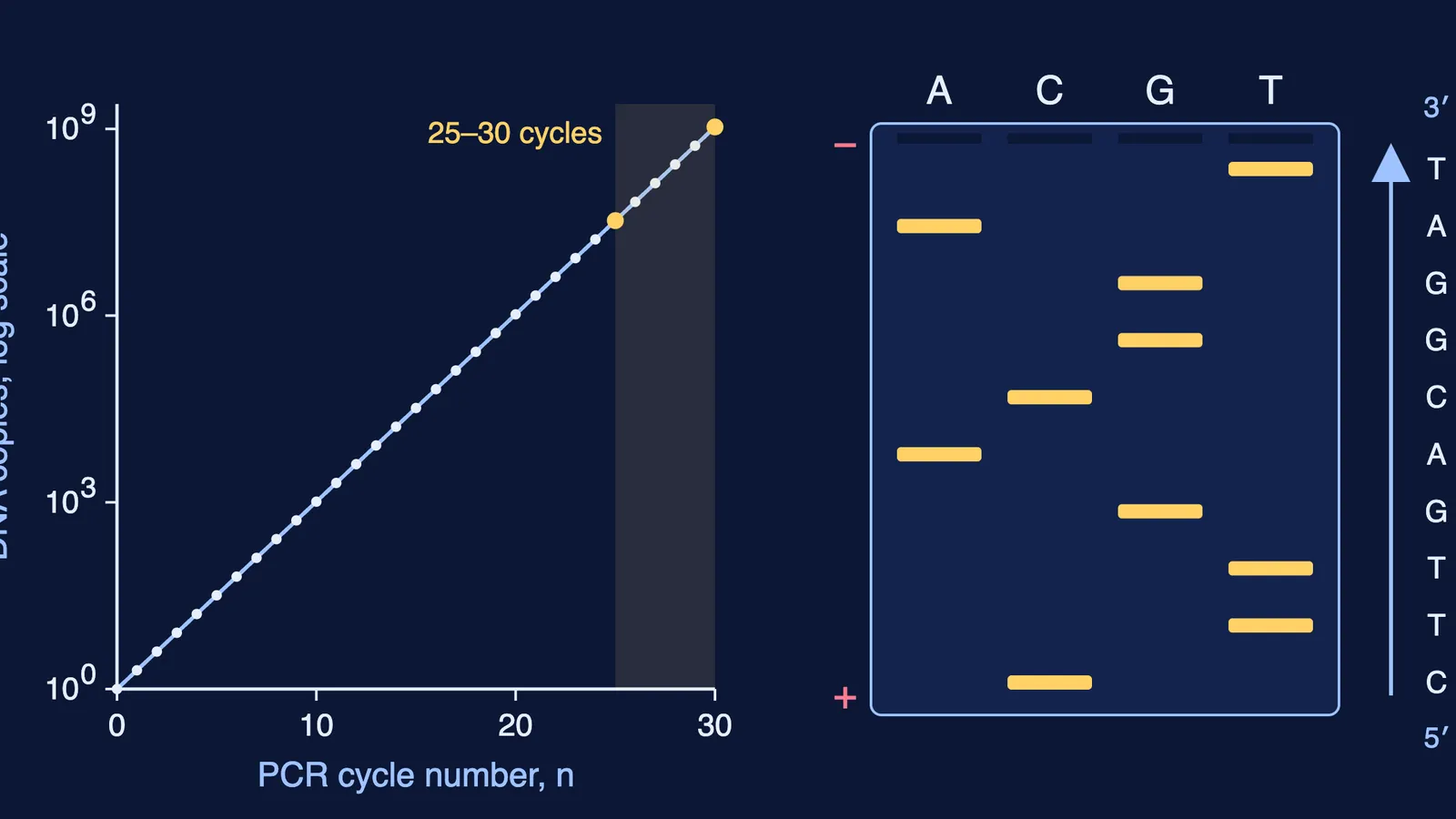
PCR, developed by Kary Mullis, repeats three steps in a thermocycler (NCERT Chapter 3): denaturation at about 94–95°C, primer annealing at around 50–55°C, and extension at about 72°C by a heat-stable polymerase such as Taq; Pfu polymerase is chosen for higher fidelity. NCERT gives the copy number after n cycles as 2ⁿ and says a typical run uses 25 to 30 cycles. Why it survives the heat: our Taq polymerase explainer.
Worked example (our numbers). 40 target copies, 25 cycles.
Copies = 40 × 2²⁵ = 40 × 33,554,432 = 1,342,177,280, about 1.34 × 10⁹.
To pass a million from one copy: 2¹⁹ = 524,288 falls short, 2²⁰ = 1,048,576 passes, so 20 cycles.
Both assume ideal doubling. NCERT also covers RT-PCR (starting from mRNA) and real-time qPCR, which tracks a dye such as SYBR green each cycle, with no gel.
How do you read a Sanger sequencing gel?
Sanger's chain-termination method is in NCERT Class 11 Biotechnology, Chapter 12 (Reprint 2026-27). A ddNTP lacks the 3′-OH, so a chain stops where one is added. Four tubes, each spiked with one ddNTP, give fragments ending in A, C, G or T, so a band's lane names its last base. Every fragment starts at the primer and shorter ones run further, so the bottom band ends at the first base added. Reading upward gives the new strand 5′ to 3′. Class XII (Chapter 5) runs the same idea with fluorescent tags in gel-filled capillaries, each reading about 800–1000 bases.
Worked example (our sequence, shown in the hero). Bands from bottom to top fall in lanes C, T, T, G, A, C, G, G, A, T.
New strand, 5′ to 3′: CTTGACGGAT.
Template, by pairing: 3′-GAACTGCCTA-5′, which is 5′-ATCCGTCAAG-3′.
Practice questions in the 2026-27 paper format
The 2026-27 sample paper has five sections: MCQs and assertion-reason at 1 mark, short answers at 2 and 3, case-based items at 4, and long answers at 5. Its marking scheme splits marks point by point. The questions are ours.
(1 mark, MCQ) Which enzyme adds a homopolymer tail to a 3′ end without a template? (a) polynucleotide kinase (b) terminal transferase (c) alkaline phosphatase (d) DNA ligase
(1 mark, assertion-reason) A: A vector with many sites for one restriction enzyme is a poor choice. R: The enzyme would cut it into several pieces.
(2 marks) Give one chemical and one physical way to put rDNA into a host cell.
(3 marks) Starting with 15 copies, how many copies does an ideal PCR give after 12 cycles? Why is Taq polymerase used?
(3 marks) Bands read bottom to top in lanes G, A, T, C, C, A. Write the new strand and the template with their ends.
Answers to check yourself: 1 (b); 2 both true, R explains A; 4 is 15 × 4,096 = 61,440; 5 is 5′-GATCCA-3′ on template 3′-CTAGGT-5′.
Short on time tonight? Fermi's AI tutor works out what you already know and builds a plan for the session.