On this page
Ray Optics and Optical Instruments is Chapter 9 of the CBSE Class 12 Physics syllabus for 2026-27, in Unit VI Optics. The syllabus gives Unit V (Electromagnetic Waves) and Unit VI (Optics) a combined 18 of the 70 theory marks. Its key terms from the current NCERT chapter, grouped by topic. For derivations and answer layout, see our Ray optics Class 12 board exam guide.
What are the basic terms for mirrors and images?
Pole and principal axis: the pole is the geometric centre of a mirror's surface; the principal axis is the line through the pole and the centre of curvature.
Centre of curvature and radius of curvature (R): the centre and radius of the sphere the mirror is cut from.
Paraxial rays: rays hitting near the pole at small angles to the axis; the chapter's formulas assume them.
Principal focus (F): where rays parallel to the axis meet after a concave mirror, or seem to spread from after a convex one.
Focal plane: the plane through F, at right angles to the axis, where a tilted parallel beam focuses. Don't confuse with: the focus, a single point.
Focal length (f): pole-to-focus distance. For a spherical mirror, f = R/2.
Cartesian sign convention: measure from the pole or optical centre; along the incident light is positive, against it negative; heights above the axis are positive. So a real object always has negative u.
Real image: rays actually meet, so it forms on a screen. Don't confuse with: virtual image, where rays only seem to come from a point when traced back.
Linear magnification (m): image height over object height, h′/h. For a mirror m = −v/u; negative means inverted.
How does refraction lead to total internal reflection?
Refractive index (n21): the constant ratio sin i / sin r in Snell's law, for medium 2 relative to medium 1. It depends on the media and the wavelength, not the angle.
Optically denser medium: the one in which light bends towards the normal. Don't confuse with: mass density. Turpentine has a lower mass density than water but is optically denser.
Apparent depth: real depth divided by refractive index, for viewing near the normal.
Critical angle (ic): the angle of incidence in the denser medium for which the refracted ray grazes the surface at 90°. Table 9.1 of the NCERT chapter lists 48.75° for water and 24.41° for diamond.
Total internal reflection: beyond the critical angle, no light is transmitted; all of it reflects.
Optical fibre: a glass or quartz core inside lower-index cladding, guiding light by repeated total internal reflection.
Which lens terms do you need?
Thin lens: a lens so thin that its thickness can be neglected; at least one of its two faces is curved (spherical). A ray through its optical centre goes undeviated.
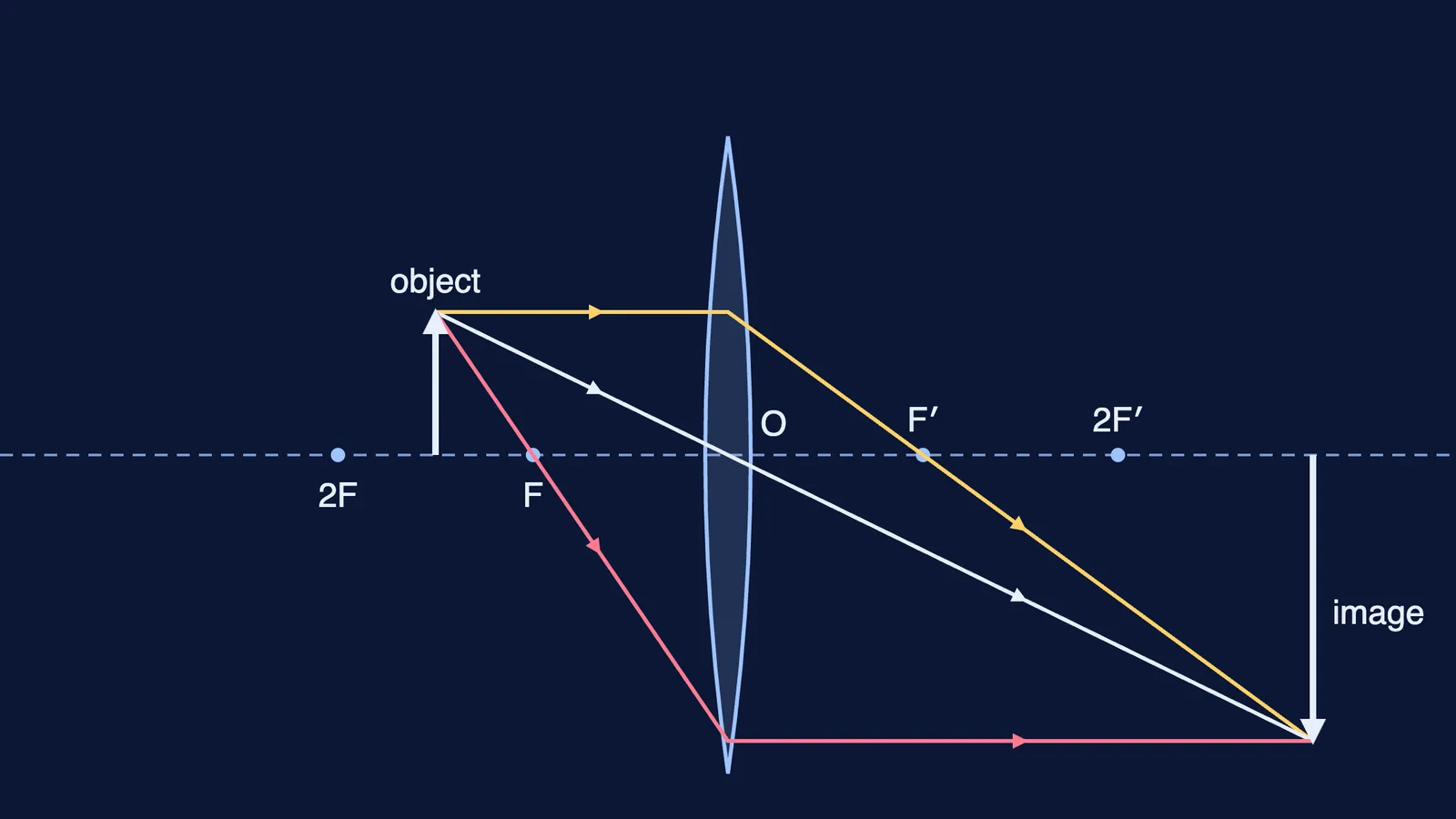
First and second focal points (F and F′): the focus on the incoming-light side is the first. In a thin lens both are equally far from the optical centre.
Lens maker's formula: links f to the refractive index and both radii of curvature. It is why NCERT's Example 9.7 finds a 20 cm convex glass lens becomes about 78.2 cm in water.
Thin lens formula: 1/v − 1/u = 1/f. Don't confuse with: the mirror equation, 1/v + 1/u = 1/f.
Power (P): how strongly a lens converges or diverges light, P = 1/f with f in metres, measured in dioptres (D). A +2.5 D lens is convex with f = +40 cm.
Lenses in contact: they act as one lens whose power is the algebraic sum, P = P1 + P2 + …; magnifications multiply.
What is the angle of minimum deviation in a prism?
Angle of prism (A): the angle between the two refracting faces; inside, r1 + r2 = A.
Angle of deviation (δ): the angle between incident and emergent rays, δ = i + e − A.
Angle of minimum deviation (Dm): the smallest deviation, when i = e and the ray inside runs parallel to the base. A and Dm give the refractive index.
What do microscope and telescope terms mean?
Simple microscope: a short-focus converging lens held near the object, giving an erect, magnified, virtual image.
Near point (D): the closest distance the eye sees clearly, taken as 25 cm; also called the least distance of distinct vision.
Magnifying power: angular magnification, the angle the final image makes at the eye over the angle the object makes (at the near point, for a microscope). Don't confuse with: linear magnification, a ratio of heights.
Objective and eyepiece: the objective forms the first real image; the eyepiece works like a simple microscope on it.
Tube length (L): in a compound microscope, the gap between the objective's second focal point and the eyepiece's first focal point.
Normal adjustment: final image at infinity, for a relaxed eye. A telescope then has magnifying power fo/fe and length fo + fe. In the NCERT example, fo = 100 cm and fe = 1 cm give 100.
Resolving power: how well two objects in nearly the same direction show as separate. It and light gathering power grow with objective diameter.
Reflecting telescope: a concave mirror as objective. Mirrors have no chromatic aberration and are easier to support.
Cassegrain telescope: a convex secondary mirror sends light through a hole in the primary, giving a long focal length in a short tube.
Dispersion, the rainbow and scattering are left out: the CBSE 2026-27 Chapter 9 syllabus does not list them, and the 2026-27 NCERT reprint has no sections on them. CBSE notes that content NCERT marks as excluded "will not be assessed in the Board examinations 2026-27".
How to learn these terms
Learn look-alike terms in pairs.
Write the mirror and lens formulas side by side and state the sign convention before each numerical.
Draw one ray diagram per group from memory, then check with our guide to drawing ray diagrams in the board paper.
Test the terms in statement pairs with our ray optics assertion-reason traps.
If total internal reflection or minimum deviation is hard to picture, the Fermi Simulation Lab has interactive simulations for ideas easier to see than to read.