

On this page
In the CBSE Class 12 Physics theory paper, Section A features four 1-mark assertion-reason questions (Questions 13 to 16) out of 70 total marks, while Unit VI (Optics) carries 18 marks according to CBSE Academic. In both board examinations and competitive tests like JEE Main and NEET-UG, the most challenging task is not eliminating a false statement. It is choosing between option A (both statements are true, and the reason is the correct explanation) and option B (both statements are true, but the reason is not the correct explanation).
When both statements cite valid physics principles from the same syllabus chapter, students readily assume one logically explains the other. Recognizing that two facts are simultaneously true is not proof of a causal link.
Why do students mistake independent facts for explanations?
Content familiarity often overrides logical deduction. In a foundational study on geometrical optics in the American Journal of Physics, researchers Fred M. Goldberg and Lillian C. McDermott showed that students frequently memorize fragmented optical rules without connecting them to the geometry of ray propagation. When facing two correct statements, students substitute topic familiarity for deductive necessity.
The common exam tip of inserting "because" between sentences often backfires. Consider: "White light disperses into colours in a glass prism because white light is a mixture of wavelengths." The sentence sounds convincing, yet the reasoning is incomplete. White light is also a mixture of wavelengths in a vacuum, where it never disperses. A necessary condition is not the physical cause.
What are the classic mirror traps where both statements are true?
Spherical mirror problems often pair a geometric limitation with a universal law of reflection:
The paraxial mirror trap:
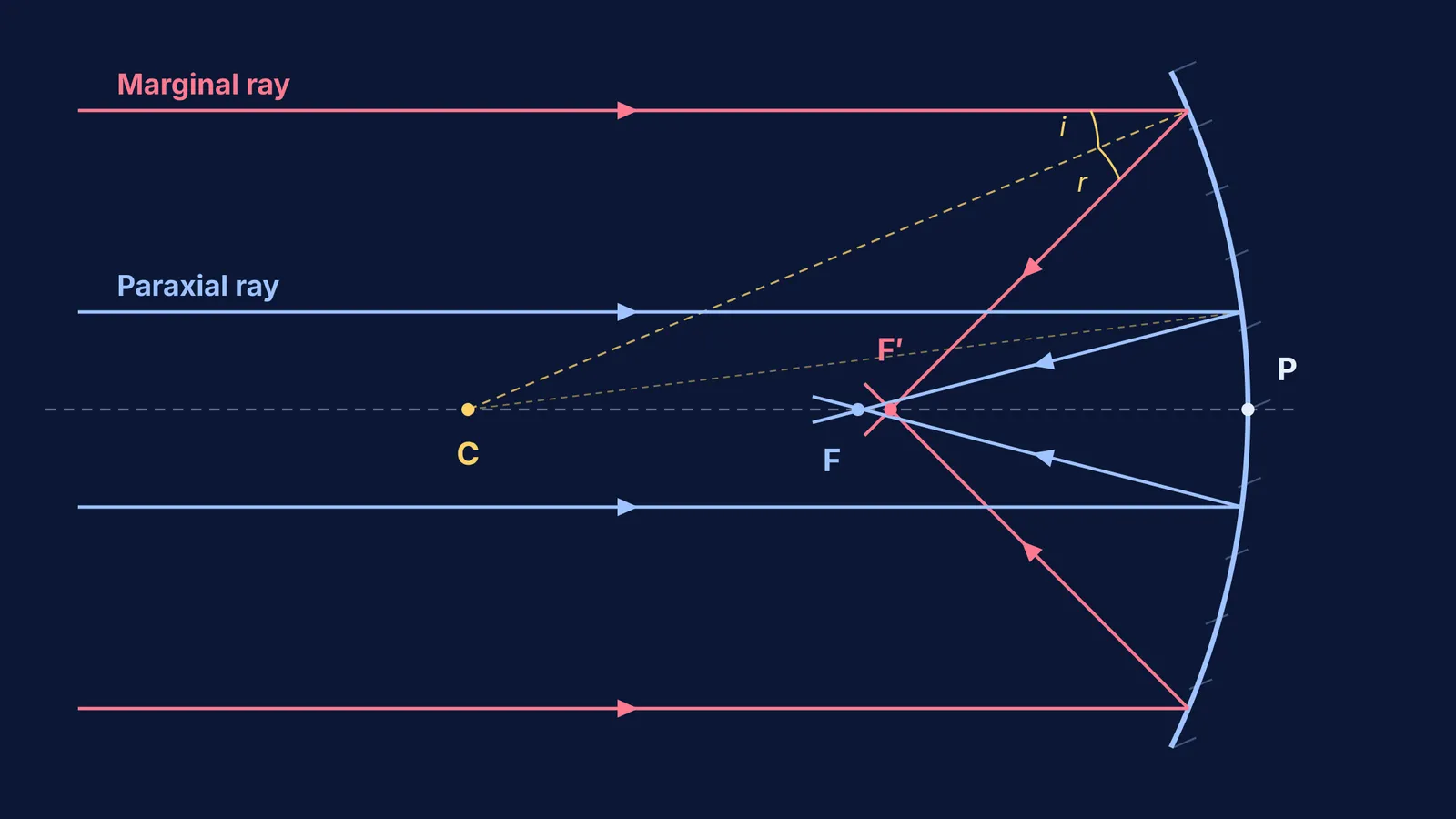
Assertion: The spherical mirror formula 1/v + 1/u = 1/f accurately predicts image positions only for small apertures.
Reason: The laws of reflection apply universally to all reflecting surfaces, plane or curved.
Why option B applies: Both statements are true. As NCERT Textbooks notes in Chapter 9, the mirror formula is derived using the paraxial approximation, where ray angles are small enough that sin θ ≈ tan θ ≈ θ. Wide apertures suffer from spherical aberration because marginal rays focus closer to the pole than paraxial rays. The universality of reflection holds everywhere, but it cannot explain why wide apertures fail the paraxial formula.
The medium-immersion trap:
Assertion: Submerging a concave mirror in water leaves its focal length unchanged.
Reason: Light travels slower in water than in air, corresponding to a refractive index of roughly 1.33 as listed in NCERT Textbooks.
Why option B applies: Light slows to roughly 2.25 × 10⁸ m/s in water, but a spherical mirror's focal length is purely geometric: f = R/2. Because reflection angles depend strictly on surface normals rather than phase velocity, the surrounding liquid has zero effect on the focus. Tracing concave mirror images for all six object positions reinforces why curvature alone dictates where reflected rays intersect.
Which lens and prism pairs fool the standard "because" test?
Lenses and prisms provide fertile ground for statement pairs where an effect or precondition is mistaken for the cause:
Slicing a convex lens along its principal axis:
Assertion: When an equiconvex lens of focal length f is cut horizontally along its principal axis, each half retains focal length f.
Reason: The intensity of the image formed by each half lens is half that of the original lens.
Why option B applies: By the lens maker's formula 1/f = (n - 1)(1/R1 - 1/R2), each half keeps the original radii and refractive index, so f remains unchanged. Halving the aperture area halves the collected light flux, reducing brightness. While both facts are true, reduced brightness is a consequence of smaller aperture, not the cause of focal length conservation. Knowing why a lens's object and real image are at least 4f apart clarifies how focal length sets geometry independently of brightness.
Spectral dispersion through a prism:
Assertion: White light entering a glass prism disperses into constituent colours.
Reason: White light consists of electromagnetic waves spanning wavelengths from roughly 400 nm to 750 nm as detailed in NCERT Textbooks.
Why option B applies: Polychromatic light is necessary, but the direct cause of dispersion is material dispersion. Glass has a wavelength-dependent refractive index governed by Cauchy's relation n(λ) ≈ A + B/λ², meaning violet light experiences greater deviation δ ≈ (n - 1)A than red light. A hollow prism filled with air does not disperse white light despite all wavelengths being present. Data from deviation vs incidence in the prism experiment show how refraction geometry and material dispersion determine each path.
How can you test for a direct causal mechanism under exam conditions?
To separate option A from option B during exams, apply this three-step filter:
Independent verification: Evaluate Assertion and Reason separately. If either statement is false, the question resolves immediately to option C or D.
Derivation check: Ask whether the Reason supplies a necessary algebraic step or physical postulate in deriving the Assertion. If the Reason describes a property omitted from the derivation, choose option B.
Counterfactual test: Imagine altering the condition in the Reason while holding fundamental laws fixed. If the Reason's condition changes and the Assertion remains valid, there is no direct causal link.
Mastering this distinction replaces guesswork with systematic deduction. The Fermi Problem Library provides worked problems with a step-by-step solver that explains the reasoning rather than printing an answer. For reviewing theoretical derivations, the Fermi Concept Library includes every concept in physics and its place in the map, helping you trace which definitions lead directly to each formula.


