On this page
For Class 12 students taking the Biotechnology (045) elective: the listed topics, one worked mass spectrometry problem and practice questions we wrote.
What does the 2026-27 curriculum list for this chapter?
The CBSE Biotechnology curriculum for 2026-27 places Protein Structure and Engineering as Chapter 2 of Unit V, Protein and Gene Manipulation. Unit V carries 40 of the 70 theory marks, shared with two other chapters; CBSE prints no separate figure for this one.
The listed topics are: the world of proteins, structure-function relationship, characterisation, protein-based products, and protein engineering. The prescribed book is CBSE's A Text Book of Biotechnology, Class XII; the copy on CBSE's site is the second edition of June 2011. Its chapter also has sections on 3-D shape and on purification, which the curriculum does not list, so we leave purification out. NCERT's Biotechnology XII (Reprint 2025-26) has no chapter of this name; its closest match is section 5.6, Protein Engineering, in Chapter 5.
Core Biology teaches protein levels in Class 11 (our Biomolecules Class 11 guide) and rDNA tools in Class 12 (Biotechnology principles and processes). The elective adds how proteins are measured and redesigned.
How does a protein's shape decide its job?
Recall the four levels: sequence, helices and sheets, the compact fold, and subunits joining (protein structure from primary to quaternary helps). The CBSE book sorts the non-covalent forces into four kinds: ionic bonds (salt bridges), hydrogen bonds, van der Waals forces and hydrophobic interactions. Hydrophobic interactions drive folding strongly, so water-avoiding side chains end up in the core.
Chymotrypsin (245 amino acids): folding brings His57, Asp102 and Ser195 together, and this charge relay lets Ser195 attack the substrate's peptide bond. It is made as inactive chymotrypsinogen and switched on only in the duodenum.
Sickle cell haemoglobin: valine replaces glutamic acid at position 6 of the beta chain, and the haemoglobin forms fibres that distort red cells. V. M. Ingram showed this in 1957 by protein fingerprinting, hence "molecular disease".
How are proteins characterised?
The book lists SDS-PAGE, fingerprinting, 2-D gel electrophoresis, protein sequencing and mass spectrometry.
Fingerprinting: trypsin cuts after arginine and lysine; peptides run by paper electrophoresis, then chromatography at right angles.
2-D gel: isoelectric focusing separates by isoelectric point, then SDS-PAGE by size.
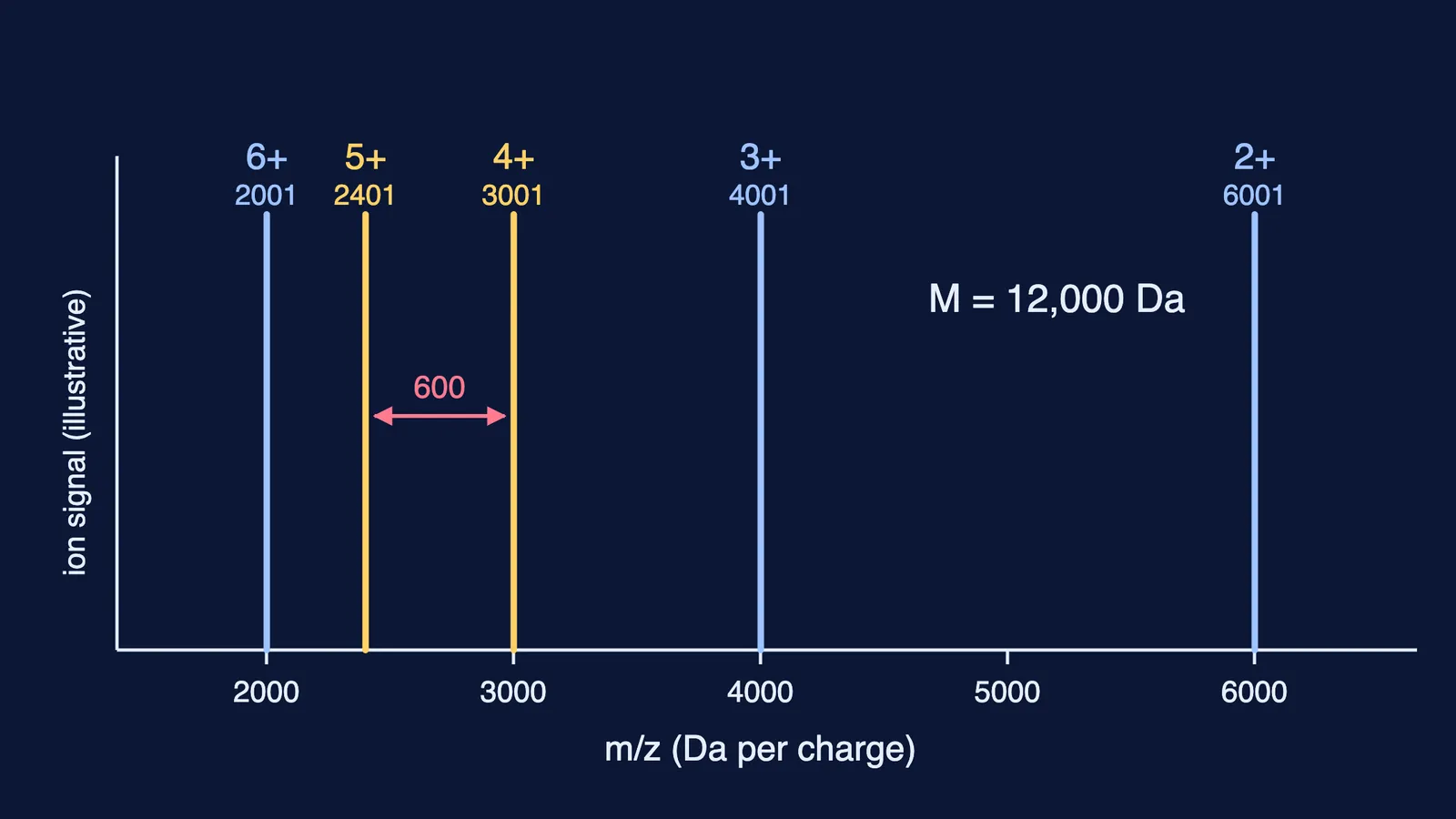
Mass spectrometry: ions are sorted by mass-to-charge ratio (m/z). MALDI uses a laser and a matrix to turn proteins into gas-phase ions.
Worked example: a protein's mass from two peaks. The CBSE book uses m/z = (M + n) / n for a protein of mass M carrying n protons, each counted as 1 Da. Two neighbouring peaks sit at 3,001 and 2,401; the lower one carries one more charge.
n(3,001 − 1) = (n + 1)(2,401 − 1)
3,000n = 2,400n + 2,400, so n = 4.
M = 4 × 3,000 = 12,000 Da.
Check: (12,000 + 5) / 5 = 2,401.
What are protein-based products?
The book's eight commercial groups, one example each:
Blood products and vaccines: Factor VIII.
Therapeutic antibodies and enzymes: tissue plasminogen activator.
Hormones and growth factors: insulin.
Regulatory factors: interferons.
Analytical uses: horseradish peroxidase in ELISA.
Industrial enzymes: papain.
Functional non-catalytic proteins: kappa casein.
Nutraceutical proteins: whey protein concentrates.
This is a study summary, not medical advice.
How does protein engineering redesign a protein?
Find the amino acid behind a trait, change its codon by site-directed mutagenesis, and express the protein. NCERT's section 5.6 gives these cases:
Subtilisin, a detergent protease (triad Ser221, His64, Asp32). Bleach oxidises Met222; an alanine codon in its place gives an enzyme that stays stable with bleach.
6-His tag: six histidines bind nickel, zinc or cobalt ions, so the tagged protein sticks to a metal-ion column while others wash away.
GFP tag: the jellyfish green fluorescent protein gene, fused to another gene, shows where that protein sits under UV light.
Immunotoxin: a single-chain antibody fragment joined to a toxin.
Humanised antibody: the mouse antigen-binding part placed in a human antibody gene.
Practice questions (our own)
Mark values follow the CBSE 2026-27 sample paper.
(1 mark, MCQ) A 6-His-tagged protein is held on its column by: (A) hydrophobic beads (B) nickel ions (C) trypsin (D) ninhydrin. Answer: B.
(2 marks) Why would active chymotrypsin inside the pancreas be harmful, and how is it avoided?
(3 marks) A single-chain protein has 5 lysines and 3 arginines, none at its C-terminus. Assuming trypsin cuts after every one, how many peptides form? Why does a one-residue change move only one spot on the fingerprint? Answer: 9 peptides; only the peptide carrying the change alters its charge or hydrophobicity.
(4 marks, case-based) A protein gives neighbouring peaks at m/z 1,601 and 1,501. Find both charges and the mass. Answer: 15+ and 16+; 24,000 Da.
(5 marks) A stain-remover enzyme fails with bleach. Explain how protein engineering could fix it, and describe two other engineered proteins.
Short on time? Fermi's AI tutor works out what you already know and builds a plan for the session.