On this page
This glossary follows Chapter 14 of the NCERT Class 11 Mathematics textbook (Reprint 2026-27) and the CBSE Mathematics curriculum for 2026-27. For the full walk-through, read our Probability Class 11 maths guide.
What do random experiment, outcome and sample space mean?
The chapter opens with the words it builds on: random experiment, outcome and sample space.
Random experiment: an action with more than one possible outcome, where you cannot predict which will happen. Example: rolling a die.
Outcome: one possible result of the experiment. Example: a 4.
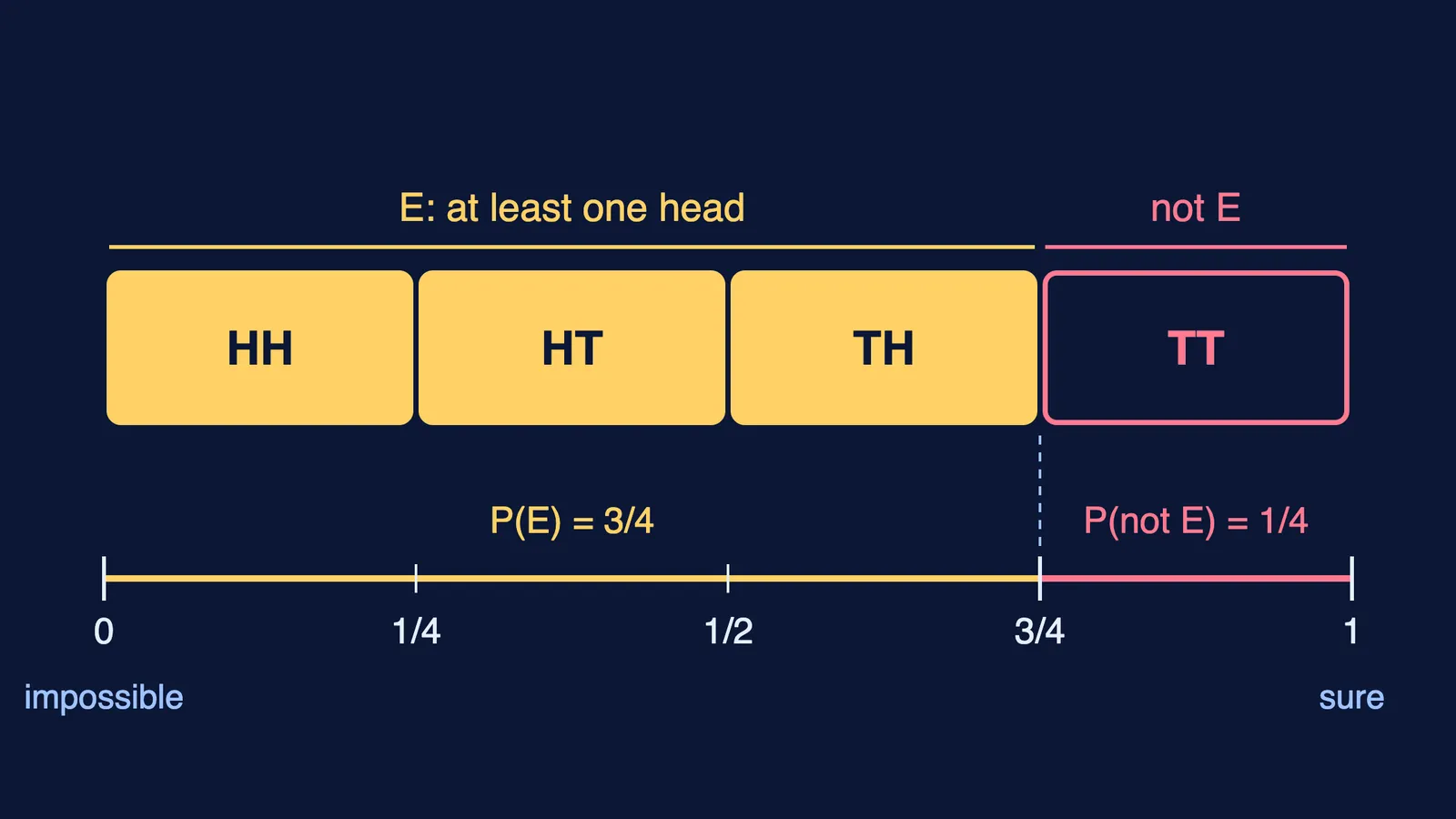
Sample space (S): the set of all possible outcomes. Example: tossing two coins gives S = {HH, HT, TH, TT}.
Sample point: a single element of S. Example: TH above. Don't confuse with: event; a sample point is an element, an event is a set, even {TH}.
What is an event in Class 11 probability?
Event: any subset E of the sample space S. Example: on a die, "a prime appears" is E = {2, 3, 5}.
Occurrence of an event: E occurs when the actual outcome ω is in E. Example: rolling a 3 means E has occurred.
Impossible event (φ): the empty set; no outcome gives it. Example: "a 7 appears" on one die.
Sure event (S): the whole sample space; every outcome gives it. Example: "a number from 1 to 6".
Simple (elementary) event: an event with exactly one sample point; n outcomes give n simple events. Example: {5}.
Compound event: an event with more than one sample point. Example: "at least one head" in two tosses is {HH, HT, TH}.
How do 'not', 'or' and 'and' become set operations?
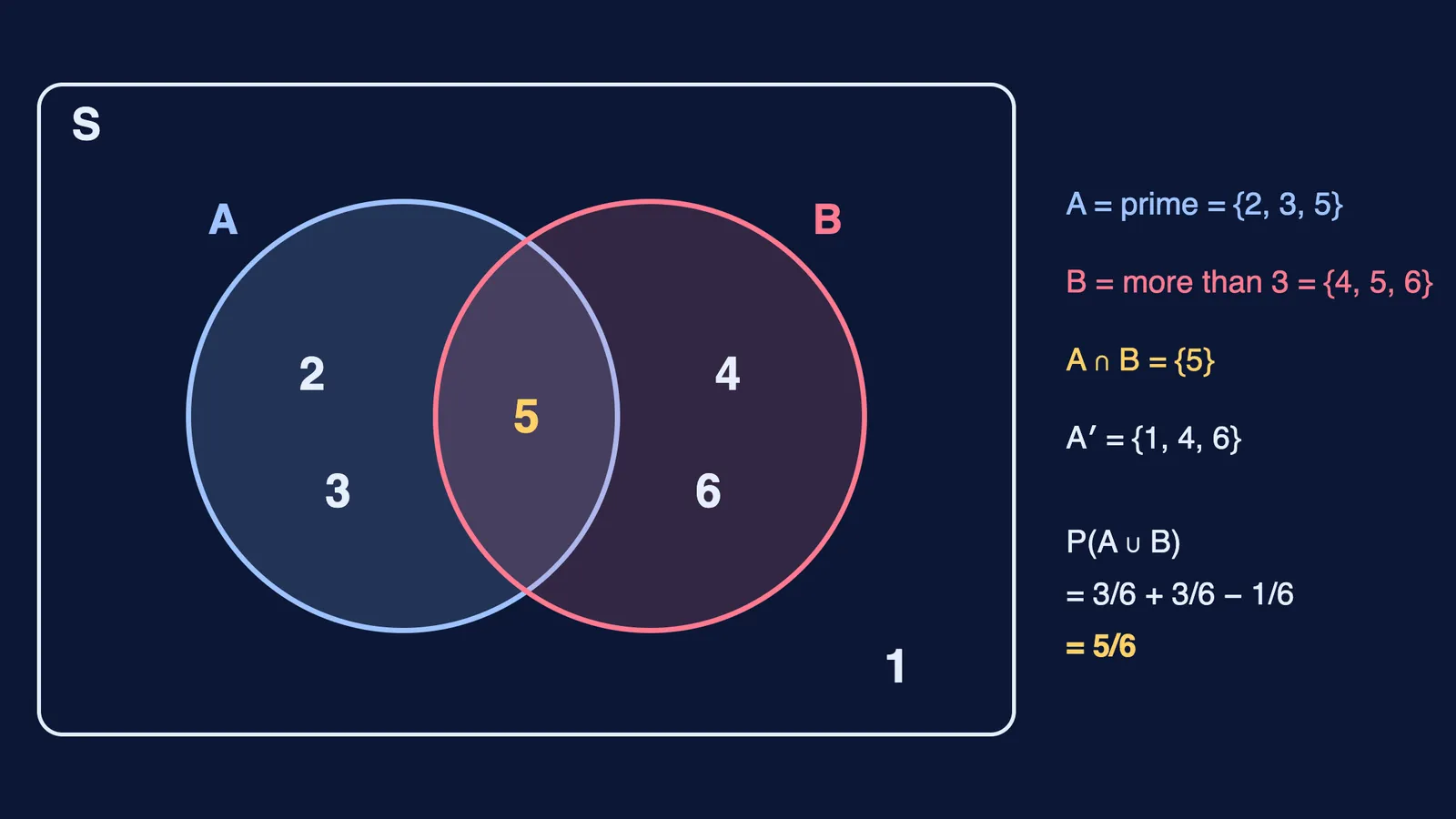
On one die, take A = "prime" = {2, 3, 5} and B = "more than 3" = {4, 5, 6}.
Complementary event A′ ('not A'): the outcomes of S that are not in A, so A′ = S − A. Example: A′ = {1, 4, 6}.
Event 'A or B' (A ∪ B): A, B or both happen. Example: A ∪ B = {2, 3, 4, 5, 6}.
Event 'A and B' (A ∩ B): both happen on the same trial. Example: A ∩ B = {5}.
Event 'A but not B' (A − B): A happens and B does not, and A − B = A ∩ B′. Example: A − B = {2, 3}. Don't confuse with: B − A = {4, 6}.
Mutually exclusive events: events that cannot happen together, so A ∩ B = φ. Example: "odd" {1, 3, 5} and "even" {2, 4, 6}.
Exhaustive events: events whose union is S, so at least one must happen. Example: "at most 4" {1, 2, 3, 4} and "at least 4" {4, 5, 6}. Don't confuse with: mutually exclusive; these two share the outcome 4.
Mutually exclusive and exhaustive events: events E1, E2, ..., En whose union is S and with Ei ∩ Ej = φ for i ≠ j. Example: "1 or 2", "3 or 4" and "5 or 6"; also any A with A′.
What does the axiomatic approach to probability say?
Probability (axiomatic): a rule P that assigns every event, that is every subset of S, a real number from 0 to 1, and that obeys three axioms.
The three axioms: P(E) ≥ 0 for every event E; P(S) = 1; and if E and F are mutually exclusive, P(E ∪ F) = P(E) + P(F).
Probability of an outcome P(ω): the number given to a sample point; each lies in [0, 1] and they add to 1. Example: P(H) = 0.3, P(T) = 0.7 is valid; 0.6 and 0.6 is not.
Probability of an event P(A): the sum of P(ω) over the outcomes in A. Example: a loaded die gives 0.25 to a six and 0.15 to each other face (total 1), so P(even) = 0.15 + 0.15 + 0.25 = 0.55.
Equally likely outcomes: outcomes with the same probability; with n of them, each gets 1/n.
P(E) = n(E)/n(S): for a finite sample space with equally likely outcomes; the counting method from earlier classes is this special case. Example: P(prime on a fair die) = 3/6 = 1/2. Don't confuse with: the loaded die above, where counting would wrongly give P(even) = 3/6.
Which rules follow from the axioms?
Impossible event rule: P(φ) = 0, from the third axiom with F = φ.
Complement rule: P(not A) = 1 − P(A), because A and A′ are mutually exclusive and exhaustive. Example: P(no six on a fair die) = 1 − 1/6 = 5/6.
Addition rule for any two events: P(A ∪ B) = P(A) + P(B) − P(A ∩ B); subtract the overlap so it is not counted twice. Example: with A and B above, 3/6 + 3/6 − 1/6 = 5/6.
Addition rule for mutually exclusive events: when A ∩ B = φ, P(A ∪ B) = P(A) + P(B). Don't confuse with: the general rule, needed whenever events overlap.
'A but not B' rule: P(A ∩ B′) = P(A) − P(A ∩ B). Example: P(prime but not more than 3) = 3/6 − 1/6 = 1/3, matching {2, 3}.
Addition rule for three events: P(A ∪ B ∪ C) = P(A) + P(B) + P(C) − P(A ∩ B) − P(A ∩ C) − P(B ∩ C) + P(A ∩ B ∩ C).
How to learn these terms
Pair each word with its set: 'not' with A′, 'or' with A ∪ B, 'and' with A ∩ B, 'but not' with A − B, and shade each on a Venn diagram.
Run the two-question test before adding probabilities.
Check any assignment against the axioms first: every value from 0 to 1, total exactly 1.
Before using n(E)/n(S), say why the outcomes are equally likely.
Check every 'or' answer by listing the union and counting it.
If a term still feels slippery, the Fermi Concept Library gives every mathematics concept its own lesson and its place in the map. Then test yourself with our Probability Class 11 case study questions.