On this page
Plant Growth and Development is Chapter 13 of the NCERT Class 11 Biology textbook (reprint 2026-27). The CBSE Biology syllabus for 2026-27 covers growth, its phases and rate, differentiation, development and five plant growth regulators. The terms below follow that order. For an overview, read our Plant Growth and Development Class 11 guide.
Not covered: photoperiodism, vernalisation and seed dormancy. NCERT's rationalised content list dropped these three sections from this chapter, and the 2026-27 CBSE syllabus line for it does not list them. ABA's role in dormancy stays in the PGR section.
What is growth in plants?
Growth: a permanent, irreversible increase in the size of a cell, an organ or part of one, usually powered by metabolism.
Seed germination: the first step of plant growth, when a seed resumes metabolism in favourable conditions.
Meristem: cells that keep dividing and renewing themselves. Example: root and shoot apical meristems.
Open form of growth: growth in which meristems keep adding new cells, so a plant can grow through its life.
Primary growth: lengthening of root and shoot along their axis, driven by apical meristems. Don't confuse with: secondary growth, the increase in girth from lateral meristems (vascular cambium and cork cambium) in dicots and gymnosperms.
Growth parameters: what we measure in place of protoplasm: fresh weight, dry weight, length, area, volume or cell number. NCERT notes that one maize root apical meristem can make more than 17,500 new cells per hour, while watermelon cells can grow up to 3,50,000 times in size.
Meristematic phase: the dividing cells at root and shoot tips, rich in protoplasm, with large nuclei and thin cellulose walls.
Elongation phase: the zone just behind the tip, where cells become more vacuolated, enlarge and deposit new cell wall.
Maturation phase: further back, where cells reach their maximum size, with fully thickened walls and modified protoplasm.
Conditions for growth: water (turgid cells extend), oxygen for energy, nutrients, a suitable temperature, plus light and gravity.
How is plant growth rate measured?
Growth rate: the increase in growth per unit time.
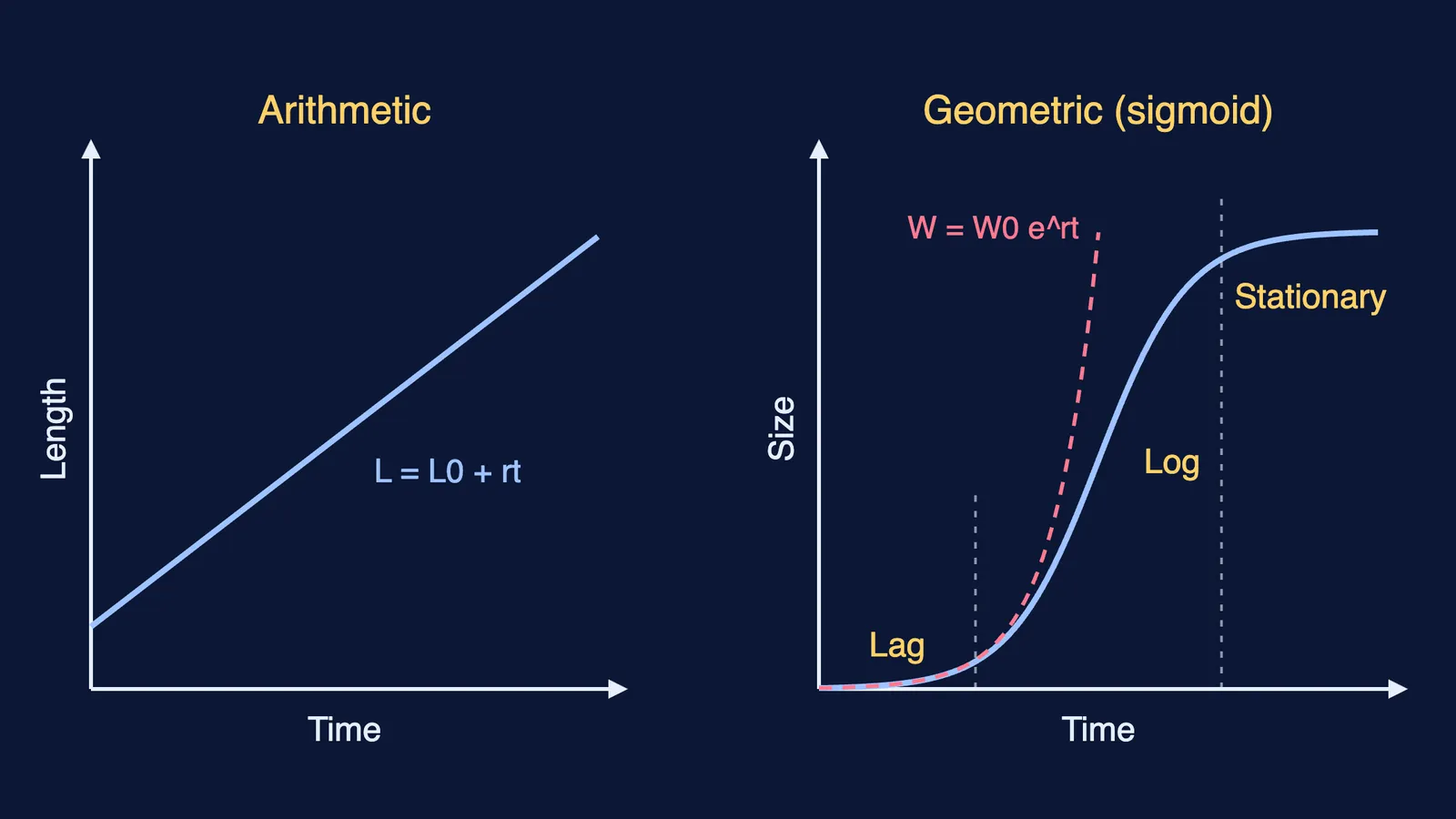
Arithmetic growth: after mitosis only one daughter cell keeps dividing; the other matures. Example: a root lengthening at a constant rate, giving a straight line, Lt = L0 + rt.
Geometric growth: after mitosis both daughter cells keep dividing. Don't confuse with: arithmetic growth, where only one does.
Sigmoid curve: the S-shaped graph of size against time, typical of plant cells, tissues and organs: a slow lag phase, a fast log phase, then a stationary phase as nutrients run short.
Relative growth rate (efficiency index): growth per unit time per unit of starting size; r in W1 = W0 e^rt.
Absolute growth rate: total growth per unit time. Example (NCERT Figure 13.7): two leaves of different sizes each gain 5 cm2: equal absolute rates, but the smaller leaf has the higher relative rate.
Differentiation, dedifferentiation and development
Differentiation: meristem-derived cells maturing for a specific job. Example: a tracheary element loses its protoplasm and builds a lignocellulosic secondary wall.
Dedifferentiation: a living, differentiated cell regaining the power to divide. Example: parenchyma forming interfascicular cambium and cork cambium.
Redifferentiation: cells produced by such meristems losing the power to divide again and maturing for a function. Example: secondary xylem, secondary phloem and cork in a woody dicot.
Open differentiation: cells from one meristem ending up different, depending on position. Example: root-cap cells vs epidermis.
Development: all the changes in a life cycle from seed germination to senescence; growth plus differentiation.
Senescence: the ageing stage that ends in death, the last step in a plant cell's development.
Plasticity: a plant's ability to form different structures in response to environment or life phase.
Heterophylly: different leaf shapes on one plant. Example: juvenile vs mature leaves in cotton, coriander and larkspur; air vs water leaves in buttercup.
What are plant growth regulators?
Plant growth regulators (PGRs): small, simple molecules of varied chemistry that control growth and development; also called plant hormones or phytohormones.
Growth promoters vs inhibitors: auxins, gibberellins and cytokinins promote growth; abscisic acid inhibits it; ethylene fits either but mostly inhibits.
Phototropism: growth towards light. As NCERT recounts, the Darwins saw canary grass coleoptiles bend towards one-sided light, and F.W. Went later isolated auxin from oat coleoptile tips.
Auxin: IAA and IBA occur in plants; NAA and 2,4-D are synthetic. Auxins start roots on stem cuttings, and 2,4-D kills dicot weeds without harming mature monocots.
Apical dominance: the growing shoot tip holding back lateral buds. Cutting the tip lets them branch, as in tea plantations and hedges.
Parthenocarpy: fruit forming without fertilisation, induced by auxins in tomato.
What do gibberellins, cytokinins, ethylene and ABA do?
Gibberellins (GAs): acidic PGRs; NCERT counts more than 100, with GA3 the most studied. First traced to bakanae (foolish seedling) disease of rice, caused by the fungus *Gibberella fujikuroi*.
Bolting: internode elongation just before flowering in rosette plants such as beet and cabbage, promoted by GAs.
Cytokinins: PGRs that promote cell division (cytokinesis), made where cells divide fast. They delay leaf senescence and help overcome apical dominance.
Kinetin: a cytokinin first found in autoclaved herring sperm DNA; it does not occur naturally in plants. Don't confuse with: zeatin, a natural cytokinin from corn kernels and coconut milk.
Ethylene: a gaseous PGR made by ripening fruits and ageing tissues; it ripens fruit and speeds abscission (shedding) of leaves and flowers.
Respiratory climacteric: the rise in respiration rate during fruit ripening (printed "respiratory climactic" in NCERT).
Abscisic acid (ABA): a growth inhibitor that closes stomata, blocks germination and brings on seed dormancy. Called the stress hormone as it raises stress tolerance. Don't confuse with: GAs, which ABA usually opposes.
How to learn these terms
Learn in pairs: arithmetic vs geometric, absolute vs relative rate, kinetin vs zeatin.
Sketch the sigmoid curve and label lag, log and stationary phases from memory.
Make a PGR grid on paper: discovery, chemical nature, two effects, one farm use.
Test yourself with our plant physiology practice questions.
If a term feels abstract, the Fermi Concept Library covers every concept in biology, each with its own lesson and its place in the map.