On this page
This guide covers Unit VI, Chapter 2 of CBSE Class 12 Biotechnology (045). The prescribed book is CBSE's A Text Book of Biotechnology for Class XII, but we found no official PDF of it on cbseacademic.nic.in, so this post follows the topic list in the 2026-27 Biotechnology curriculum and uses NCERT's Biotechnology XII Chapter 7, Plant Tissue Culture (the file on the NCERT site is marked Reprint 2025-26) as the reference.
Core Biology gives tissue culture a few paragraphs in NCERT Biology Chapter 10. The elective adds media, culture types, haploids, cybrids, metabolites and transgenic plant regulation. For core Biology, see our Biotechnology and its applications Class 12 board guide.
What does the 2026-27 curriculum include, and how many marks?
The curriculum lists five topics: introduction, cell and tissue culture techniques, their applications, transgenic plants with beneficial traits, and biosafety of transgenic plants.
Unit VI, Cell Culture and Genetic Manipulation, carries 30 marks out of the 70-mark theory paper. That figure is shared by three chapters (microbial, plant and animal cell culture); CBSE prints no separate figure for this chapter.
The 2026-27 sample paper tests it through 1-mark MCQ and assertion-reason items, a 2-mark answer and a 5-mark choice.
How does plant cell culture go from explant to plantlet?
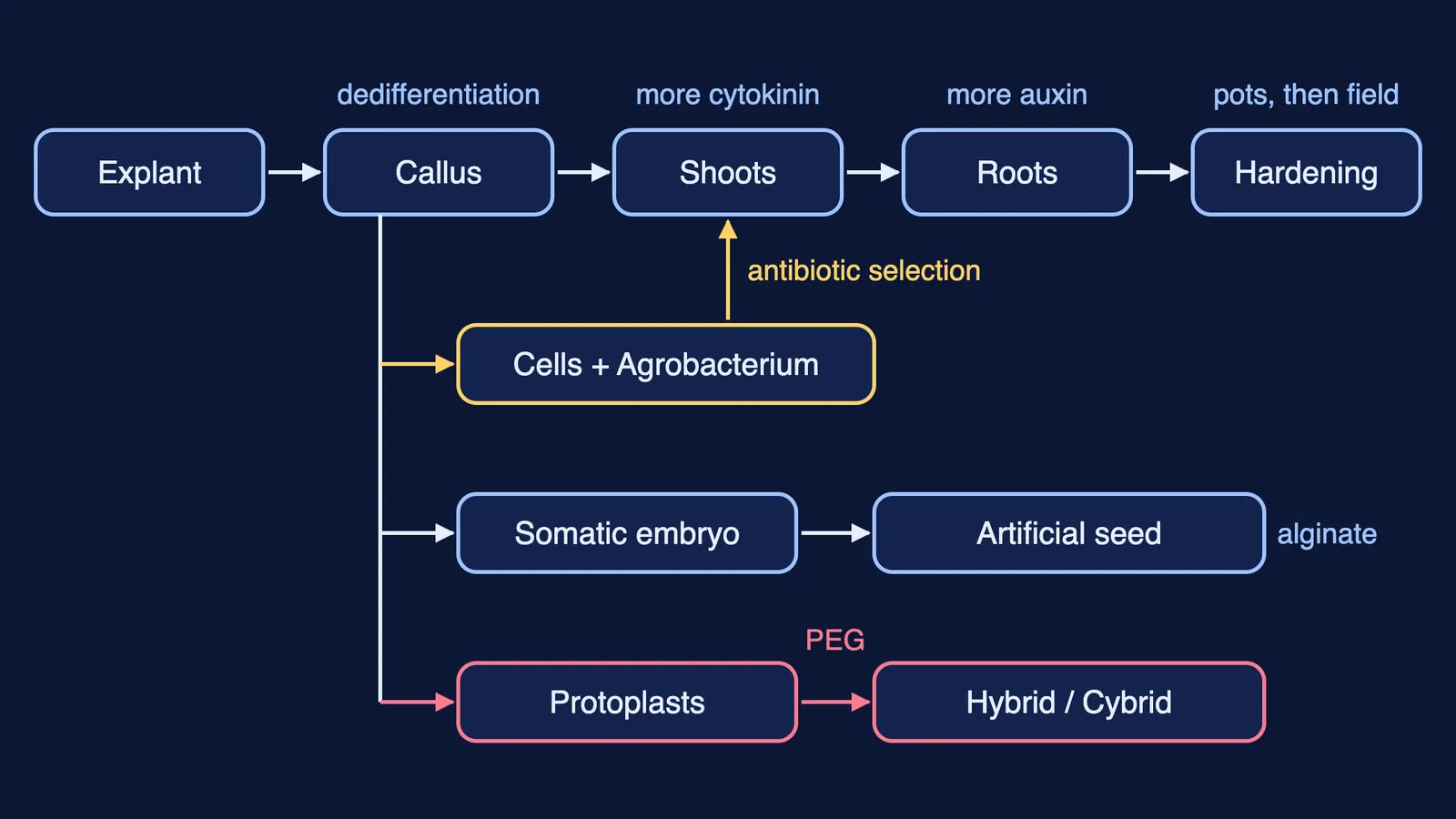
NCERT Chapter 7 builds on totipotency, the power of one plant cell to form a whole new plant. The sequence:
Sterilise the medium.
Pick an explant: shoot tip, leaf, cotyledon, hypocotyl or immature embryo.
Surface-sterilise it, usually with sodium hypochlorite.
Inoculate and grow under controlled light, temperature and humidity.
Shift to a shoot medium, then root the shoots.
Harden plantlets in pots before the field.
The medium has six parts: inorganic salts, organic supplements, a carbon source, hormones, a gelling agent such as agar, and antibiotics. NCERT gives sucrose at 2 to 5 per cent and pH about 5.8 to 6.0; lower pH sets the gel poorly. Murashige and Skoog's 1962 MS medium is the most used.
Culture types are organ, callus, cell suspension and protoplast. Regeneration runs through organogenesis (shoots or roots) or somatic embryogenesis (embryos from body cells).
Which applications of plant cell culture should you know?
Micropropagation: fast, season-free cloning. NCERT says India raises over 400 million banana plantlets a year this way.
Artificial seeds: somatic embryos coated in calcium alginate, used in carrot, grapes and sandalwood.
Haploids: grown from anther, pollen or ovary culture; colchicine doubles the chromosomes to give homozygous double haploids.
Somatic hybrids and cybrids: cellulases and pectinases strip the walls; PEG fuses the protoplasts. A cybrid pairs one parent's nucleus with the other parent's mitochondria or plastids.
Virus-free plants: a meristem tip under 1 mm, used for sugarcane, banana and potato.
Somaclonal variation: a problem for cloning, a source of new traits.
Secondary metabolites: shikonin, taxol and azadirachtin from cell or hairy root cultures.
How are transgenic plants made, and how is biosafety checked?
Transgenic plants depend on tissue culture. In NCERT Chapter 4, Agrobacterium tumefaciens carries a disarmed Ti plasmid whose T-DNA holds the useful gene. Infected cells grow on a medium with an antibiotic that kills untransformed cells, then form shoots and roots. Particle bombardment suits cereals; protoplasts take DNA with PEG or electroporation.
Its beneficial traits include insect resistance (Bt cotton, grown commercially in India since 2002), herbicide and stress tolerance, provitamin A in Golden Rice, PHB bioplastic in sugarcane and mercury detoxification.
Its biosafety concerns: possible allergens, invasiveness and unpredictable effects of random transgene insertion. In India, the Genetic Engineering Appraisal Committee (GEAC), set up by India's Ministry of Environment, Forest and Climate Change, oversees GMOs and rules on whether introducing one is safe.
Worked example: how do you mix a shoot medium?
Our own illustrative recipe, not an NCERT one: 500 mL of medium with 3 per cent sucrose, kinetin at 2.0 mg/L and an auxin at 0.2 mg/L. Stocks: kinetin 1 mg/mL, auxin 0.1 mg/mL.
Sucrose: 3 g per 100 mL × 5 = 15 g.
Kinetin: 2.0 mg/L × 0.5 L = 1.0 mg, so 1.0 mL of stock.
Auxin: 0.2 mg/L × 0.5 L = 0.1 mg, so 1.0 mL of stock.
Cytokinin to auxin ratio: 2.0 ÷ 0.2 = 10, so expect shoots.
Set pH near 5.8.
For rooting, make auxin the larger one.
Practice questions in the sample-paper format
(1 mark, MCQ) Callus forms but no shoots. Best change? (a) more cytokinin relative to auxin (b) no sucrose (c) pH 7.5 (d) add colchicine. *Answer: (a).*
(1 mark, assertion-reason) A: Double haploids are homozygous. R: Colchicine copies one chromosome set, so both copies of each gene match. *Answer: both true; R explains A.*
(3 marks) Compare a somatic hybrid and a cybrid: formation and genomes kept.
(5 marks) Trace a herbicide-tolerant transgenic plant from infected leaf disc to hardened plantlet; give two biosafety concerns and India's approving body.
Short on revision time this week? Fermi's AI tutor works out what you already know and builds a plan for the session. For the hormone experiments, read our plant tissue culture explainer.