On this page
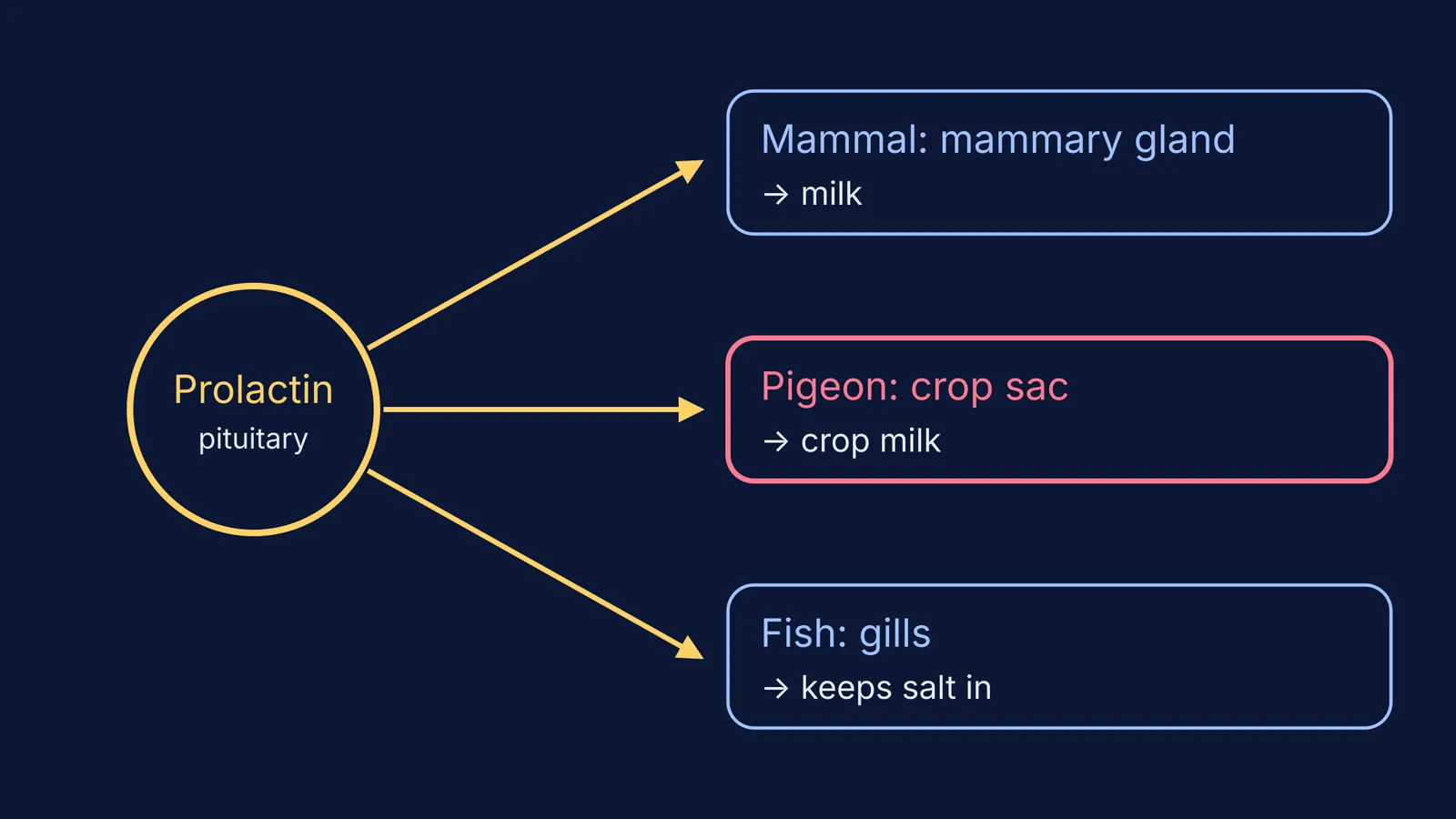
Pigeon chicks, called squabs, do not start life on grain. Their first meals come from both parents: a thick, fatty paste brought up from the crop, a pouch in the throat that normally just stores food. It is called crop milk, and the signal that switches it on is prolactin, the same pituitary hormone that drives milk production in mammals.
That makes the pigeon a neat lesson in how hormones work. The hormone carries the message. The tissue that receives it decides what the message means.
How do pigeons produce crop milk?
A 2011 study in BMC Genomics compared the crops of "lactating" and non-lactating pigeons and set out how the change happens (Gillespie et al., 2011):
Crop milk production starts about two days before the first egg hatches.
Cells in the base layer of the crop lining multiply, so the lining thickens and pushes deep folds into the tissue.
Cells near the surface fill with fat (triglycerides) and become keratinised, like the tough outer cells of skin.
These cells gather into small rice-shaped pellets, and the parent regurgitates this curd-like material to feed the squab.
So crop milk is not a liquid poured out by a gland. It is made of whole fat-filled cells, which is why the authors call it curd-like.
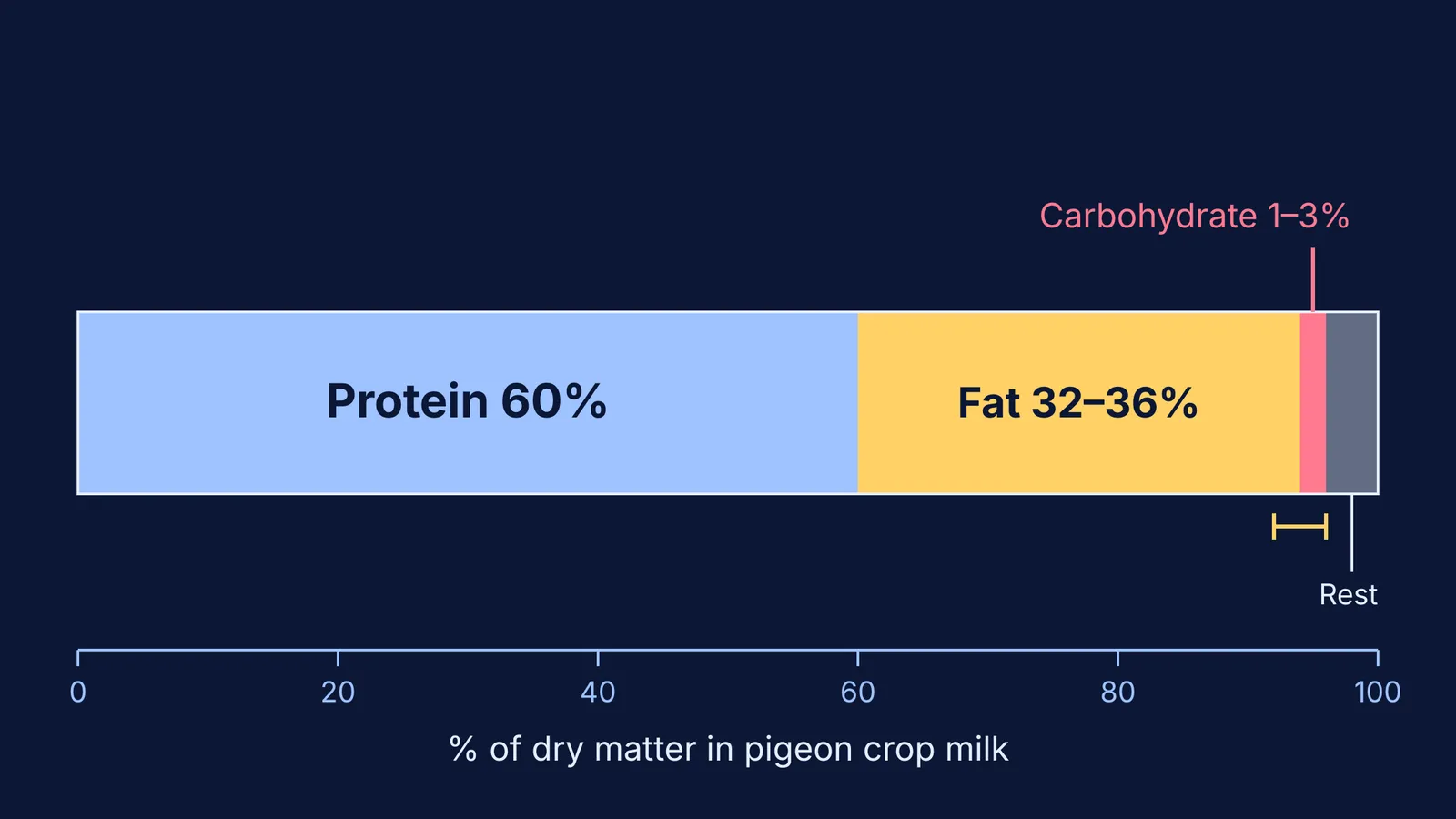
The dry matter of pigeon crop milk is about 60% protein, 32-36% fat and 1-3% carbohydrate, plus minerals such as calcium and IgA antibodies (Gillespie et al., 2011). When the team compared gene activity, 542 genes were switched up and 639 were switched down in the lactating crop. The authors also note that when this diet was copied artificially and fed to squabs, the chicks grew very poorly or died.
Why do both male and female pigeons make crop milk?
In mammals, milk normally comes from the mother. In pigeons, both male and female birds can produce crop milk (Gillespie et al., 2011). The same paper notes that flamingos and male emperor penguins make a similar substance.
A review in the Annual Review of Nutrition explains that prolactin drives the growth of the specialised cells in the pigeon crop sac (Horseman and Buntin, 1995). It adds that high prolactin also supports the parenting behaviour that goes with crop milk: eating more, staying at the nest and feeding by regurgitation.
How did pigeons help discover prolactin?
The pigeon crop is so responsive to prolactin that it helped identify the hormone itself. In June 1933, Oscar Riddle, Robert Bates and Simon Dykshorn published "The preparation, identification and assay of prolactin, a hormone of the anterior pituitary" in the American Journal of Physiology (CSHL repository record). Riddle's group was the first to isolate prolactin and was among the first to show that it induces crop milk in pigeons (Oscar Riddle, Wikipedia).
Does prolactin do the same job in every animal?
No, and this is the bigger idea. A major review in Physiological Reviews says prolactin was named for promoting lactation in mammals, but it is also made in the brain, the immune system and the uterus, and it helps control behaviour and the body's internal balance (Freeman et al., 2000).
In bony fish, prolactin is called the "freshwater-adapting hormone": it acts on the gills, kidney, gut and bladder to hold on to salts in fresh water (Breves, McCormick and Karlstrom, 2014). The name comes from a 1959 study on killifish cited there. The authors argue that controlling the movement of water and ions is the job prolactin has kept across vertebrates.
In humans, prolactin's best-known job is milk, and it also has knock-on effects on fertility, which we cover in how breastfeeding delays pregnancy through a hormone chain.
How can you remember one hormone with many jobs?
Use a five-part chain for any hormone: source, target tissue, response, what it does for the animal, and what else the same hormone does elsewhere. Here it is for prolactin:
Source: anterior pituitary.
Target in a pigeon: the crop lining. Response: cells multiply, fill with fat and form pellets of crop milk.
Target in a mammal: the mammary gland. Response: milk production.
Target in a freshwater fish: gills and kidney. Response: salts are kept in, water is let out.
Now test yourself without looking:
Why can a male pigeon feed its chick but a male mammal normally cannot?
Is crop milk a secretion or a mass of whole cells? What is the evidence?
Name one prolactin job that has nothing to do with feeding young.
If you get stuck on the chain itself, revise target tissues and receptors in our Class 11 notes on chemical coordination and integration, and the difference between hormones and local signals in endocrine, paracrine and autocrine signalling. The Fermi Concept Library gives every concept in biology its own lesson and its place in the map, so you can see how the pituitary hormones connect.
Next time you see pigeons on a balcony ledge with chicks, remember that both parents are feeding them with the help of a hormone you share.