On this page
You rub your tired eyes after an evening of revision, and the dark fills with swirls, grids and spots of colour. No light got in. So where did the colours come from?
What are the colours you see when you rub your eyes?
They are called phosphenes. A phosphene is a sensation of light produced without light entering the eye. The ones you get from rubbing are pressure phosphenes, and they are old news to science: Otto-Joachim Grüsser and Michael Hagner wrote a whole history paper on deformation phosphenes and the idea of light made inside the eye (Documenta Ophthalmologica, 1990).
The physiologist Johannes Müller described the effect clearly in his textbook, published in English in 1842. Pressing on the closed eye gives “a luminous circle”, he wrote, and “by more gentle pressure the appearance of colours may be produced, and one colour may be made to change to another” (Müller, Elements of Physiology, vol. 2, p. 1061).
How does pressing your eye make light without light?
Normally rods and cones in your retina absorb light and pass a signal on, through other retinal cells, to ganglion cells, whose fibres form the optic nerve. Rubbing squeezes the whole eyeball. In a study of three rhesus monkeys fitted with wireless pressure sensors, eye rubs raised the pressure inside the eye by about 80 to 150 mmHg above baseline for 3 to 4 seconds, with peaks reaching 310 mmHg (Turner, Girkin and Downs, Ophthalmology). In 11 people with glaucoma who had a pressure sensor implanted in the eye, rubbing the eyelid raised pressure by an average peak of 59.1 mmHg (van den Bosch et al., British Journal of Ophthalmology).
Grüsser and colleagues recorded single ganglion cells in anaesthetised cats and found that deforming the eyeball in total darkness “fairly consistently” activated on-centre ganglion cells and inhibited off-centre ones (Vision Research, 1989). Their explanation: the dent stretches the retina unevenly, and that stretch changes the activity of retinal cells that feed the ganglion cells. On-centre cells are the ones that normally say “light here”, so the message reaching your brain looks like light.
Why does the brain read pressure as light?
This is the law of specific nerve energies: the kind of sensation depends on which nerve is excited, not on what excited it. Müller put it plainly for the eye: “The light thus produced has no existence external to the optic nerve, it is merely a sensation excited in it” (Elements of Physiology, p. 1061). He even tested it: pressing his eye in the dark never helped him see nearby objects, and an onlooker could not “perceive in it the slightest trace of real light” (same source, p. 1062).
In modern terms, the optic nerve carries only electrical impulses, the same kind of signal whatever started it (see why a nerve impulse travels only one way). The brain cannot check the cause, so signals from the eye are experienced as sight. Your visual system fills in and invents in other ways too, as the blind spot card test and the green afterimage after staring at red show.
If the chain from receptor to nerve to brain feels shaky, the Fermi Concept Library gives every biology concept its own lesson and its place in the map.
Worked example: where will the spot appear?
You can predict a phosphene before you see it. Use light pressure only, for a second or two.
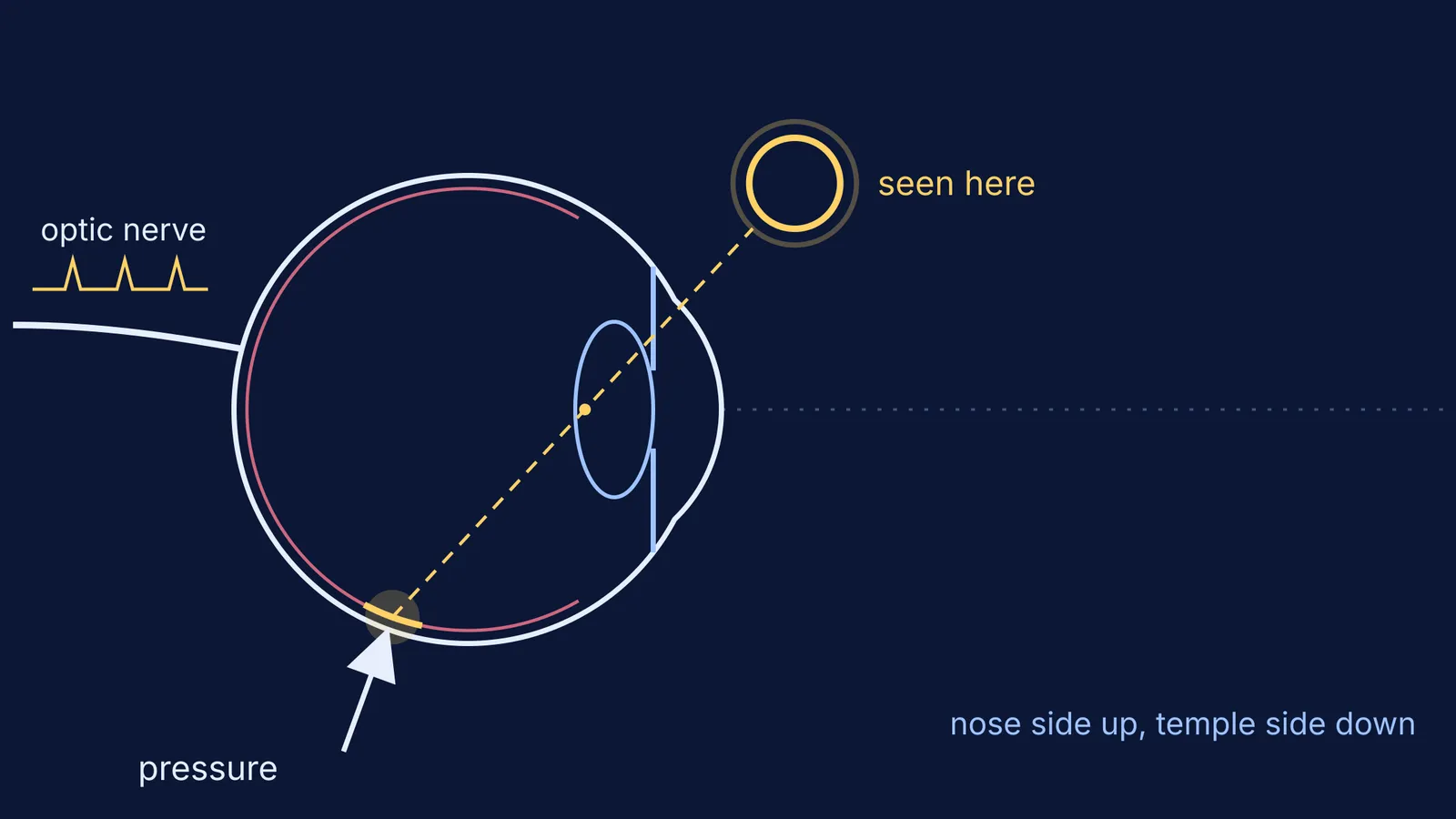
Close your right eye and press very gently through the lid at the outer corner, on the temple side.
You are pushing on the temple side of the eyeball, and the retina under it.
Light reaches that side of the retina only from the nose side of the world, because rays cross inside the eye.
Your brain assumes the signal came from light, so it places the spot where that light would have come from.
Prediction: a ring or patch on the nose side of your view, opposite your finger.
Then repeat Müller's check in a dark room: make a phosphene and try to see your hand by it. You cannot, because there is no light, only a signal.
Is it bad to rub your eyes?
Hard, frequent rubbing is worth avoiding. The American Academy of Ophthalmology's EyeWiki says eye rubbing and repeated trauma in genetically predisposed people result in keratoconus, a progressive thinning and steepening of the cornea, and that patients should be told not to rub their eyes (EyeWiki, Keratoconus).
That advice is from the National Eye Institute's page on retinal detachment. Phosphenes from a gentle press are different: a free demonstration that seeing happens in the brain.
To test yourself on the worked example, Fermi's AI tutor works out what you already know and checks your understanding as it goes.