On this page
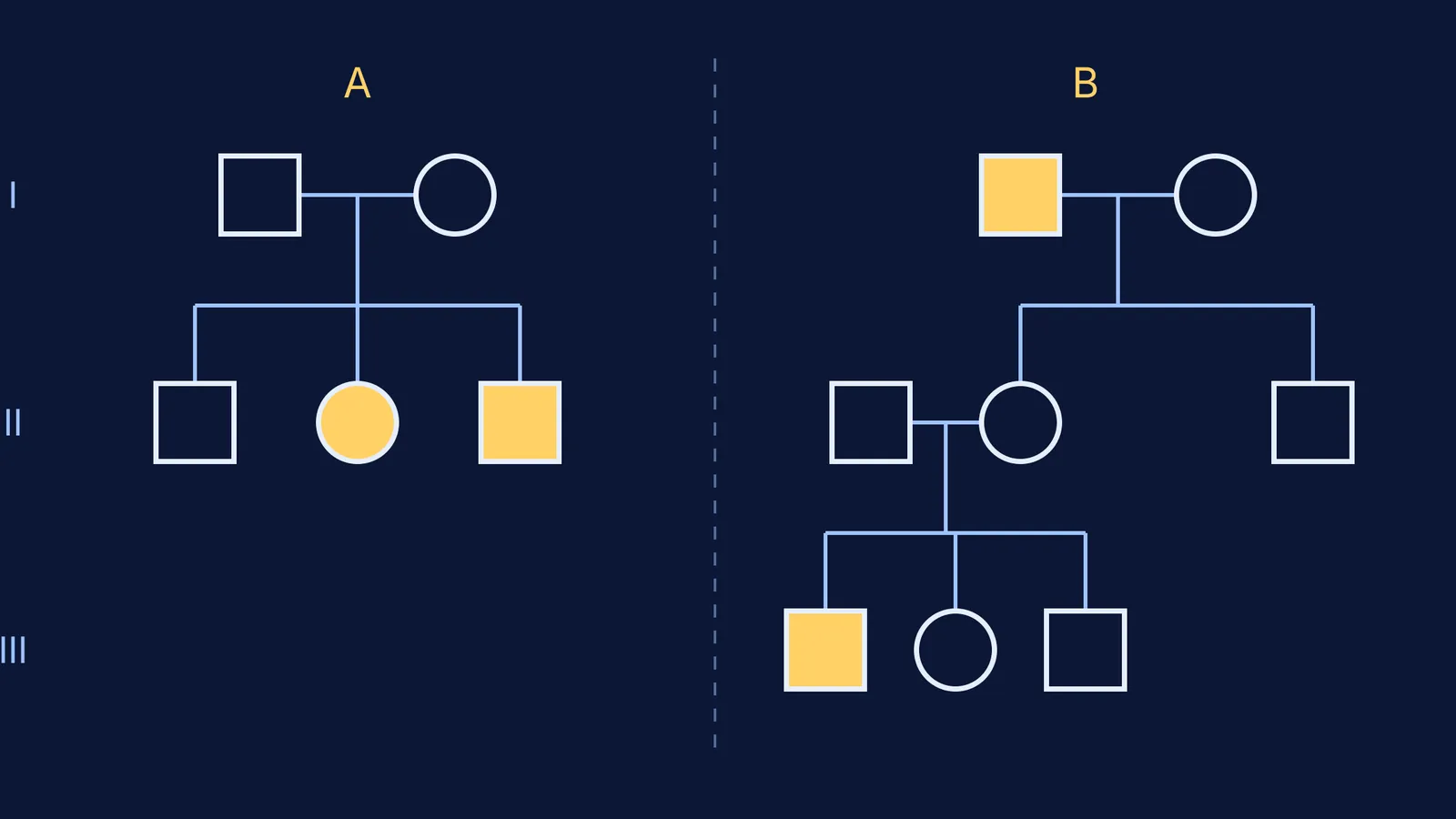
Many pedigree questions in Class 12 biology come down to one choice: is this recessive trait carried on the X chromosome or on an ordinary chromosome? Three questions, asked in order, settle most charts. Below we explain why they work, then apply them to the two pedigrees in the diagram above.
Why does the X chromosome change the pattern?
Females have two X chromosomes; males have one X and one Y. According to MedlinePlus Genetics from the US National Library of Medicine, in males one altered copy of an X-linked gene is enough to cause the condition, while in females the variant has to be in both copies. So males are affected much more often than females. The same page states that fathers cannot pass X-linked traits to their sons: a father gives his son a Y, not an X.
An autosomal recessive disorder is one where the gene sits on a numbered, non-sex chromosome and two altered copies, one from each parent, are needed to cause it (NHGRI Talking Glossary). The parents of an affected child usually each carry one altered copy and show no signs themselves (MedlinePlus Genetics). Sons and daughters both carry two copies of every autosome, so neither sex is favoured.
Red-green colour vision deficiency, an X-linked trait, occurs in about 1 in 12 men and 1 in 200 women among people of Northern European ancestry (MedlinePlus Genetics).
How do you tell X-linked recessive from autosomal recessive in a pedigree?
First confirm the trait is recessive at all; if you are unsure, use our guide on how to tell if a pedigree is dominant or recessive. Then ask:
Is there an affected daughter whose father is unaffected? If yes, X-linked recessive is ruled out. An affected girl needs the altered X from both parents, so her father would have to be affected too. Answer: autosomal recessive.
Are the affected people mostly males? If all or nearly all are male, and the trait reaches them through unaffected mothers, lean towards X-linked recessive. This is a hint, not proof: small families can be lopsided by chance.
Is there any male-to-male passing? Look for an affected son of an affected father. In X-linked inheritance a son's X comes from his mother, so she would also need to be a carrier. If she married into the family, that is unlikely, and examiners read it as strong evidence for autosomal.
Worked example 1: what does an affected daughter tell you?
Pedigree A (left in the diagram): two unaffected parents in generation I have three children, an unaffected son (II-1), an affected daughter (II-2) and an affected son (II-3).
Question 1: yes. II-2 is affected and her father, I-1, is not. X-linked recessive is out.
Question 2: one male and one female affected, so no male bias.
Question 3: no affected father, so nothing to test.
Verdict: autosomal recessive, and both parents must be carriers (Aa). The NHGRI glossary notes that when both parents are carriers, roughly a quarter of their children will have the disease. To work out the chance that the unaffected son is a carrier, see pedigree probability: the chance a child is affected or a carrier.
Worked example 2: what if the trait skips from grandfather to grandson?
Pedigree B (right in the diagram): in generation I, an affected man (I-1) and an unaffected woman (I-2) have an unaffected daughter (II-2) and an unaffected son (II-3). II-2 marries an unaffected man from outside the family (II-1). Their children are an affected son (III-1), an unaffected daughter (III-2) and an unaffected son (III-3).
Question 1: there are no affected daughters at all.
Question 2: both affected people are male, linked through an unaffected daughter.
Question 3: I-1's son, II-3, is unaffected. No male-to-male passing.
Verdict: X-linked recessive is the best fit. I-1 gave his only X to his daughter, which makes her a carrier (X^A X^a), and she passed the altered X to her son III-1. It could only be autosomal recessive if II-1, who married in, also happened to be a carrier, which is unlikely for a rare trait. For the crosses behind this, see how to solve X-linked crosses for colour blindness and haemophilia.
Which mistakes cost marks on these questions?
Calling a trait X-linked because a few males are affected, without first running question 1.
Treating an affected father and son as proof of autosomal inheritance when the mother is a known carrier.
Writing only the answer. Name the individuals that decide it, such as II-2 and her father I-1.
If you keep reaching the wrong verdict, the Fermi Problem Library has worked problems with a step-by-step solver that explains the reasoning rather than printing an answer. If the gap is the idea underneath, the Fermi Concept Library gives each concept in biology its own lesson.
Tonight, take three pedigree questions from your textbook, write the three questions in the margin of each, and answer them before you choose a pattern.