On this page
If you have watched a pigeon squab push its beak into a parent’s throat on a balcony ledge, you have seen milk feeding. The “milk” just comes from the crop, and both parents make it.
Do pigeons really feed their babies milk?
Yes, in a functional sense. A 2011 study in BMC Genomics by Meagan Gillespie and colleagues opens with the key fact: both male and female pigeons can produce a nutrient substance in their crop for their young. The paper notes that production begins about two days before the first egg hatches, and that the crop is normally a food-storage pouch between the oesophagus and the proventriculus.
Animal Diversity Web reports that rock pigeons average two eggs a season, which hatch about 19 days after laying, and both males and females incubate them. A 2023 review in Life reports that squabs aged 0 to 3 days receive crop milk only. After that, cereals are mixed in and the milk is gradually replaced by feed.
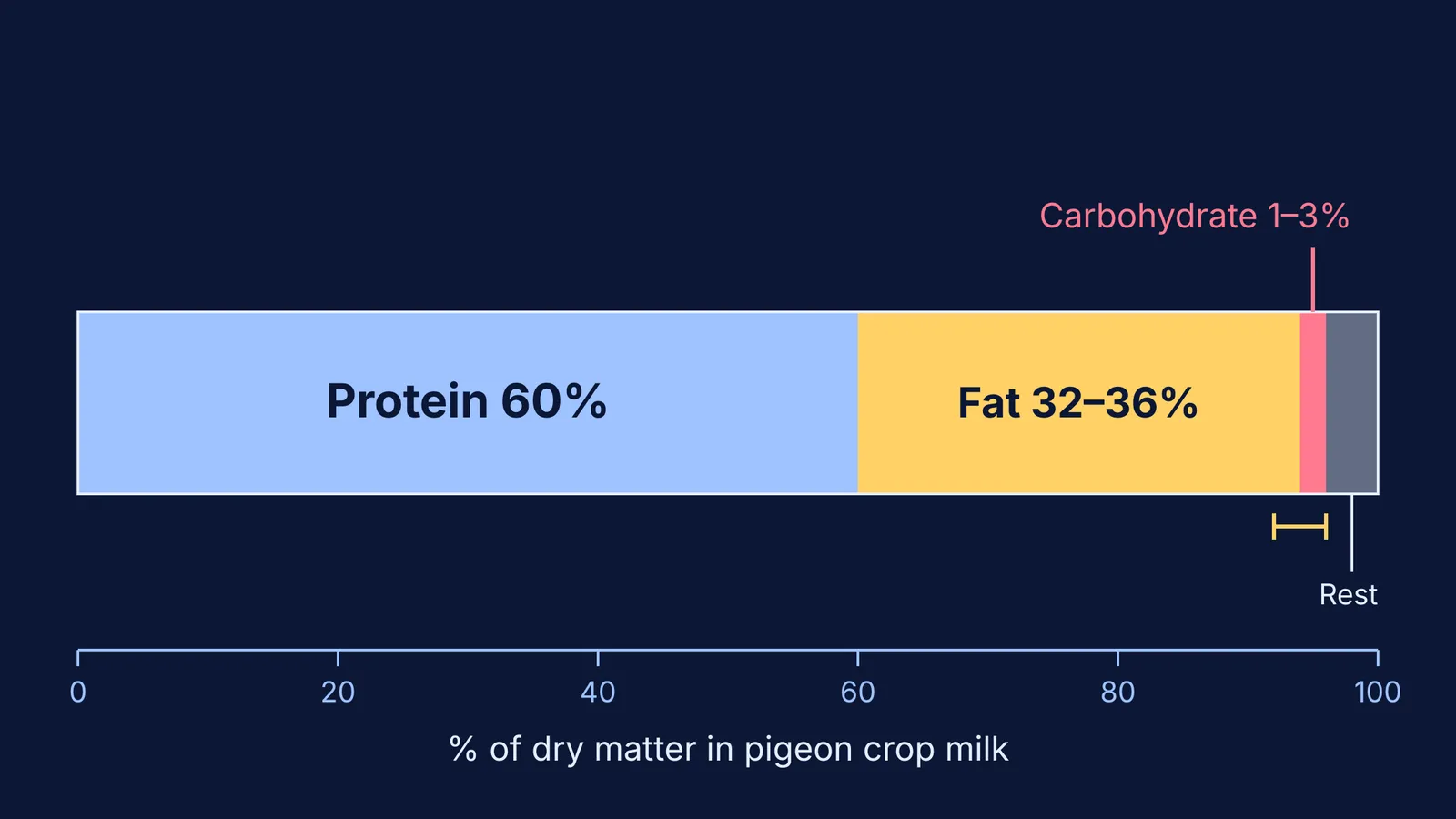
The milk is rich. In the Gillespie paper, the dry matter of pigeon milk is about 60% protein, 32-36% fat and only 1-3% carbohydrate.
How does prolactin make crop milk?
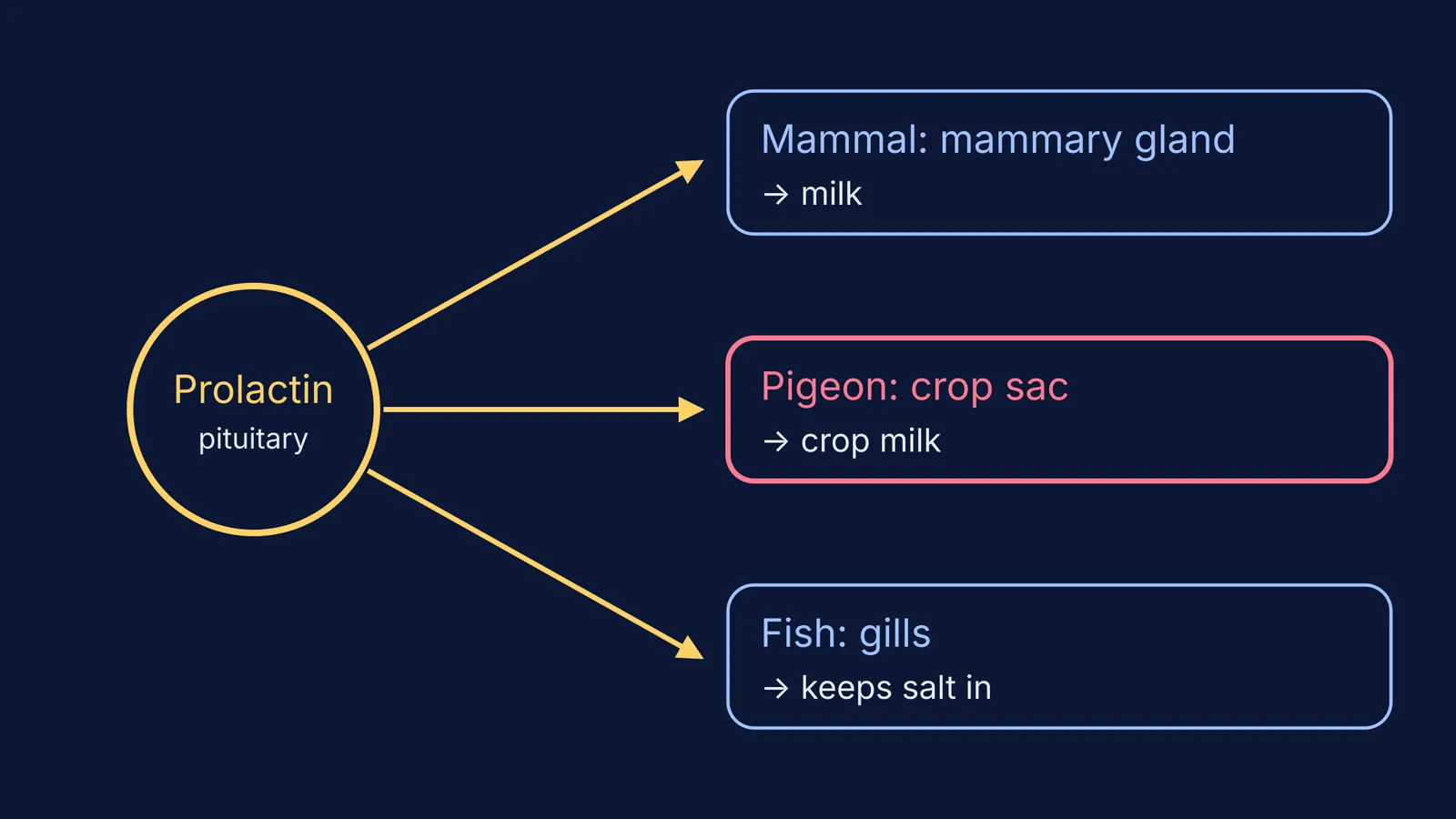
Prolactin is a hormone from the anterior pituitary, and Gillespie’s team describes the pigeon crop as responsive to the lactogenic (milk-making) hormone prolactin. You may know the name from human lactation, which our post on the hormones behind birth and lactation walks through.
The Life review describes the sequence: prolactin rises in adult pigeons in the latter half of incubation, and the crop sac develops right after. The cells of the crop lining multiply rapidly, so the lining thickens and folds. Those cells load up with fat and nutrients, then are shed into the crop. The loose cells are the milk.
A 1995 review in the Annual Review of Nutrition by Nelson Horseman and John Buntin adds the behaviour side: high prolactin in parent pigeons also supports eating more, attending the nest and feeding the squab by regurgitation. The 1933 paper on how to prepare, identify and assay prolactin was by Oscar Riddle, Robert Bates and Simon Dykshorn; late in 1913 Riddle had moved a large pigeon breeding colony to Cold Spring Harbor.
How is crop milk different from mammalian milk?
Where it is made. Mammals make milk in mammary glands. The pigeon crop, Gillespie’s team writes, is not glandular, and secretion does not seem to be involved.
How it is made. Mammary glands release milk as a secretion. In the crop, whole nutrient-filled cells are shed and fed to the squab: the same function, made by a different mechanism.
Who makes it. All female mammals produce milk from their mammary glands. In pigeons, father and mother both make crop milk.
What is in it. Crop milk is mostly protein and fat, with very little carbohydrate. The Life review notes that proteomic studies found no trace of casein in pigeon milk, which it calls a major component of mammalian milk.
What it shares. A 2012 PLOS ONE study on the functional similarities between pigeon milk and mammalian milk notes that pigeon milk contains IgA antibodies. In that study, chickens fed about 5 grams of pigeon milk a day for 7 days grew on average 12.5% heavier than controls.
Why doesn’t crop milk make pigeons mammals?
Classification uses a set of features, not one behaviour. Animal Diversity Web lists three features found only in mammals: three middle ear bones, hair, and milk from modified sweat glands called mammary glands. Pigeons have none of them. They have feathers and lay eggs. Crop milk is a different organ reaching a similar result; Horseman and Buntin describe milk feeding and parenting in pigeons and mammals as convergent evolution.
For the full list of features an examiner expects, see the characteristics of mammals, from hair to mammary glands. For where the crop sits in a bird’s gut, read our post on air sacs, the crop and the gizzard.
A three-step check for “is it a mammal?” questions
Use this when one surprising trait seems to decide the answer:
Find the organ, not the outcome. “Feeds milk” is an outcome. Ask which organ makes it: mammary gland or crop.
Run the full list. Check for hair, three middle ear bones and mammary glands. One unusual trait does not override the rest.
Name the pattern. Same job, different organ, separate origin: the trait arose independently, so it does not decide the class.
Worked example: “Pigeons feed their young milk, so they should be mammals. True or false?” False. Crop milk comes from shed cells of the crop lining in both sexes, not from mammary glands, and pigeons have feathers, lay eggs and lack hair.
If questions like this keep catching you, the Fermi Concept Library gives every concept in biology its own lesson and its place in the map, so you can see how prolactin, lactation and bird anatomy connect. For practice, the Fermi Problem Library has worked problems with a step-by-step solver that explains the reasoning rather than printing an answer.