

On this page
You can tell a mammal from a bird, reptile or fish with a short list of body features. The open textbook OpenStax Biology 2e sets them out clearly, and the egg-laying platypus shows why "gives birth to live young" is not on that list.
What are the main characteristics of mammals?
All five features below come from OpenStax Biology 2e, section 29.6:
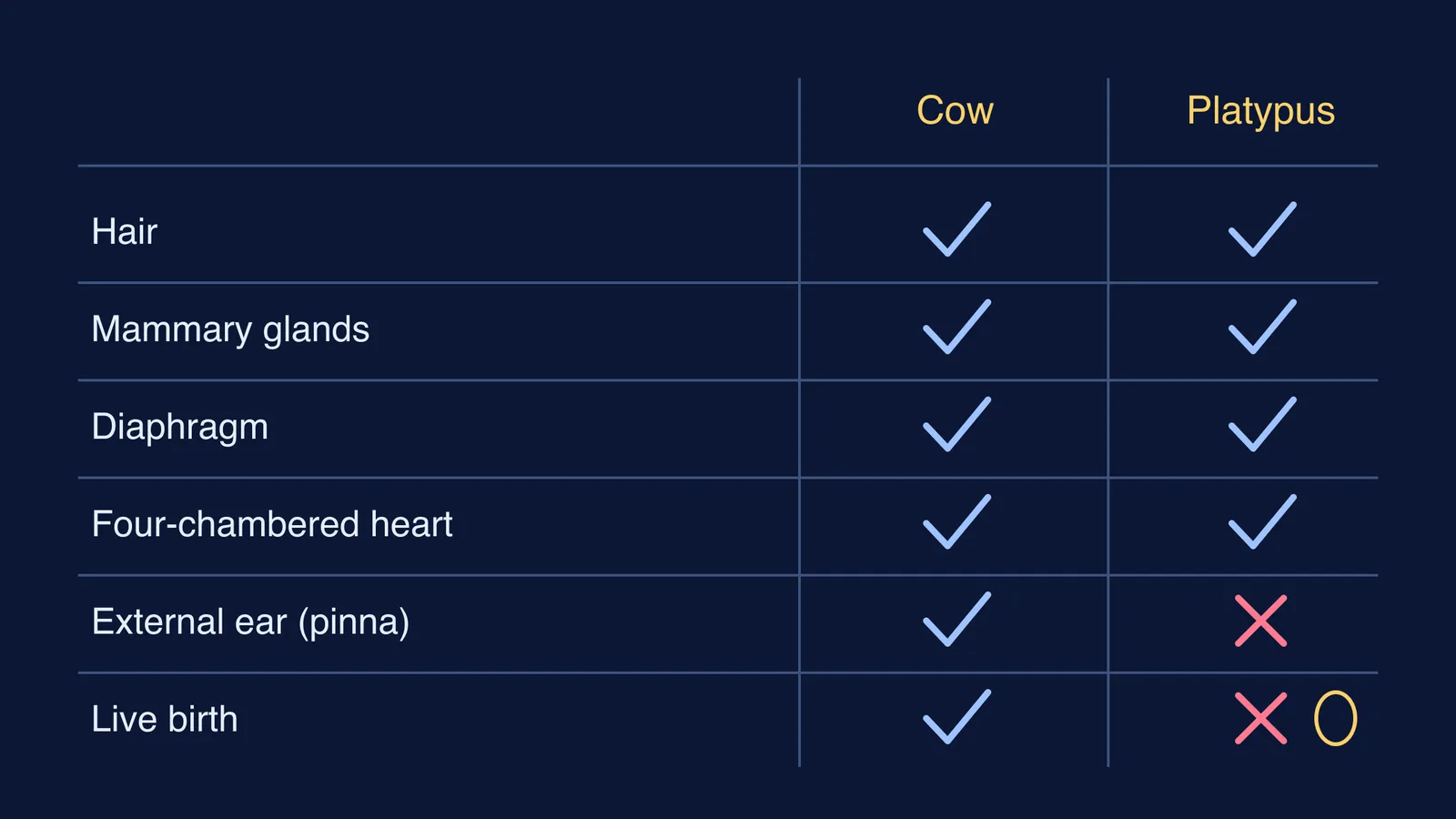
Hair. Hair is made of the protein keratin and is one of the most obvious characteristics of mammals. It traps a layer of air next to the skin, which holds in the heat a mammal makes as an endotherm.
Mammary glands. Mammary glands produce milk that is used to feed newborns.
External ears. Mammals have fleshy external ears, called pinnae, quite unlike the bare ear openings of birds.
Diaphragm. Mammals have a muscular diaphragm, which birds lack. If you want to see how this sheet of muscle moves air, read our guide to the diaphragm and intercostal muscles in breathing.
Four-chambered heart. Mammals have a four-chambered heart, as birds do.
Two more features often appear in textbooks. Mammals have three middle ear bones, the malleus, incus and stapes, and OpenStax notes that the quadrate and articular bones "have moved into the middle ear" in mammals. Most mammals also have teeth of different shapes (heterodont) and grow two sets in a lifetime (diphyodont), according to Biology LibreTexts/29%3A_Vertebrates/29.06%3A_Mammals/29.6A%3A_Characteristics_of_Mammals).
Which mammal features do other animals share?
This matters for statements like "only mammals have..." in a test. The features are not equally strong evidence.
Four-chambered heart: shared with birds. OpenStax calls this convergent evolution, because mammals and birds arose from different groups of ancestors. A four-chambered heart on its own does not prove an animal is a mammal.
Diaphragm: birds lack one, so it separates mammals from birds.
Pinnae: birds have only bare ear openings.
Hair and milk: the two features to lean on first.
Do all mammals give birth to live young?
No. The monotremes lay eggs. OpenStax lists the living monotremes as the platypus and four species of echidnas, and says they lay eggs rather than giving birth to live young. Their babies hatch in a fetal state and are fed milk from mammary glands that open directly onto the skin.
The Australian Museum adds detail for the platypus. A female lays 1 to 3 eggs, usually 2. When the young hatch, they suckle from two milk patches covered by fur on her abdomen, not from nipples.
Monotremes also break the external-ear rule. The Australian Museum describes the platypus's ear openings sitting in grooves behind the bill, with no visible ears. For the short-beaked echidna, a 2014 study by Saber and Hassanin in the Journal of Veterinary Anatomy reports that it "possesses neither an apparent ear pinna nor a tympanic bulla."
Hair is the other feature that can mislead you. OpenStax notes that hair is "not very extensive or obvious" on some species, such as whales. Sparse hair is still hair.
So the platypus keeps the two features that define a mammal, hair and milk, while lacking live birth and pinnae. That is why it is often called a connecting link; our post on Peripatus, lungfish and the platypus as connecting links explains the idea.
How do you check whether an animal is a mammal?
Use this five-question check, in this order:
Does it have hair, even a little? If yes, it is very likely a mammal.
Does the mother feed her young milk from mammary glands? If yes, it is a mammal.
Does it have a muscular diaphragm? Birds do not.
Does it have fleshy external ears? A "no" does not rule out a mammal: think platypus.
Does it have a four-chambered heart? A "yes" does not prove a mammal: think birds.
How does the check work on a sparrow and a platypus?
A sparrow has feathers, not hair. It has a four-chambered heart, so question 5 says yes, but it has no diaphragm and no pinnae (OpenStax). Verdict: not a mammal. The heart was the trap.
A platypus has fur and feeds its young milk (Australian Museum), so questions 1 and 2 already say mammal. It fails question 4 and lays eggs. Verdict: a mammal, from the egg-laying group, the monotremes.
Try the same check on a bat, which flies like a bird; our post on why a bat is a mammal, not a bird walks through the clues.
If a word here, such as endotherm or convergent evolution, feels shaky, the Fermi Concept Library has every concept in biology with its own lesson and its place in the map, so you can see where mammals sit beside birds and reptiles.
Next time you see "all mammals give birth to live young" in a question, you will know to answer with the platypus.


