On this page
Peripatus, the lungfish and the platypus turn up on nearly every biology list of connecting links. Each one carries features of two groups that look very different today. Knowing which feature belongs to which group, and what scientists now think these animals show, gives you a complete answer and a clearer picture of evolution.
What is a connecting link in biology?
A connecting link is a living organism that shows features of two different groups, which suggests those groups share a common ancestor. A fossil with mixed features is usually called a transitional fossil or missing link instead; we cover the most famous one in Archaeopteryx: the connecting link between reptiles and birds.
Carry one idea into every answer: a connecting link is not an ancestor sitting halfway between two groups. It is a modern animal that kept a mix of features, and it has been evolving for just as long as the groups it links. That is the branching picture of life, explained in what branching descent means in Darwin's theory.
Why is Peripatus a connecting link between annelids and arthropods?
Peripatus is a velvet worm, from the phylum Onychophora. A 1997 study in Nature by Anna Marie Aguinaldo and colleagues listed its mixed features in the abstract (Aguinaldo et al., 1997):
Like arthropods, onychophorans moult periodically and have an arthropod arrangement of the haemocoel, the blood-filled body cavity.
Like annelids, they have segmental nephridia (excretory tubes repeated along the body) and muscles that combine smooth and obliquely striated fibres.
Velvet worms found in Australia, relatives of Peripatus, have between 14 and 16 pairs of stumpy, lobe-like legs and breathe through little holes called tracheae scattered over the body, according to the Australian Museum. The same page says velvet worms have lived on land, largely unchanged in structure, for about 500 million years.
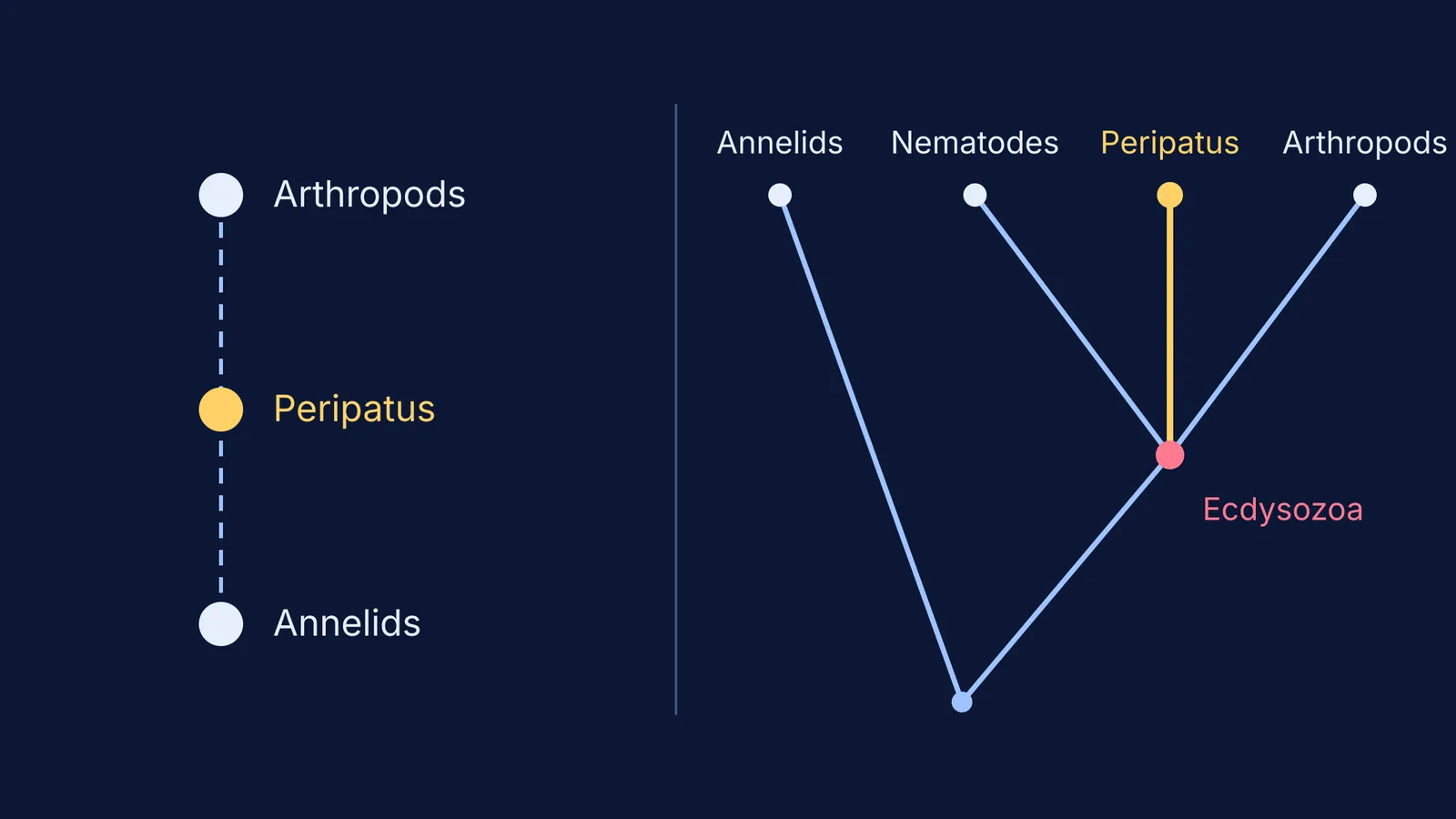
Now the twist. The 1997 study compared 18S ribosomal DNA sequences and found no support for a group uniting annelids with arthropods. Instead it placed onychophorans with arthropods, nematodes and other moulting animals in a new clade, Ecdysozoa (Aguinaldo et al., 1997). The Australian Museum puts it plainly: onychophorans are much more closely related to arthropods than to annelids.
Its annelid-like features show that similar body parts can appear in groups that are not close cousins. A shared feature is a clue to kinship, not proof of it.
Why are the lungfish and the platypus connecting links?
The lungfish links fish with tetrapods, the four-limbed land vertebrates. A 2021 Nature study of the Australian lungfish genome confirmed that lungfish are the closest living relatives of tetrapods (Meyer et al., 2021). It found limb-like activity of developmental genes such as hoxc13 and sall1 in the lobed fins, and duplicated or fast-evolving genes tied to obligate air-breathing, such as lung surfactants. The same study reports that the Australian lungfish genome is about 14 times larger than the human genome; it is known to be the largest genome of any animal.
The platypus links reptiles and mammals. The 2008 platypus genome paper describes "a fascinating combination of reptilian and mammalian characters": females lactate yet lay eggs, the body has a coat of fur, and males carry venom similar to that of reptiles (Warren et al., 2008). The genome showed that milk protein genes are conserved despite egg laying, and that platypus and reptile venom proteins were co-opted independently from the same gene families.
That repeats the Peripatus lesson: the venom looks reptilian but evolved separately, so a mixed feature is not always an inherited one.
How do you answer a connecting link question in an exam?
Use this four-step frame for any connecting link, from a one-mark MCQ to a five-mark long answer:
Name the organism and the two groups it links.
Give two features it shares with the first group.
Give two features it shares with the second group.
Say what it suggests: the two groups share common ancestry. Add the modern caution if the marks allow.
Worked example, three marks: "Why is Peripatus called a connecting link?"
"Peripatus links annelids and arthropods. Like annelids, it has segmental nephridia and a mix of smooth and obliquely striated muscles. Like arthropods, it moults periodically and has an arthropod-like arrangement of the haemocoel. This suggests the groups share common ancestry, though DNA studies now place it much closer to arthropods."
Now try the frame for the lungfish and the platypus. To turn these into quick revision, the blank-table method for NEET biology examples works well: write the organism, leave the feature columns empty, and fill them from memory.
If terms like haemocoel or nephridia are the real gap, the Fermi Concept Library covers every concept in biology, each with its own lesson and its place in the map, so you can see how ideas like moulting and segmentation connect.
Pick one connecting link tonight, run it through the four steps, and say the answer out loud without notes.