

On this page
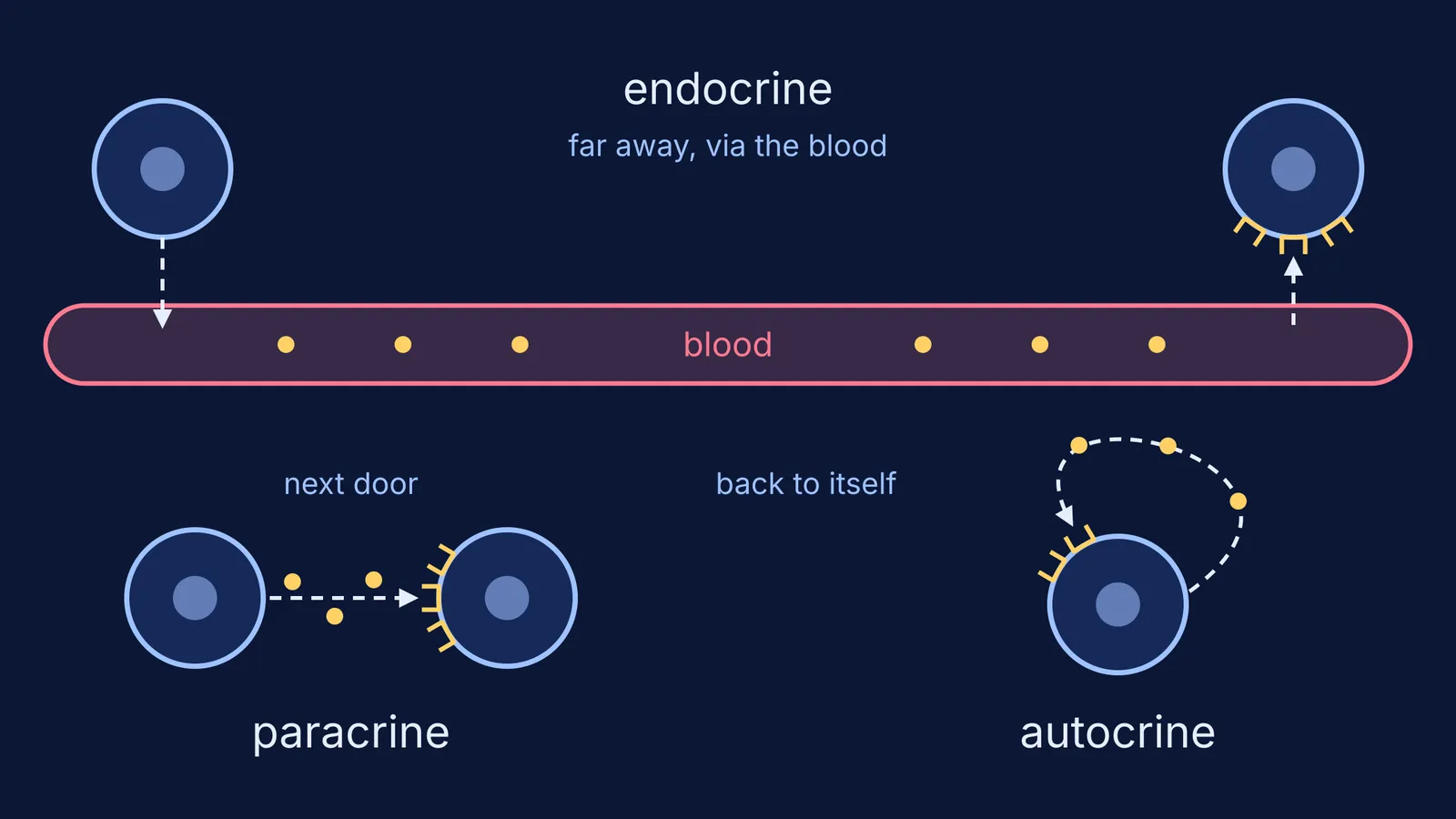
Cells talk with chemicals. A cell releases a signal molecule, and any cell with the right receptor can respond. Endocrine, paracrine and autocrine are not three kinds of molecule. They are three answers to one question: how far away is the cell that responds?
The diagram at the top shows all three: a signal sent through the blood to a far-away target, a signal to a neighbour, and a signal back to the sender. The yellow cups are receptors; a cell responds only if it has them.
What is the difference between endocrine, paracrine and autocrine signalling?
These definitions come from the open textbook OpenStax Biology 2e, section 9.1.
Endocrine: signals from distant cells, which travel from endocrine cells to their target cells through the bloodstream.
Paracrine: signals that act locally between cells that are close together.
Autocrine: signals made by a cell that can also bind the signal it has released.
The same OpenStax section notes that endocrine signals usually produce a slower response but a longer-lasting effect, and that hormones are diluted and present in low concentrations by the time they reach their targets. Paracrine signals, by contrast, usually produce quick responses that last only a short time. OpenStax gives the synapse as an example: neurotransmitters cross a gap of only 20 to 40 nanometres between nerve cells.
What is an example of endocrine signalling?
Insulin is the classic case. A 2015 review in Molecular Aspects of Medicine puts it in one sentence: when blood glucose rises, insulin is secreted from pancreatic beta cells to stimulate glucose clearance in muscle and adipose tissue and to suppress glucose production by the liver.
Trace the route on the diagram. The beta cell sits in the pancreas. Its targets are in your thigh muscles, belly fat and liver. The only way to reach all of them is the blood. That is what makes it endocrine. What happens when insulin arrives depends on the receptor, which is covered in our post on how hormones act through membrane and intracellular receptors.
What is an example of paracrine signalling?
Stay in the pancreas. The insulin-making beta cells sit in small clusters called islets, alongside other cell types. One of them, the delta cell, makes somatostatin. A 2018 review in Nature Reviews Endocrinology by Rorsman and Huising reports that delta cells make up about 5% of islet cells. It describes somatostatin acting locally within the islet to inhibit the release of insulin and glucagon.
Insulin leaves the islet and travels the body; somatostatin works on neighbours in the same islet. Same organ, different range.
The synapse is the other textbook paracrine example. If the difference between a nerve signal and a hormone still feels blurry, read neurotransmitter vs hormone: the difference explained.
What is an example of autocrine signalling?
Interleukin-2 (IL-2) is a signal made by T cells, a type of white blood cell. In a 1984 study in PNAS, Meuer and colleagues triggered the antigen receptor on human T-cell clones. This raised the number of IL-2 receptors on the cell surface about 6-fold. When the receptor was fully triggered, the cells also made and released their own IL-2 and then multiplied. When the researchers blocked either IL-2 or its receptor with antibodies, the multiplying stopped. The authors concluded that the T cells were stimulating themselves through an autocrine pathway: they made IL-2, released it and picked it up with their own receptors.
OpenStax adds that autocrine signalling helps regulate pain and inflammation, and that a cell infected by a virus can signal itself to undergo programmed cell death.
How do you tell which type a question is describing?
Ignore the molecule's name and find the receiving cell. Ask these three questions in order:
Does the signal enter the blood to reach its target? If yes, it is endocrine.
Does it act on a different cell close by, without using the blood? If yes, it is paracrine.
Does it act on the same cell that released it? If yes, it is autocrine.
Worked examples, using only the cases above:
"Beta cells release insulin, and liver cells reduce glucose output." The liver is a separate organ, reached through the blood: endocrine.
"Delta cells release somatostatin, and nearby beta cells release less insulin." Different cell, same islet: paracrine.
"A T cell makes IL-2 and divides in response to it." Same cell: autocrine.
"A neurotransmitter crosses the narrow synaptic gap to the next neuron." Different cell, very close: paracrine (some books call this synaptic signalling).
If a statement does not tell you where the receiving cell is, that is often the trap. Look for words like "bloodstream", "neighbouring" or "itself". For quick revision of the related terms, see our Class 11 chemical coordination key terms.
If terms like receptor, ligand or target cell are what keep slowing you down, the Fermi Concept Library has a lesson for each biology concept, showing where it sits in the map, so you can fill that gap before going back to practice questions.


