On this page
Chapter 1 of Khel Praveen, the NCERT Physical Education and Well-being textbook for Grade 9 (First Edition, April 2026) covers what physical education means, what it aims to do, and what physical literacy is. We explain the Unit 1 PDF in our own words.
How many marks does Chapter 1 carry in Class 9?
The CBSE 2026-27 curriculum for Physical Education and Well-being, Grade 9 sets 100 marks: 20 theory and 80 practical. Every unit carries 2 theory marks (MCQ, objective or short answer), giving 16 across eight units, plus a 4-mark viva.
Chapter 1 has no mark figure of its own. The curriculum's Unit 1, Development of Physical Culture in India, groups its topics with history, physical literacy and careers, and they share the unit's 2 marks.
Your school assesses this subject through tests, projects, a sports file and skill demonstrations; it is not a board exam. The book has six units and the curriculum eight, and their names differ: the book calls its Unit 1 "Evolution of Physical Education and Well-being". Ask your teacher which chapters fall under each tested unit.
What is physical education, according to the book?
Physical education is not just the games period. The book treats it as learning through the body, training body and mind together: a sprint builds speed, a held yoga posture builds balance, a team game builds strategy.
Know who gave which definition:
Sri Aurobindo: perfection of the body as the aim of physical culture.
Central Advisory Board of Physical Education and Recreation (India, 1959): education through physical activity that develops the whole personality, physically, mentally and spiritually.
J.P. Thomas (1963): a similar whole-personality idea.
UNESCO's International Charter of Physical Education and Sport (1978): physical education as a fundamental right and a part of lifelong learning.
Charles A. Bucher (1979): part of education, aiming at physically, mentally, emotionally and socially fit citizens.
NCF-SE 2023: movement, games, yoga and sports that build perseverance and teamwork.
Why "and Well-being"? NCF-SE 2023 chose the name because the subject also supports happiness, confidence and emotional balance. The book adds that NEP 2020 makes it a compulsory, core subject.
What are the aims and objectives of physical education?
Think of the aim as the big direction and the objectives as the areas where you grow.
The aim goes beyond fitness: playing together builds honesty, patience, fairness, humility in victory and courage in defeat. The end point is an emotionally balanced, socially responsible person ready to contribute to the nation.
The chapter names five objectives. Our example of each, from an inter-house kho-kho match:
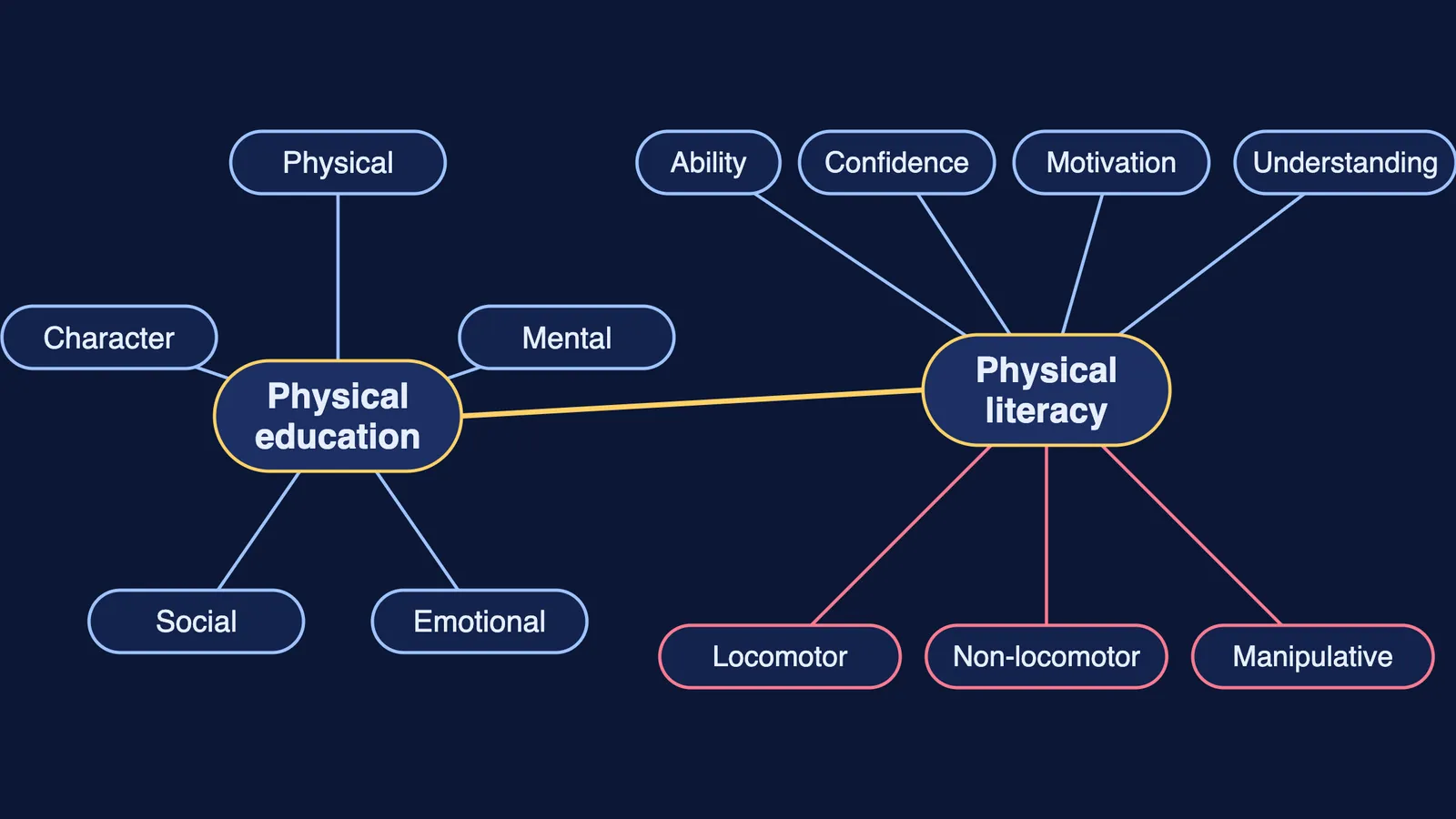
Physical development: chasing and dodging build speed.
Mental development: planning who chases first sharpens decision-making.
Emotional development: staying calm after an early loss.
Social development: working with teammates you rarely sit with.
Character formation: owning a foul honestly even when the umpire missed it.
The chapter's Read and Reflect case study, about a Grade 9 student who swaps mobile games for a team sport, is good practice for matching changes to objectives.
What is physical literacy and what are its parts?
Physical literacy is the ability, confidence and motivation to take part in physical activity throughout life (NCERT Khel Praveen, Chapter 1). The book compares it to reading and writing, which give you language literacy.
It has four parts: physical ability (running, throwing, balancing, jumping), confidence in your own movement, motivation to stay active, and understanding why activity matters for health. Listed benefits include fitness, self-esteem, help against lifestyle diseases, teamwork and better focus. This is a study summary, not medical advice.
Movement skills, the building blocks, fall into three groups:
Locomotor: moving from place to place, such as walking, hopping, leaping and skipping. Kabaddi and Kho-Kho rely on them.
Non-locomotor: moving without travelling, such as bending, twisting, swaying and balancing. Yoga postures like Tadasana and Vrikshasana use them.
Manipulative: controlling an object with hands or feet, such as throwing, kicking, striking and dribbling. Gilli-Danda, cricket, football and volleyball depend on them.
Practice questions for Chapter 1
Our own questions; mark labels are our suggestion.
(1 mark) Which is a non-locomotor skill: hopping, swaying, dribbling or skipping?
(1 mark) Which Indian body defined physical education in 1959?
(2 marks) Classify each as locomotor, non-locomotor or manipulative: a volleyball serve, a long-jump run-up, holding a balance on one leg, a hockey dribble.
(2 marks) The book compares physical literacy with language literacy. Explain the comparison in two sentences, using one movement example.
(2 marks) Give one example each of how a team game builds social development and character formation.
Answer hints: 1. swaying. 2. Central Advisory Board of Physical Education and Recreation. 3. manipulative, locomotor, non-locomotor, manipulative. 4. reading and writing build language literacy; learning to move confidently (say, throwing and catching) builds physical literacy.
Not sure where to start revising? Fermi's AI tutor works out what you already know and builds a plan for the session.
Going further, see physical fitness, wellness and lifestyle in Class 11, careers in physical education for Class 11 and Olympism and Olympic values in Class 11.