On this page
Photosynthesis in Higher Plants is Chapter 11 of the NCERT Class 11 Biology textbook (reprint 2026-27). The CBSE Biology syllabus for 2026-27 includes this chapter. Its key terms follow the chapter's order, in our own words. For steps and a revision plan, see our Photosynthesis in Higher Plants Class 11 chapter guide.
Where does photosynthesis happen, and which pigments help?
Photosynthesis: the process in which green plants use light energy to build sugars from CO2 and water, releasing oxygen. Example: a variegated leaf makes starch only in its green, lit parts.
Autotroph: an organism that makes its own food. Don't confuse with: heterotrophs, such as animals.
Chloroplast: the organelle where photosynthesis happens, packed into leaf mesophyll cells.
Grana and stroma lamellae: the chloroplast's membranes, which trap light and make ATP and NADPH. Don't confuse with: the stroma, the fluid matrix where enzymes make sugar.
Accessory pigments: chlorophyll b, xanthophylls and carotenoids, which absorb extra wavelengths, pass the energy to chlorophyll a and shield it from photo-oxidation. Don't confuse with: chlorophyll a, the chief pigment.
Absorption spectrum: a graph of how much light a pigment absorbs at each wavelength. Don't confuse with: action spectrum, a graph of how fast photosynthesis runs at each wavelength; both peak in blue and red.
What happens in the light reaction and chemiosmosis?
Light reaction (photochemical phase): membrane steps that absorb light, split water, release O2 and make ATP and NADPH.
Light harvesting complex (LHC), or antenna: a cluster of protein-bound pigments that collects light and funnels its energy to the reaction centre.
Reaction centre: the single chlorophyll a molecule in each photosystem that receives the collected energy and gives up an excited electron.
PS I and PS II: the two photosystems, numbered by order of discovery, not of working. PS I's reaction centre is P700 and PS II's is P680, named after their absorption peaks in nanometres.
Z scheme: the zigzag path electrons take from PS II through an electron transport chain to PS I and on to NADP+.
Splitting of water (photolysis): water broken into protons, electrons and oxygen at PS II; it replaces PS II's lost electrons and is the source of released O2.
Photophosphorylation: making ATP from ADP and phosphate using light.
Non-cyclic photophosphorylation: PS II and PS I working in series; it gives both ATP and NADPH. Don't confuse with: cyclic photophosphorylation, where only PS I works and electrons loop back, so only ATP is made.
Chemiosmotic hypothesis: the idea that ATP synthesis is powered by a proton gradient across a membrane, here the thylakoid membrane.
Proton gradient: protons pile up inside the thylakoid lumen while the stroma loses them, so the lumen's pH falls. Don't confuse with: mitochondria, where protons collect in the intermembrane space.
ATP synthase (CF0 and CF1): CF0 is the proton channel in the membrane; CF1 faces the stroma and makes ATP as protons flow back.
What happens in the Calvin cycle?
Biosynthetic phase (dark reaction): stroma reactions that use ATP and NADPH to fix CO2 into sugar. Don't confuse with: "happens in the dark"; it needs light-reaction products and stops soon after light is gone.
Calvin cycle: the cyclic pathway that makes sugar and regenerates its CO2 acceptor; it runs in all photosynthetic plants, C3 or C4.
RuBP (ribulose bisphosphate): the 5-carbon sugar that accepts CO2 in the Calvin cycle.
RuBisCO: the enzyme that adds CO2 to RuBP; it can also bind O2, and NCERT calls it the most abundant enzyme in the world.
3-PGA (3-phosphoglyceric acid): the 3-carbon acid that is the first stable product in C3 plants.
Carboxylation, reduction, regeneration: the cycle's three stages: fix CO2, build carbohydrate, remake RuBP.
As the NCERT chapter shows, each CO2 fixed costs 3 ATP and 2 NADPH, so one glucose takes 6 turns, 18 ATP and 12 NADPH.
How do C4 plants avoid photorespiration?
C3 pathway: fixation whose first product is the 3-carbon PGA.
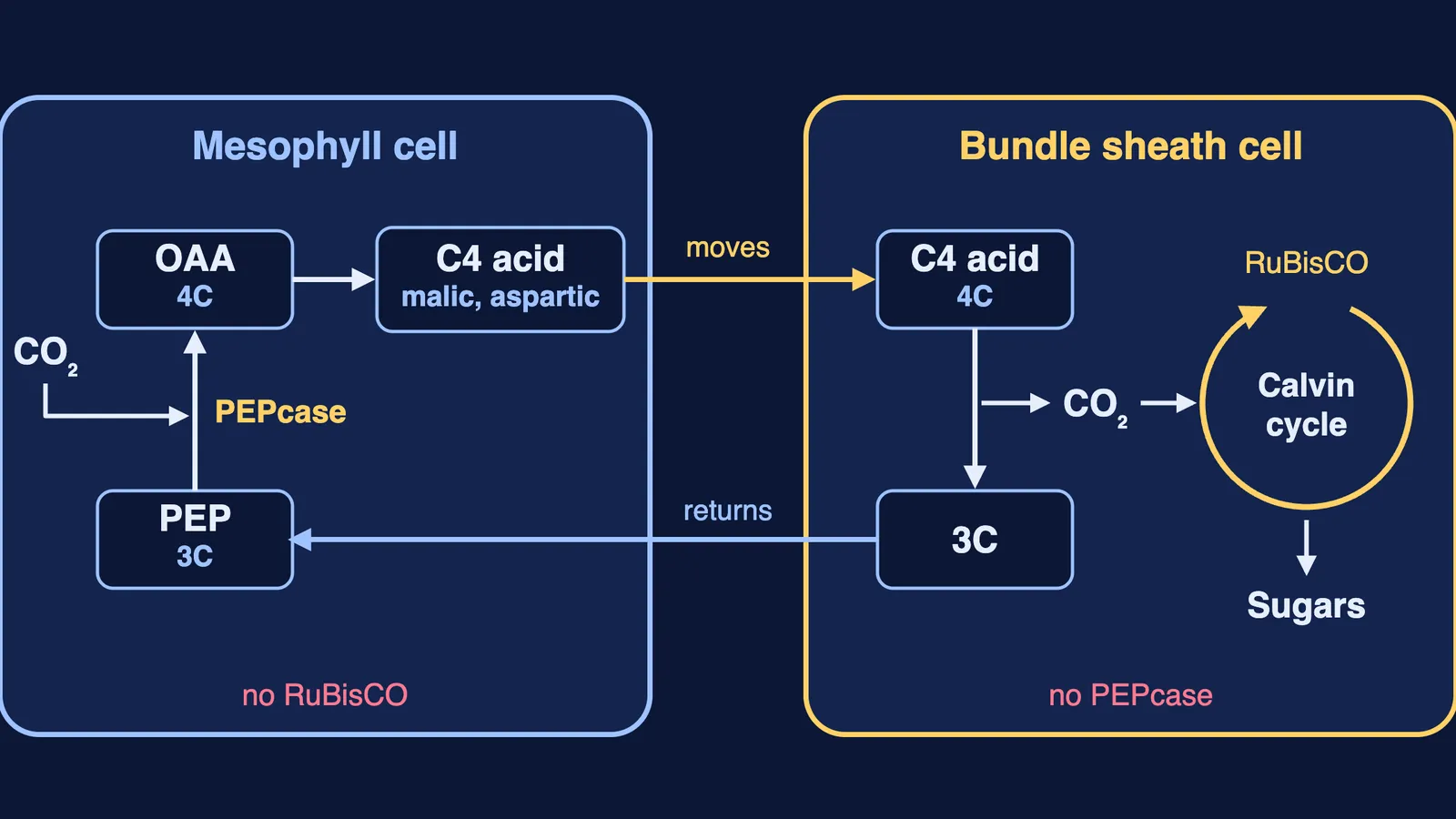
C4 pathway (Hatch and Slack pathway): fixation whose first product is the 4-carbon oxaloacetic acid (OAA); it is found in plants adapted to dry tropical regions, such as maize and sorghum.
PEP and PEPcase: phosphoenol pyruvate, a 3-carbon molecule, is the CO2 acceptor in C4 mesophyll cells; PEP carboxylase catalyses that step. Don't confuse with: RuBP and RuBisCO, which C4 plants use in their bundle sheath cells.
Kranz anatomy: a wreath of large bundle sheath cells around the veins of C4 leaves. They are rich in chloroplasts, their thick walls block gas exchange and no air spaces separate them; in C4 plants the Calvin cycle runs only in these cells.
Photorespiration: RuBisCO binding O2 instead of CO2, so RuBP gives one phosphoglycerate and one 2-carbon phosphoglycolate; it makes no sugar or ATP and releases CO2. C4 plants lack it because they concentrate CO2 at RuBisCO.
What limits the rate of photosynthesis?
Figures below are from the NCERT chapter.
Blackman's law of limiting factors (1905): when several factors affect a process, its rate is set by the one nearest its minimum. Example: a well-lit leaf stops photosynthesising when very cold.
Internal vs external factors: plant traits such as leaf number, age and chlorophyll amount, versus light, temperature, CO2 and water.
Light saturation: the point where more light no longer raises the rate; it occurs at about 10 per cent of full sunlight.
CO2 as a limiting factor: air holds only 0.03 to 0.04 per cent CO2, the main limiting factor. C4 plants saturate at about 360 µL/L, C3 plants only beyond 450 µL/L; because C3 plants keep responding to extra CO2, greenhouse C3 crops such as tomatoes and bell peppers yield more in CO2-enriched air.
Water stress: closes stomata and wilts leaves, cutting photosynthesis indirectly.
How to learn these terms
Draw the Z scheme from memory, labelling PS II, P680, water splitting, PS I, P700 and NADP+.
Learn the mix-ups above as pairs.
Fill NCERT's C3 vs C4 comparison table (Table 11.1) without looking, then check it.
Test yourself with our assertion-reason questions on photosynthesis and respiration.
If a term feels abstract, the Fermi Concept Library covers every concept in biology, each with its own lesson and its place in the map.