On this page
Each option in a multiple-correct question is its own count, and one usually drops a 2!, a +1 or a case. Test every option before you tick.
How does partial marking work in JEE Advanced multiple-correct questions?
In the official JEE Advanced 2025 Paper 1 mathematics answer key, Section 2 has questions where one or more of four options is correct, marked like this:
+4 only if you choose all the correct options.
+3 if all four options are correct and you choose exactly three.
+2 if three or more options are correct and you choose two, both correct.
+1 if two or more options are correct and you choose one correct option.
0 if you leave it blank; −2 in all other cases.
The scheme can change, so read the instructions on exam day.
Eight questions, option by option
Q1. Arrangements of the letters of ARRANGE
(A) There are 1260. True: 7!/(2!·2!).
(B) 720 have the two R's together. False: glue RR; six units with two A's give 6!/2! = 360.
(C) 900 have the R's apart. True: 1260 − 360.
(D) 180 begin with A. False: 6!/2! = 360.
Answer: A, C. B forgets the repeated A.
Q2. Binomial coefficients
(A) C(10, 3) + C(10, 4) = C(11, 3). False: Pascal's rule gives C(11, 4).
(B) C(10, 0) + C(10, 1) + … + C(10, 10) = 1024. True: 2¹⁰ subsets.
(C) If C(n, 4) = C(n, 6), then n = 24. False: n = 4 + 6 = 10.
(D) r·C(n, r) = n·C(n − 1, r − 1). True: pick a team of r and its captain, in either order.
Answer: B, D.
Q3. Integer solutions of x + y + z = 10
(A) 66 with x, y, z ≥ 0. True: stars and bars, C(12, 2).
(B) 36 with x, y, z ≥ 1. True: C(9, 2).
(C) 21 with each at most 5. True: 66 − 3 × 15 (one variable ≥ 6).
(D) 36 with x ≥ 3. True: x = 3 + t leaves a sum of 7, so C(9, 2).
Answer: all four; dropping C earns +3, not +4.
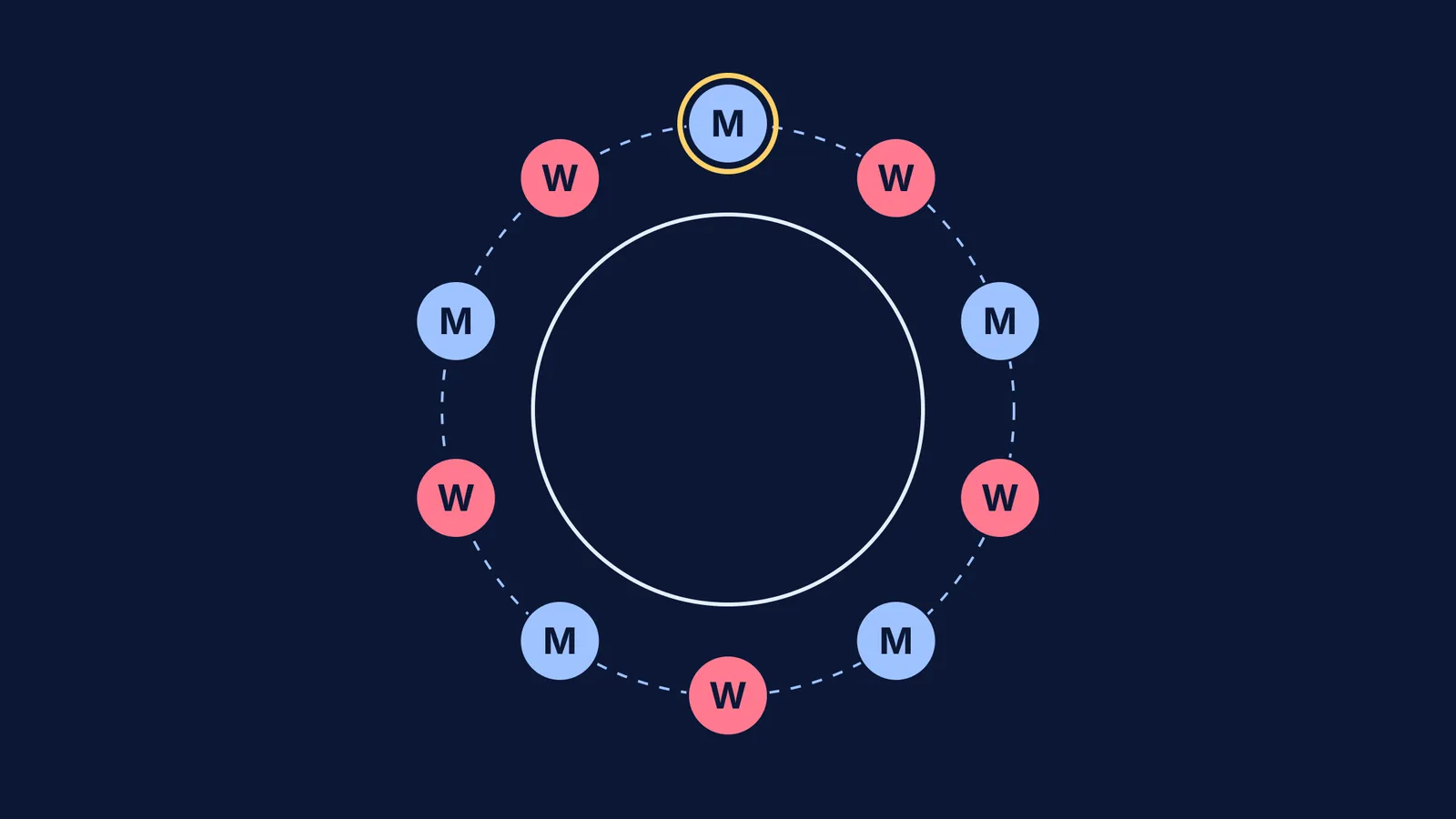
Q4. Five men and five women at a round table
(A) With no condition, there are 9! seatings. True: fix one person.
(B) Alternating, there are 4!·5! = 2880. True: 4! for the men, 5! for the women.
(C) Ten different beads make 9! different necklaces. False: flipping halves it, 9!/2.
(D) The alternating count is 2·4!·5!. False: on a circle, MWMW… and WMWM… are one seating rotated.
Answer: A, B. D copies the factor 2 from a straight row.
Q5. Five letters in five addressed envelopes
(A) 44 ways put no letter right. True: D5 = 44.
(B) 45 put exactly one right. True: 5 × D4 = 5 × 9.
(C) 5 put exactly four right. False: the fifth is then right too, so 0.
(D) 76 put at least one right. True: 120 − 44.
Answer: A, B, D.
Q6. Divisors of N = 360 = 2³·3²·5
(A) N has 24 positive divisors. True: 4·3·2.
(B) They add up to 1080. False: (1 + 2 + 4 + 8)(1 + 3 + 9)(1 + 5) = 1170.
(C) 18 are even. True: 3·3·2.
(D) N splits into two coprime factors in 4 ways, order ignored. True: 2³ = 8 ordered splits, 4 unordered.
Answer: A, C, D.
Q7. A committee of 5 from 6 men and 4 women
(A) 80 have exactly 3 women. False: C(4, 3)·C(6, 2) = 60.
(B) 186 have at least 2 women. True: 120 + 60 + 6.
(C) 196 do not contain both Mr X and Ms Y. True: 252 − C(8, 3).
(D) C(4, 1)·C(9, 4) = 504 have at least one woman. False: a committee with k women is counted k times; the answer is 246.
Answer: B, C.
Q8. MATHS in dictionary order
(A) MATHS is word 52. False: 48 (A…, H…) + 4 (MAH…, MAS…) = 52 come before it.
(B) 120 words begin with M. False: 4! = 24.
(C) MATHS is word 53. True.
(D) A comes before H in 72 words. False: by symmetry, 60.
Answer: C only. Forgetting the +1 makes A tempting.
What should you do with options you cannot settle?
Mark each option T, F or ? first.
Test a doubtful formula on a small case.
Tick every T; never tick a ?.
With no sure T, leave the question blank, since a guess risks −2.
For worked solutions, try the permutations and combinations JEE Advanced practice set, the JEE Advanced numerical questions on permutations and combinations and how to prepare permutations and combinations for JEE Advanced. If one counting slip keeps returning, the Fermi Problem Library has a step-by-step solver that explains the reasoning. For the rest of your JEE Main and Advanced preparation, start at Fermi Test Prep.