On this page
These are the key terms of Chapter 6, Permutations and Combinations, in the NCERT Class 11 Mathematics textbook (Reprint 2026-27). For worked examples, see our Permutations and Combinations Class 11 guide.
The CBSE Mathematics curriculum for 2026-27 lists the counting principle, factorial n, nPr and nCr with their derivation and connections, and simple applications. Circular arrangements do not appear in the current NCERT chapter, so they are left out.
What is the fundamental principle of counting?
Fundamental principle of counting (multiplication principle): if one event can happen in m ways and, after it, another can happen in n ways, the two together, in that order, can happen in m × n ways. Example: 4 routes from home to tuition, then 3 routes from tuition to the library, give 4 × 3 = 12 trips.
Several events: the principle extends to any finite number of events in succession. Example: 3 kurtas, 4 dupattas and 2 pairs of chappals give 3 × 4 × 2 = 24 outfits.
Filling vacant places: count the choices for each position in turn. Example: 3-digit codes from the digits 1 to 5, no digit used twice, give 5 × 4 × 3 = 60.
Repetition allowed: an object already used can be used again, so every position has all n choices. Example: the same codes with repetition give 5 × 5 × 5 = 125. Don't confuse with: repetition not allowed, where choices drop by one each time.
What does n factorial mean?
n factorial (n!): the product of the first n natural numbers, 1 × 2 × 3 × ... × n. Example: 5! = 120.
Zero factorial: 0! is defined as 1, so the nPr and nCr formulas also work at r = 0 and r = n.
Recursive form: n! = n × (n − 1)! for a natural number n. Example: 7! = 7 × 6! = 7 × 720 = 5040.
What is a permutation?
Permutation: an ordered arrangement of some or all of a group of objects, where a change of order counts as a new arrangement. Example: AB and BA are different permutations.
nPr: the number of permutations of n different objects taken r at a time with no repetition, n(n − 1)...(n − r + 1) = n! ÷ (n − r)!, for 0 ≤ r ≤ n. Example: a president, secretary and treasurer from 7 students: 7P3 = 210.
nPn: arranging all n different objects, n! ways. Example: 4 books on a shelf: 4! = 24.
nP0: arranging nothing can be done in exactly 1 way, so nP0 = 1.
Permutations with repetition: n different objects taken r at a time, repetition allowed, give n^r arrangements. Example: a 4-digit PIN from 0 to 9 has 10^4 = 10,000 options. Don't confuse with: 10P4 = 5040, where no digit repeats.
Objects of the same kind: if p of n objects are alike and the rest different, there are n! ÷ p! arrangements. Example: APPLE gives 5! ÷ 2! = 60.
Several kinds alike: with p1 alike of one kind, p2 of another and so on, the count is n! ÷ (p1! p2! ... pk!). Example: BANANA gives 6! ÷ (3! × 2!) = 60.
Treating as one object (block): letters that must stay together become one unit; then arrange the letters inside it. Example: MANGO with A and O together: 4! × 2! = 48.
Never together (complement): subtract the "together" count from the total. Example: MANGO with A and O apart: 5! − 48 = 72.
How is a combination different from a permutation?
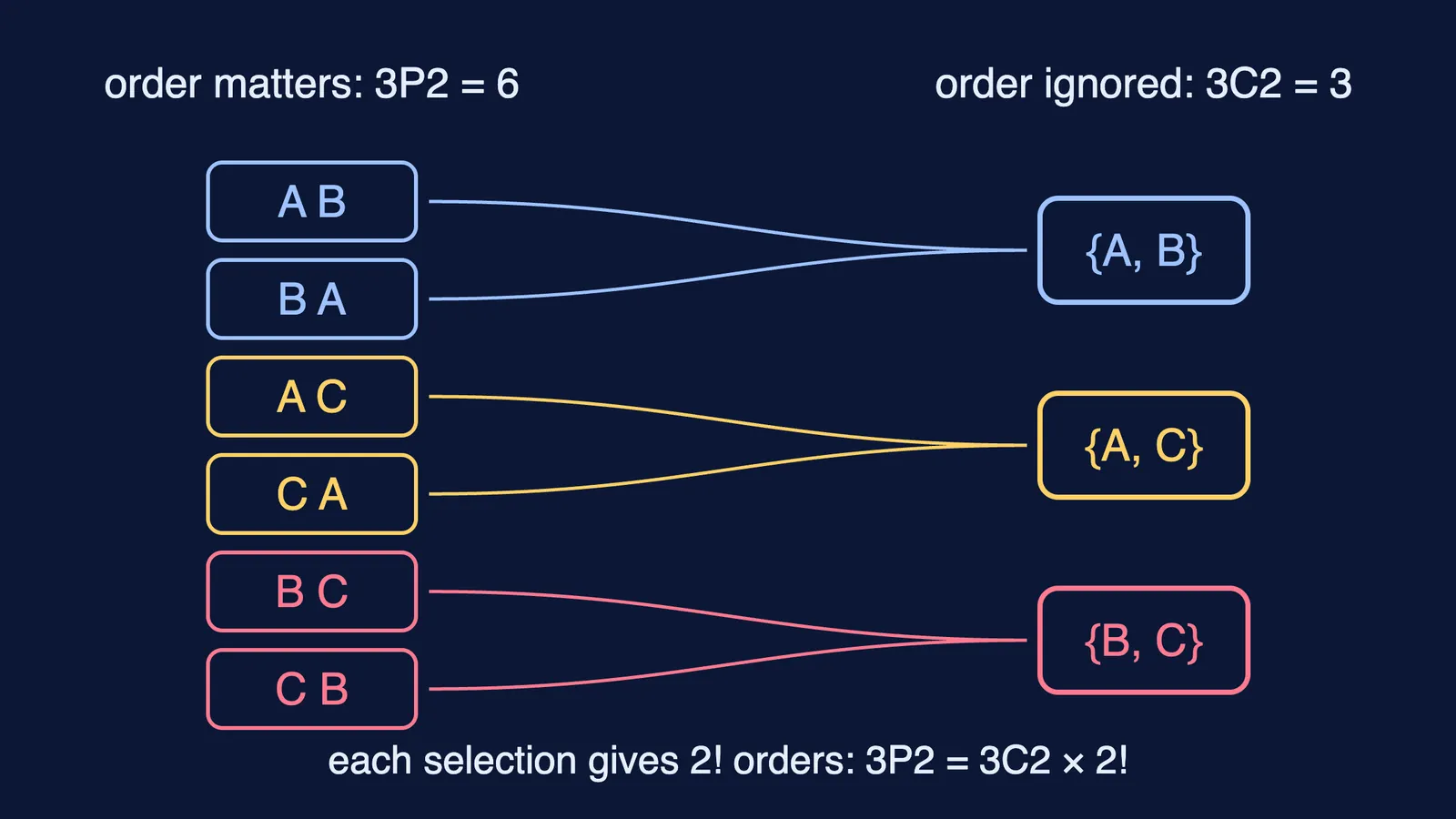
Combination: a selection of objects where order does not matter. Example: from A, B and C, the pairs AB, AC and BC are the only 3 combinations of two.
Order test: if swapping two chosen items gives a new outcome, it is a permutation; if not, a combination. Example: a captain and vice-captain is a permutation; a 2-person team is a combination.
nCr: the number of combinations of n different objects taken r at a time, n! ÷ [r! (n − r)!], for 0 ≤ r ≤ n. Example: 10C3 = 120.
Link between nPr and nCr: each selection of r objects can be arranged in r! ways, so nPr = nCr × r!. Example: 10P3 = 120 × 6 = 720.
nC0 and nCn: selecting nothing, or everything, can each be done in 1 way, so both equal 1.
Complementary selection: nC(n − r) = nCr, because choosing r objects is the same as leaving out n − r. Example: 10C8 = 10C2 = 45.
Equal combinations: if nCa = nCb, then a = b or a + b = n. Example: nC4 = nC6 gives n = 10.
Theorem 6 (often called Pascal's rule): nCr + nC(r − 1) = (n + 1)Cr. Example: 5C2 + 5C1 = 10 + 5 = 15 = 6C2.
Handshakes: when each pair of objects is counted once, the answer is nC2. Example: 8 friends shaking hands give 8C2 = 28 handshakes. Don't confuse with: 8P2 = 56, which counts each handshake twice.
Restricted selection: if one person must be included, select the rest from the others. Example: a 4-member team from 10 with Riya always in: 9C3 = 84.
"At least" selections: split into separate cases and add, or subtract the unwanted case from the total. Example: 3 from 4 boys and 3 girls with at least one girl: 7C3 − 4C3 = 35 − 4 = 31.
Select, then arrange: choose with nCr, then order with r!. Example: choose 3 of 5 students and seat them in a row: 5C3 × 3! = 60 = 5P3.
How to learn these terms
For every problem, write "order matters" or "order doesn't matter" before you write a formula.
List 3 objects taken 2 at a time by hand and check against 3P2 = 6 and 3C2 = 3.
Pair the confusable terms: nPr with n^r, nPr with nCr, "together" with "never together".
Check nCr answers with nC(n − r).
nCr returns in our Binomial Theorem Class 11 guide. If a definition feels slippery, the Fermi Concept Library gives every concept in mathematics its own lesson and its place in the map.