On this page
Eight new JEE Advanced-style questions, each with a worked solution and the trap behind the likeliest wrong option. Take g = 10 m/s².
What does JEE Advanced ask from oscillations and waves?
The official JEE (Advanced) 2026 syllabus lists forced and damped oscillation, resonance, and linear and angular SHM, plus stationary waves, strings and air columns, beats, speed of sound in gases, the Doppler effect and the resonance-column experiment. All eight questions stay inside it. New to the chapter? Start with our guide on how to prepare oscillations and waves for JEE Advanced.
How should you use this practice set?
Allow 35 minutes.
Labels: single-correct, one or more options correct, or numerical-value. Judge every option on its own; see JEE Advanced question types.
Write the restoring force or wave condition before any number.
Easy: physical pendulum, damping and a passing train
Q1 (easy, single-correct). A uniform disc of radius 0.20 m swings in its own vertical plane about a horizontal axis through a point d from its centre. For which d is the period least, and what is it?
(A) 0.20 m, 1.09 s (B) 0.141 m, 1.06 s (C) 0.10 m, 0.89 s (D) 0.115 m, 1.07 s
Answer: (B). T = 2π√((R²/2 + d²)/gd), least when d = R/√2 = 0.141 m, the radius of gyration. Then T = 2π√(√2R/g) = 1.06 s. Trap: (C) uses R²/4, the value about a diameter.
Q2 (easy, one or more options correct). A 0.50 kg block on a spring (k = 200 N/m) feels a damping force −bv, with b = 0.10 kg/s. Which are correct?
(A) Left alone, its amplitude after 10 s is about 37% of the start. (B) Left alone, its mechanical energy after 10 s is about 37% of the start. (C) Driven by 0.20 cos(20t) N, its steady amplitude is about 0.10 m. (D) Driven by 0.20 cos(10t) N, its steady amplitude is larger than in (C).
Answer: (A), (C). Amplitude decays as e^(−bt/2m) = e^(−0.1t), giving e^(−1) ≈ 0.37; energy goes as its square, e^(−2) ≈ 0.14. Since √(k/m) = 20 rad/s, (C) is resonance: F₀/bω = 0.10 m. Trap: (B) forgets energy decays twice as fast.
Q3 (easy, numerical-value). A train sounding a 660 Hz whistle passes a person beside the track at 30 m/s. Sound travels at 330 m/s. By how many hertz does the pitch she hears drop?
Answer: 121. Approaching: 660 × 330/300 = 726 Hz. Receding: 660 × 330/360 = 605 Hz. Trap: 120, from the approximate shortcut 2fu/v.
Medium: two blocks, a resonance tube and a rolling ball
Q4 (medium, single-correct). Blocks A (1 kg) and B (3 kg) on a smooth floor are joined by a light spring (k = 300 N/m) at natural length. B is given 2 m/s towards A. Find the maximum compression and the time to reach it.
(A) 20 cm, 0.157 s (B) 10 cm, 0.079 s (C) 10 cm, 0.157 s (D) 20 cm, 0.091 s
Answer: (B). With reduced mass μ = 0.75 kg, ½μv² = 1.5 J = ½kx², so x = 0.10 m. ω = √(k/μ) = 20 rad/s, and maximum compression comes a quarter period later: 0.079 s. Trap: (C) takes half a period; (A) puts all of B's energy into the spring.
Q5 (medium, one or more options correct). With a 512 Hz fork, a resonance column resonates at 15.8 cm and 49.0 cm. Which are correct?
(A) The speed of sound is about 340 m/s. (B) The end correction is about 0.8 cm. (C) With a 1024 Hz fork, the first resonance would be at about 7.9 cm. (D) At resonance, the pressure variation is largest at the water surface.
Answer: (A), (B), (D). Resonances are λ/2 apart, so λ = 66.4 cm and v ≈ 340 m/s. Then 15.8 + e = λ/4 = 16.6 cm, so e = 0.8 cm. At 1024 Hz the length is 8.3 − 0.8 = 7.5 cm. The water surface is a displacement node: a pressure antinode. Trap: (C) halves 15.8 cm, but the end correction does not halve.
Q6 (medium, numerical-value). A solid ball of radius 1.0 cm rolls without slipping inside a fixed hemispherical bowl of radius 36 cm, making small oscillations. Find the period in seconds, to two decimal places.
Answer: 1.39. The centre moves on a circle of radius R − r = 0.35 m, and rolling gives kinetic energy (7/10)mv². So T = 2π√(7(R − r)/5g) = 1.39 s. Trap: 1.18, the sliding answer 2π√((R − r)/g).
Hard: echo beats and a wall in the path
Q7 (hard, one or more options correct). A 500 Hz source moves at 20 m/s straight towards a flat wall. A listener stands still behind the source, on the same line. Sound travels at 340 m/s. Which are correct?
(A) The wall receives 531.25 Hz. (B) The listener hears about 59 beats per second. (C) The wavelength between source and wall is 0.64 m. (D) The echo reaching the listener has wavelength 0.72 m.
Answer: (A), (B), (C). Ahead of the source, λ = 320/500 = 0.64 m, so the wall receives 340/0.64 = 531.25 Hz and returns it unchanged. Directly, the listener hears 500 × 340/360 ≈ 472.2 Hz: about 59 beats per second. Trap: (D) gives the echo the stretched wavelength from behind the source.
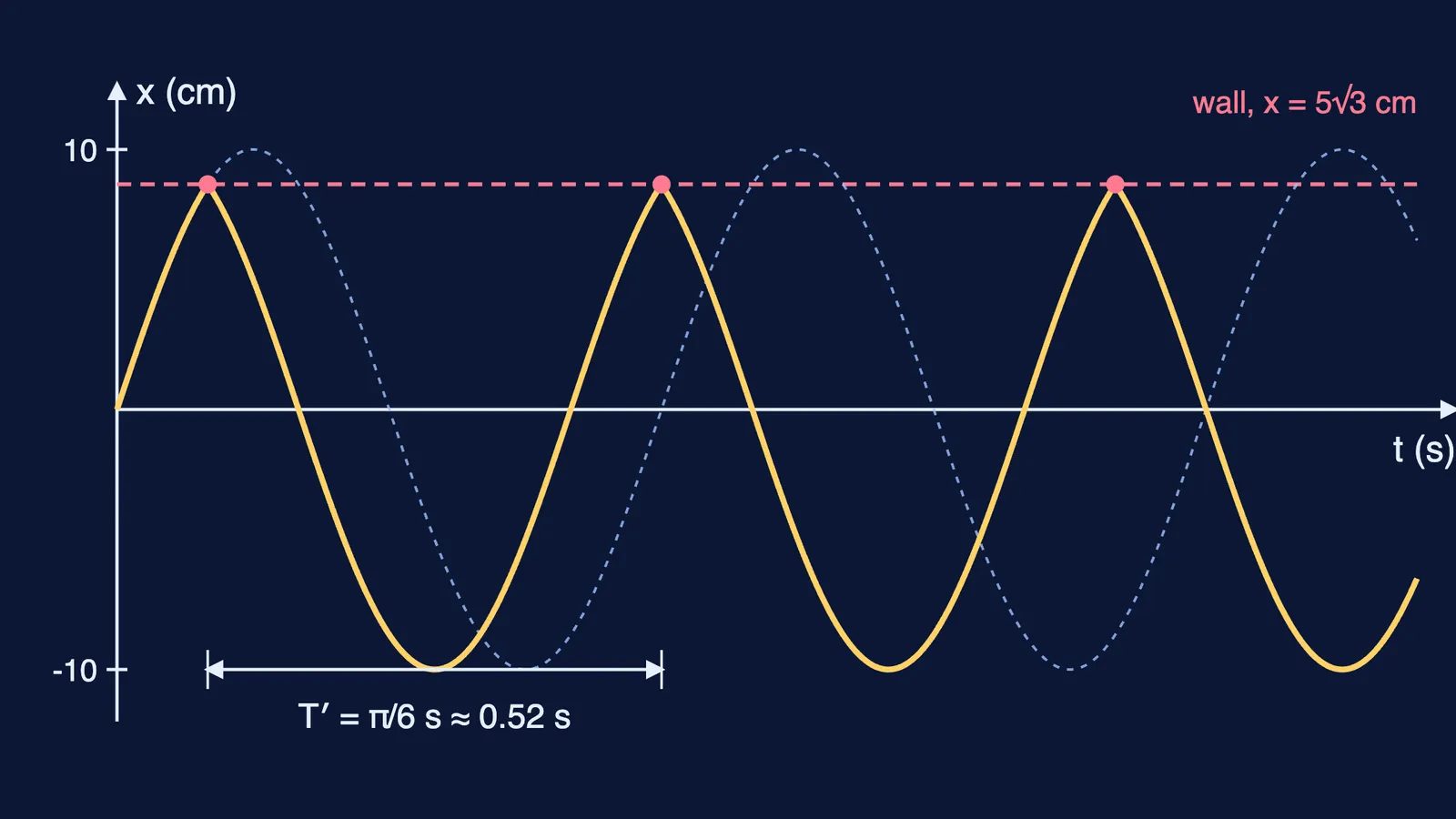
Q8 (hard, numerical-value). A 1 kg block on a smooth floor is attached to a spring (k = 100 N/m) at natural length, with a rigid wall 5√3 cm away. It is given 1 m/s towards the wall; collisions are elastic. Find the time between successive hits, in seconds, to two decimal places.
Answer: 0.52. ω = 10 rad/s and the free amplitude is v/ω = 10 cm. The wall is reached at phase 60° and the bounce jumps the phase to 120°, so 60° of each cycle is cut off: T′ = (300/360)(2π/10) = π/6 ≈ 0.52 s. Trap: 0.63, the free period.
What should you do after this set?
Sort misses: wrong mass or inertia (Q1, Q4, Q6), wrong boundary or frequency (Q3, Q5, Q7), or wrong phase or decay (Q2, Q8). The Fermi Problem Library has worked problems with a step-by-step solver that explains the reasoning rather than printing an answer. Then read how partial marking in JEE Advanced works.