On this page
Eight new JEE Advanced-style optics questions, easy to hard, all inside the Optics list of the official JEE (Advanced) 2026 syllabus. For a study plan, read our guide on how to prepare optics for JEE Advanced.
How should you use this optics practice set?
Allow 35 minutes; sketch a ray diagram for ray-optics questions.
Labels: single-correct, one or more options correct, or numerical-value.
Judge each option of a "one or more" question on its own; our guide to JEE Advanced question types explains the formats.
Easy: critical angle, Brewster's law and a submerged mirror
Q1 (easy, single-correct). A point source sits 12 cm below the surface of a liquid of refractive index 5/3. What is the smallest opaque disc, floating directly above it, that stops all light from leaving? Give its radius.
(A) 7.2 cm (B) 9 cm (C) 15 cm (D) 16 cm
Answer: (B). sin C = 3/5, so tan C = 3/4. Critical rays reach r = h tan C = 9 cm; more oblique ones are totally reflected. Trap: (A) uses h sin C, the wrong side of the triangle.
Q2 (easy, one or more options correct). Unpolarised light in air strikes the top face of a parallel-sided glass slab (n = √3) at Brewster's angle. Then
(A) the angle of refraction is 30°. (B) the reflected light is completely polarised, with its electric field parallel to the plane of incidence. (C) the reflected and refracted rays are perpendicular. (D) the refracted ray also meets the bottom face, glass to air, at Brewster's angle.
Answer: (A), (C), (D). tan i = √3 gives i = 60° and r = 30°, so the rays are 90° apart. The ray meets the bottom face at 30°, and tan 30° = 1/√3 is Brewster's condition for glass to air. Trap: (B); the reflected field is perpendicular to the plane of incidence.
Q3 (easy, numerical-value). A plane mirror lies flat at the bottom of a tank of water (n = 4/3) 12 cm deep. A bead is held 10 cm above the water. Looking straight down, how many centimetres below the surface does its mirror image appear?
Answer: 28. From the water, the bead seems 10 × 4/3 = 13.3 cm up, 25.3 cm from the mirror. Its image is 25.3 cm below the mirror, 37.3 cm below the surface, which looks like 37.3 × 3/4 = 28 cm from air. Trap: ignoring both refractions gives 34.
Medium: a ball lens, a single slit and a spinning Polaroid
Q4 (medium, single-correct). A parallel beam falls along a diameter of a glass sphere (n = 1.6, radius 6 cm) in air. How far beyond the far surface of the sphere is the beam brought to a focus?
(A) 2 cm (B) 4 cm (C) 8 cm (D) 16 cm
Answer: (A). First surface: 1.6/v = 0.6/6, so v = 16 cm, 4 cm past the far surface. As a virtual object for the second surface, 1/v − 1.6/4 = (1 − 1.6)/(−6) gives v = 2 cm. Trap: (B) ignores the second surface.
Q5 (medium, one or more options correct). Light of wavelength 450 nm falls normally on a 0.15 mm slit; the screen is 2.0 m away. Then
(A) the central maximum is 12 mm wide. (B) the first minimum is 6 mm from the centre. (C) halving the slit width doubles the central maximum's width and halves its peak intensity. (D) with the whole set-up in water (n = 4/3), the central maximum is 9 mm wide.
Answer: (A), (B), (D). The first minimum is at λD/a = 6 mm; the central maximum is twice that. Water cuts λ by 3/4, giving 9 mm. (C) fails: the central field scales with a, so peak intensity scales with a² and falls to a quarter. Trap: "half the light, half the intensity".
Q6 (medium, numerical-value). Unpolarised light of intensity 64 W/m² passes through two crossed Polaroids. A third Polaroid between them rotates steadily. What is the average transmitted intensity, in W/m²?
Answer: 4. With the middle axis at θ, I = (I₀/2) cos²θ sin²θ = (I₀/8) sin² 2θ, which averages to I₀/16. Trap: 8 is the maximum, at θ = 45°.
Hard: a prism at its limits and an off-axis source
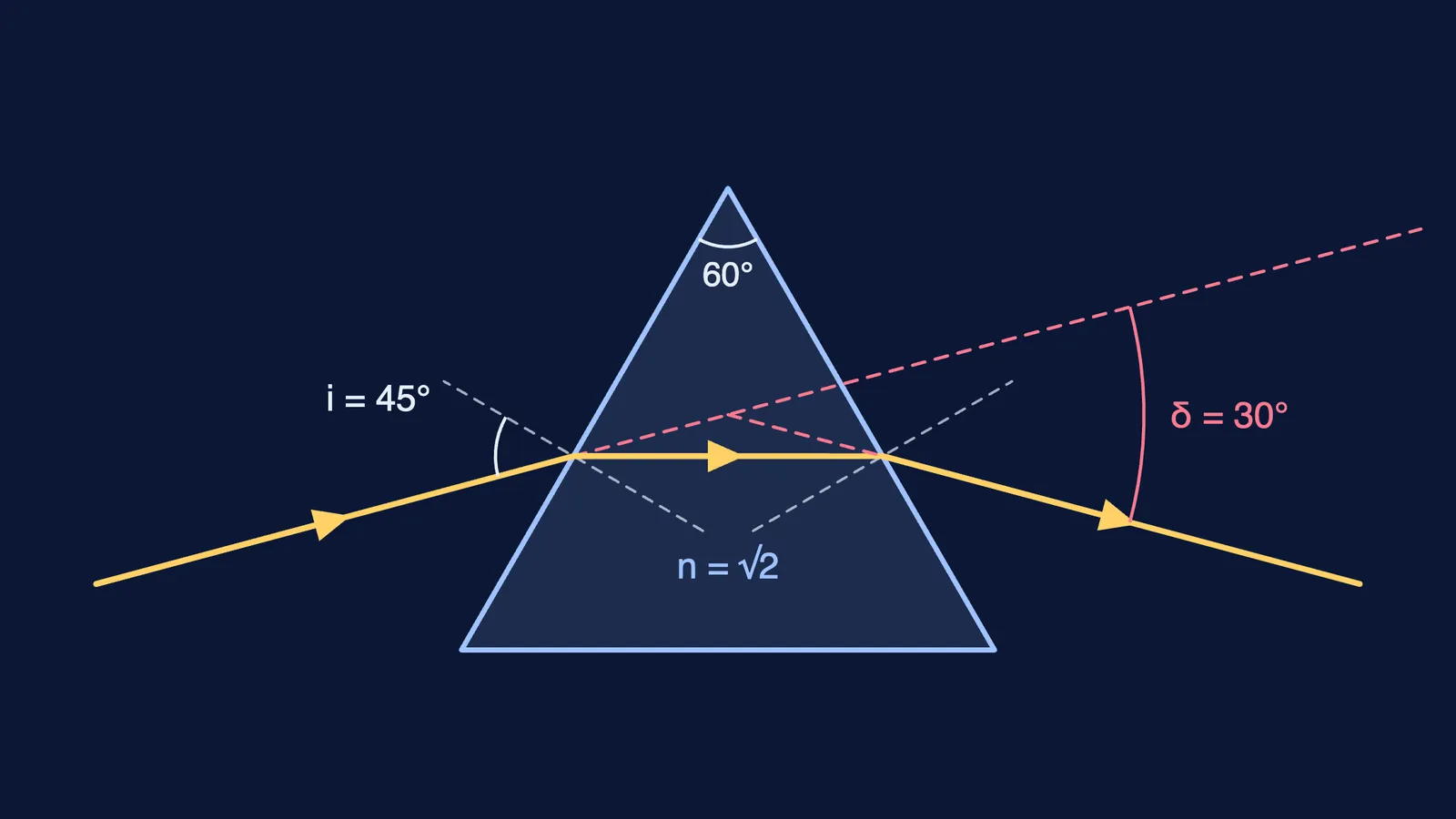
Q7 (hard, one or more options correct). A prism of angle 60° is made of glass with n = √2. Then
(A) the angle of minimum deviation is 30°. (B) at minimum deviation, the angle of incidence is 45°. (C) a ray striking the first face at 20° emerges from the second face. (D) for grazing incidence on the first face, the deviation is about 51.5°.
Answer: (A), (B), (D). At minimum deviation r = 30°, so sin i = √2 sin 30°, i = 45° and δ = 2(45°) − 60° = 30°. The critical angle is 45°. At i = 20°, r₁ = 14.0° and r₂ = 46.0°, beyond it: total internal reflection, so (C) fails. For grazing incidence r₁ = 45°, r₂ = 15°, e = 21.5° and δ = 90° + 21.5° − 60° = 51.5°. Trap: ticking (C).
Q8 (hard, numerical-value). In a double-slit set-up, the slits are 0.4 mm apart and the screen is 1.0 m away. The source (λ = 500 nm) sits 0.5 m before the slits, but 2 mm above the axis. A film (n = 1.4) over one slit brings the central maximum back to O, on the axis. Find its thickness in micrometres.
Answer: 4. The source-to-upper-slit path is shorter by d·y/D′ = (0.4 mm)(2 mm)/(0.5 m) = 1.6 μm, so the central maximum sits 4 mm below O. A film on the upper slit must add 1.6 μm: (1.4 − 1)t = 1.6 μm, so t = 4 μm. Trap: using the screen distance in place of the source distance gives 2.
What should you do after this set?
Geometry slips (Q1, Q3, Q7): redraw the ray, angles from the normal. Two-surface slips (Q4): one surface at a time. Wave slips (Q5, Q6, Q8): write the path difference or intensity law first. For the base, try the wave optics JEE Main questions.
For more practice, the Fermi Problem Library has worked problems with a step-by-step solver that explains the reasoning rather than printing an answer.