On this page
Optics in JEE Advanced rarely tests one formula. A lens problem hides a mirror, a fringe problem hides a change of medium.
JEE (Advanced) 2027, organised by IIT Delhi, is on 23 May 2027 (Sunday), per the official website. You must be in the top 2,50,000 of the JEE (Main) 2027 B.E./B.Tech paper (eligibility).
What does the JEE Advanced syllabus include for optics?
The 2027 syllabus is not published yet, so follow the JEE (Advanced) 2026 syllabus, which notes it is the same as 2025. Under Optics it lists:
Rectilinear propagation of light; reflection and refraction at plane and spherical surfaces; total internal reflection
Deviation and dispersion of light by a prism; thin lenses; combinations of mirrors and thin lenses; magnification
Wave nature of light: Huygen's principle, interference limited to Young's double slit experiment
Diffraction due to a single slit; polarization of light, plane polarized light; Brewster's law, Polaroids
How is JEE Advanced optics different from JEE Main?
The JEE (Main) 2027 syllabus also names the microscope, telescope, lens maker formula and power of a lens. The Advanced list names three items Main does not: rectilinear propagation, dispersion by a prism, and combinations of mirrors and thin lenses (Main says thin lenses in contact).
JEE (Advanced) 2026 had two compulsory papers of three hours each, with questions set to test comprehension, reasoning and analytical ability, and details of the marking scheme were given at the time of the exam (2026 Information Brochure). Formats can change, so practise judging each option on its own, and option-free numericals. Our guide to JEE Advanced question types explains the formats, and the JEE Main guides to ray optics and wave optics cover the base.
Worked example 1: a real image that stands upright
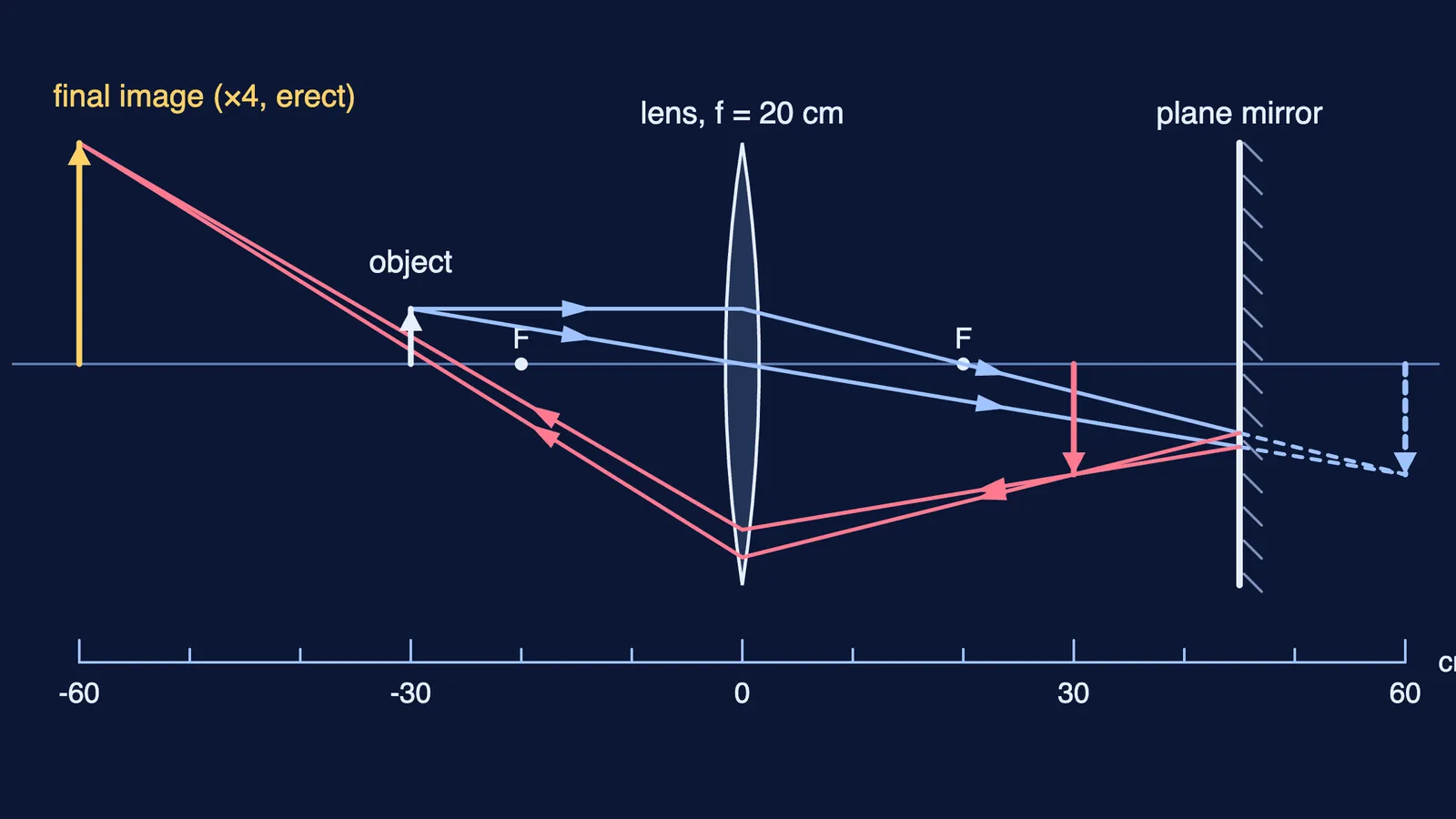
A 5 cm object stands 30 cm in front of a convex lens (f = 20 cm). A plane mirror faces the lens 45 cm behind it. Light passes the lens, reflects and passes it again. Where is the final image, and is it erect?
First pass: 1/v = 1/20 − 1/30, so v = 60 cm and m₁ = −2. The rays head for a point 15 cm beyond the mirror.
That point is a virtual object for the mirror, which forms a real image 15 cm in front of it, 30 cm from the lens; m₂ = +1.
Second pass: an object 30 cm from the lens gives an image 60 cm away on the original side; m₃ = −2.
Total m = (−2)(+1)(−2) = +4. The final image is real, erect and 20 cm tall.
The trap: "real means inverted" holds for one lens, not for a system.
Lost track of a sign? The Fermi Problem Library has worked problems with a step-by-step solver that explains the reasoning rather than printing an answer.
Worked example 2: a film over one slit, then water
Slit spacing is 0.5 mm, the screen is 1.0 m away and λ = 600 nm. A film (μ = 1.5, 3.6 μm thick) covers the upper slit. Which are correct?
(A) Fringe width stays 1.2 mm.
(B) The central maximum moves 3.6 mm towards the covered slit.
(C) The point opposite the slits' midpoint becomes dark.
(D) With the whole set-up in water (μ = 4/3), the central maximum shifts 0.9 mm.
Fringe width = λD/d = 1.2 mm; the film does not change it. (A) is correct.
Shift = (μ − 1)tD/d = 0.5 × 3.6 μm × 1.0 m / 0.5 mm = 3.6 mm, towards the film. (B) is correct.
That is exactly three fringe widths, so the midpoint holds the third bright fringe. (C) is wrong.
In water the excess index is 1.5/(4/3) − 1 = 0.125, so the shift is 0.9 mm. (D) is correct; the fringe width also falls to 0.9 mm.
Answer: A, B, D. Limit check: t = 0 or μ = 1 gives zero shift.
How should you plan four weeks of optics practice?
Week 1: reflection, refraction at plane and spherical surfaces, total internal reflection. Fix one sign convention.
Week 2: prisms, thin lenses, mirror-lens combinations, each with a rough ray diagram.
Week 3: Huygens' principle, double slit with films and media, single slit, Brewster's law, Polaroids.
Week 4: timed mixed sets, checking units and a limit each time.
Can you picture fringes sliding when one path gets longer? The Fermi Simulation Lab has interactive simulations for the ideas that are easier to see than to read.
Practice questions (our own):
Prism angle 50°, refractive index 1.5: minimum deviation? Answer: about 28.7°.
Unpolarised light I₀ passes Polaroids with axes at 0°, 30° and 90°. Output? Answer: 3I₀/32.
A 0.2 mm slit, 500 nm light, screen 1.5 m away: central maximum width? Answer: 7.5 mm.
Mark each mistake as a wrong idea, sign slip or arithmetic slip; the type tells you what to revise.