On this page
Olympic Values is Chapter 9 of *Khel Praveen*, the new NCERT Physical Education and Well-being book for Class 9 (First Edition, April 2026, per the book's prelims). It fills pages 76 to 81 of the Unit 3 PDF and asks what sport teaches you apart from winning. Here it is in plain words, with practice questions.
What is Olympism in Class 9 Khel Praveen?
The book describes Olympism as a philosophy of life that keeps body, mind and willpower in balance, and that joins sport with culture and education (Khel Praveen, Chapter 9). Its goal is sport serving human development and peace, open to all without discrimination.
At the 1936 Olympics, Jesse Owens, an African-American sprinter facing racial discrimination, won four gold medals, and German athlete Luz Long helped him in the long jump; their friendship became a lasting symbol. At the 2018 Winter Olympics, athletes from North and South Korea marched together under one flag. The chapter also notes that Pierre de Coubertin, who founded the modern Olympics, thought of sport as a fourth branch of education next to science, art and morality.
What are the three core Olympic values?
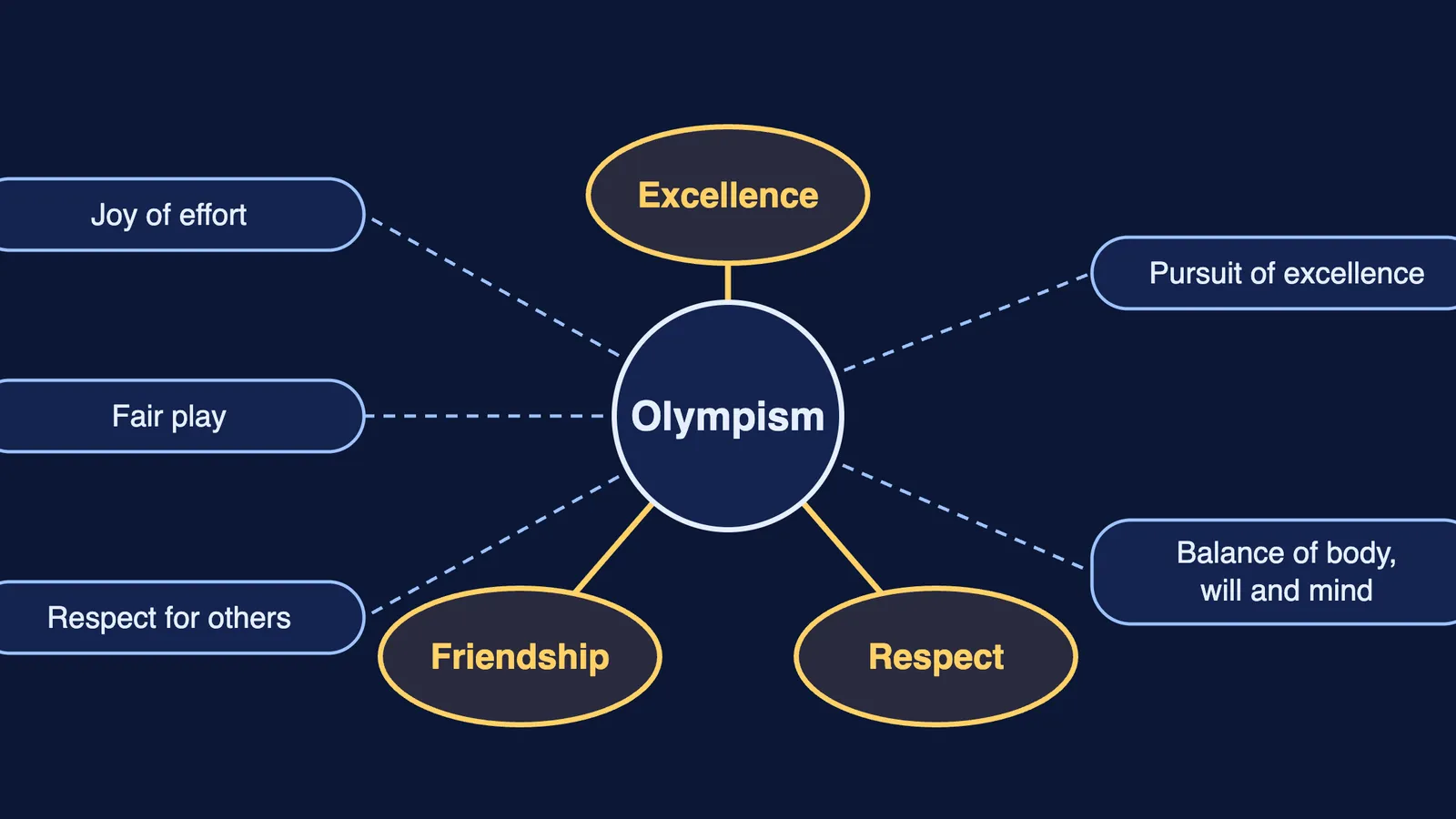
The chapter names three core values (NCERT Chapter 9):
Excellence: giving your best and improving over time, not just winning. Its examples are Neeraj Chopra, India's first Olympic gold medallist in athletics (Tokyo 2020), and Michael Phelps, with 23 Olympic gold medals.
Friendship: trust, respect and kindness, such as including others and celebrating their success. Think of Owens and Long.
Respect: valuing yourself, other people, the rules and the environment. Examples: Sachin Tendulkar touching the ground before going out to play, or accepting a referee's call.
What are the Olympic educational values?
The chapter adds educational values that link sport with learning. The CBSE 2026-27 curriculum lists five: joy of effort, fair play, respect for others, pursuit of excellence, and balance among body, will and mind (CBSE Physical Education and Well-being curriculum). Note: the book gives only three their own headings; pursuit of excellence appears in a reflection box, and respect for others gets no heading.
Joy of effort: the happiness of trying your hardest, whether you win or lose.
Fair play: honesty, keeping to the rules, and respecting teammates, opponents and officials.
Balance of body, mind and willpower: fitness, mental strength and emotional steadiness working together. The book links this to Yoga and Pañchakośha, and to Abhinav Bindra, the first Indian to win an individual Olympic gold in shooting, who took meditation and mental training as seriously as shooting practice before Beijing 2008.
Class 11 PE goes deeper: see our guide to Olympism, Olympic values and symbols in Class 11, and for the body-mind side, the Class 11 yoga chapter guide.
How do you tell similar values apart?
Excellence is about improving towards a goal; joy of effort is the satisfaction found in the trying itself. Respect is an attitude towards people, rules and surroundings; fair play is honest action inside a contest.
Worked example: name the value in five school situations.
In an inter-house kho-kho match, a chaser tells the umpire she was touched, though nobody else saw it. Fair play.
A student who came last on sports day practises all term, finishes higher next year without a medal, and is happy anyway. Joy of effort, with pursuit of excellence close behind.
A boy new to the school stands alone at lunch, and the class football group calls him onto their side. Friendship.
After losing a final, a captain thanks the referee and the ground staff. Respect.
A young archer practises her shots and also sits quietly to settle her focus before her turn. Balance of body, mind and willpower.
How is this chapter assessed in Class 9?
PE and Well-being has 20 theory marks and 80 practical marks; each of the 8 units carries 2 theory marks through MCQ, objective or short-answer items, making 16, plus a 4-mark viva (CBSE 2026-27 curriculum, Assessment Criteria). The curriculum puts this chapter in Unit 6, Olympic Movement, with the ancient and modern Olympics and the Olympic symbols (the book calls it Unit 3). Those 2 marks are shared across the whole unit, not set aside for Chapter 9, and the assessment happens in school.
Practice questions on Olympic Values
Original questions; mark labels are our suggestion.
(1 mark) Which is not a core Olympic value: excellence, victory, friendship, respect? Answer: victory.
(1 mark) Which Indian Olympian does the chapter connect with meditation and mental training? Answer: Abhinav Bindra.
(2 marks) Using one school example each, explain how joy of effort differs from excellence.
(2 marks) After a defeat, a hockey team stays on the ground to applaud the visiting side. Name the core value shown and explain your choice.
(Viva prompt) Describe one habit from your own sport or study routine that shows balance of body, mind and willpower.
Not sure where to begin your revision? Fermi's AI tutor works out what you already know and builds a plan for the session.
Tonight, write the three core values from memory, then retry the five situations without looking.