On this page
Numbers in day-to-day life is Chapter 2 of Applied Mathematics Class XI, Student Support Material (Second Edition, April 2026), which CBSE publishes itself. Its five sections are clocks, calendar, time and work, speed-distance-time, and seating arrangement. All are aptitude-style problems: one formula, then careful counting.
What is in the 2026-27 syllabus for this chapter?
The CBSE Applied Mathematics curriculum 2026-27 lists these as items 1.4 to 1.8 of Unit I:
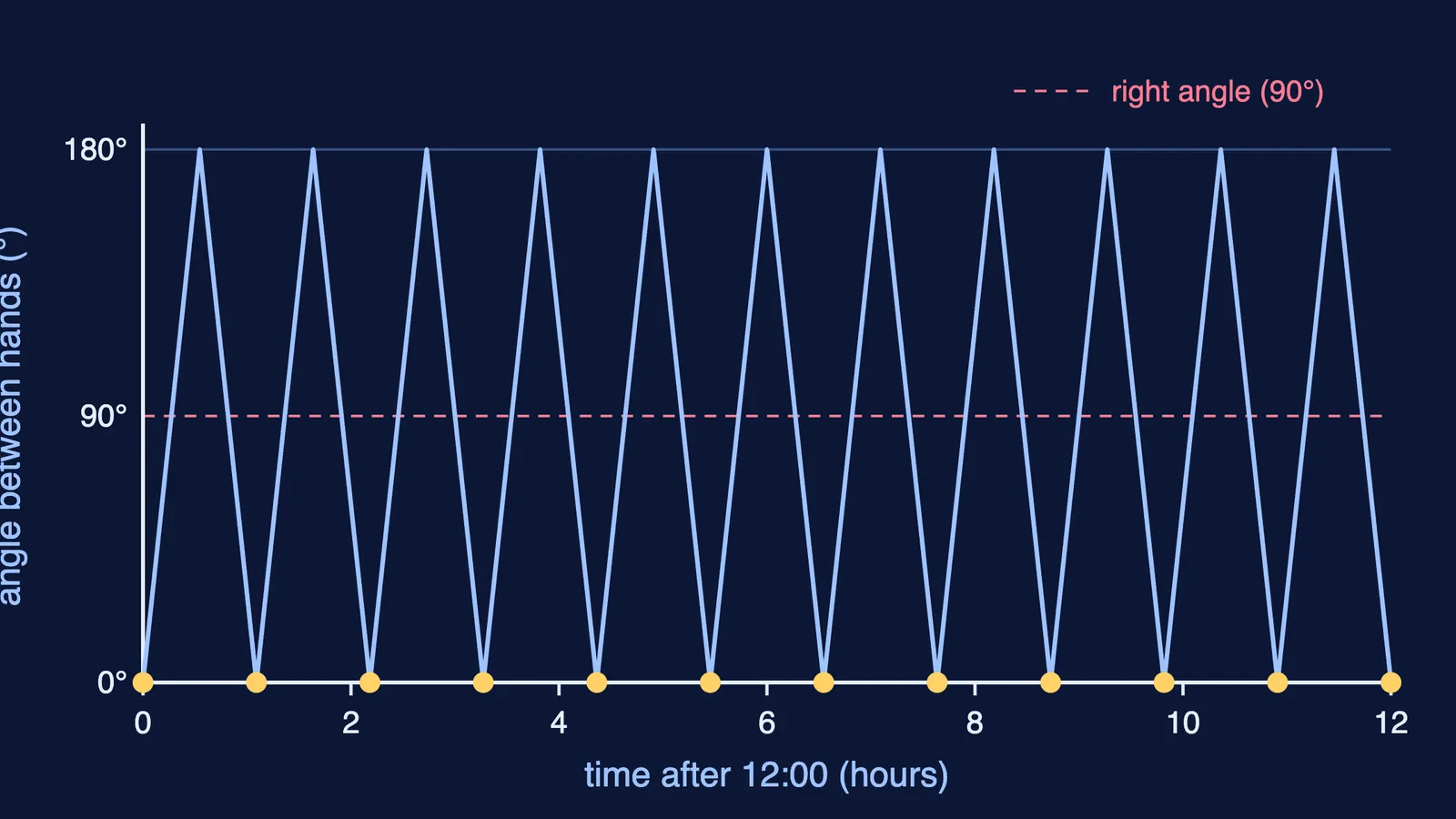
Clocks: angle between the hands at a given time; when they meet, are opposite or form a given angle.
Calendar: odd days in a month, year or century; the day of the week for any date.
Time and work: individual and group work, with a time-work graph.
Speed, distance and time: time or distance from data, with a distance-time graph.
Seating arrangement: linear or circular plans from conditions.
Unit I, Numbers, Quantification and Numerical Applications, carries 10 marks out of 80 in the Class XI theory paper, per the same curriculum. Those marks are shared with binary numbers, logarithms and Bhartiya numeration; there is no separate figure for this chapter. All five book sections appear in the 2026-27 Class XI list. The book shows a leaking tank as "negative work", but the curriculum lists pipes and cisterns, boats and streams, and races and games as Class XII topics.
How do you find the angle between clock hands?
The book gives the hour hand 30° per hour, which is 0.5° per minute, and the minute hand 6° per minute, so the minute hand gains 5.5° every minute. At H hours and m minutes, the angle is A = |30H − 5.5m|; if it exceeds 180°, subtract it from 360°.
Worked example 1. At 8:20, A = |30 × 8 − 5.5 × 20| = |240 − 110| = 130°.
Worked example 2. When do the hands meet between 2 and 3? At 2:00 the minute hand is 60° behind, so it needs 60 ÷ 5.5 = 10 10/11 minutes. They meet at about 2:10:55.
The hands meet every 720/11 minutes: 11 times in 12 hours and 22 times a day, as the book states. For the history behind clocks, read how a mechanical clock keeps time.
How do you find the day of the week from odd days?
An odd day is a day left over after complete weeks. An ordinary year has 1 odd day and a leap year 2. The book counts 24 leap years in a century: 76 + 48 = 124 days, which is 5 odd days.
Worked example 3. If 15 August 2026 is a Saturday, what day is 26 January 2027? Days after 15 August: 16 + 30 + 31 + 30 + 31 + 26 = 164. Since 164 = 23 × 7 + 3, there are 3 odd days. Saturday + 3 = Tuesday.
How do time and work and speed problems work?
Someone who finishes a job in n days does 1/n of it per day; add rates for people working together.
Worked example 4. Asha paints a wall in 6 hours; Bilal takes 9. Together they do 1/6 + 1/9 = 5/18 per hour, so they need 18/5 hours = 3 hours 36 minutes. If Bilal leaves after 2 hours, 2 × 5/18 = 5/9 is done. Asha does the other 4/9 at 1/6 per hour: 8/3 hours = 2 hours 40 minutes. Total: 4 hours 40 minutes.
Worked example 5. Average speed is total distance ÷ total time. You cycle 90 km at 45 km/h and return at 30 km/h. Time = 2 h + 3 h = 5 h, so average speed = 180 ÷ 5 = 36 km/h, not 37.5.
How are seating arrangement questions different from core maths?
For the counting side, see our Class 11 permutations and combinations guide.
Worked example 6. Friends A to E sit in a row facing north. C is in the middle, A is immediately left of C, E is at the right end, and B is not next to C. From the left: C 3rd, A 2nd, E 5th. B cannot be 4th, so B is 1st and D 4th: B, A, C, D, E.
What should you practise for the exam?
These questions are ours, and the mark labels are our suggestion, not CBSE's.
(1 mark) Find the angle between the hands at 4:40. Answer: 100°.
(2 marks) 1 March 2027 is a Monday. Find the day on 1 June 2027. Answer: 92 days, 1 odd day, Tuesday.
(3 marks) A tap fills a tank in 8 hours; a leak empties it in 12 hours. With both open, how long to fill it? Answer: 1/8 − 1/12 = 1/24, so 24 hours.
(2 marks) A 180 m train at 54 km/h passes a 120 m platform. How long does it take? Answer: 300 m ÷ 15 m/s = 20 s.
Stuck on a step? Fermi's AI tutor works out what you already know, builds a plan for the session, and teaches through it, checking understanding as it goes.