On this page
Here are the key terms of Neural Control and Coordination, Chapter 18 of the rationalised NCERT Class 11 Biology textbook (Reprint 2026-27) in our own words, with examples and commonly mixed-up pairs. For the full chapter walkthrough, read our Neural Control and Coordination Class 11 guide.
The CBSE Biology curriculum for 2026-27 lists neurons and nerves, the CNS, PNS and visceral nervous system, and the nerve impulse for this chapter. NCERT's list of rationalised content removed reflex action, the reflex arc and the eye and ear, so those terms are not here.
How is the human neural system organised?
Coordination: organs working together so each supports the others. Example: in exercise, breathing, heart rate and blood flow all rise.
Neural system vs endocrine system: the neural system coordinates quickly through direct point-to-point connections; the endocrine system coordinates chemically through hormones.
Central neural system (CNS): the brain and the spinal cord, where information is processed and decisions are made.
Peripheral neural system (PNS): all the nerves that link the CNS to the rest of the body.
Afferent fibres: nerve fibres that carry impulses from tissues and organs into the CNS. Don't confuse with: efferent fibres, which carry orders out from the CNS to tissues and organs.
Somatic neural system: the part of the PNS that carries impulses from the CNS to skeletal muscles. Don't confuse with: the autonomic neural system, which reaches involuntary organs and smooth muscles.
Sympathetic and parasympathetic neural systems: the two divisions of the autonomic system.
Visceral nervous system: the part of the PNS (nerves, fibres, ganglia, plexuses) carrying impulses both ways between the CNS and the viscera.
What are the parts of a neuron?
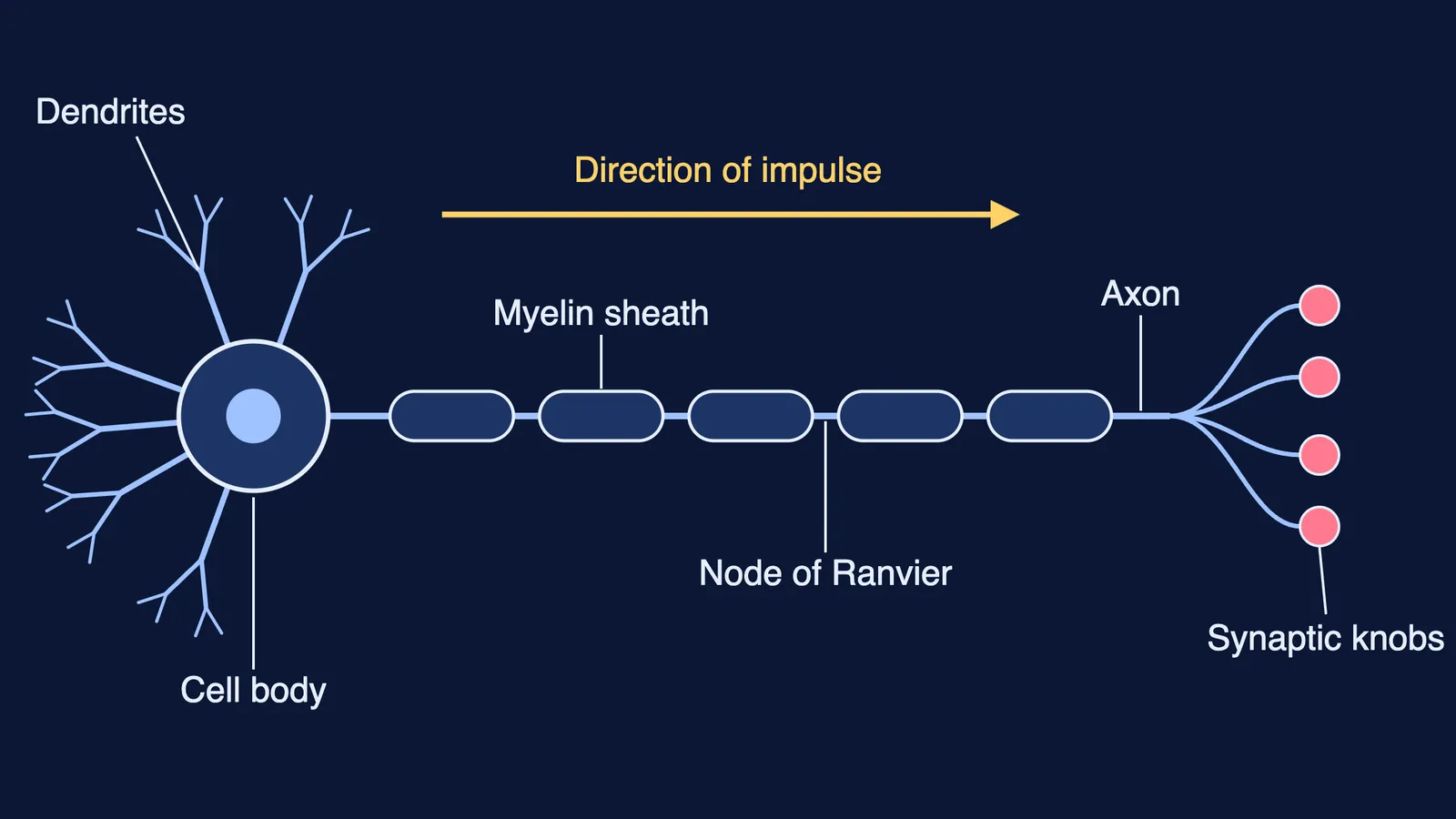
Neuron: a specialised cell that detects, receives and passes on stimuli; the unit of the neural system.
Nissl's granules: granular bodies found in the cell body (which also holds the organelles) and the dendrites. Don't confuse with: synaptic vesicles, which sit in the synaptic knobs and hold neurotransmitters.
Dendrites: short, much-branched fibres that carry impulses towards the cell body. Don't confuse with: the axon, a single long fibre carrying impulses away from the cell body.
Synaptic knob: the swollen tip of each axon branch, packed with synaptic vesicles.
Multipolar, bipolar and unipolar neurons: neurons sorted by the number of fibres. Example: multipolar (one axon, two or more dendrites) in the cerebral cortex; bipolar (one axon, one dendrite) in the retina; unipolar (one axon only) mainly in the embryo.
Myelin sheath: an insulating cover around an axon formed by Schwann cells. Example: myelinated fibres occur in spinal and cranial nerves.
Node of Ranvier: the bare gap between two neighbouring myelin sheaths. Don't confuse with: the synaptic cleft, which is a gap between two neurons, not along one.
Non-myelinated fibre: an axon wrapped by a Schwann cell that does not form a myelin sheath; common in the autonomic and somatic neural systems.
What is the difference between resting potential and action potential?
Sodium-potassium pump: active transport that keeps the ion gradients by moving 3 Na+ out for every 2 K+ in, as the NCERT chapter states.
Resting potential: the voltage across the membrane of a resting neuron, positive outside and negative inside (polarised). Don't confuse with: action potential, the reversed voltage at a stimulated spot.
Depolarisation: the reversal of charge at a stimulated site when Na+ rushes in, making the inside positive and the outside negative.
Action potential (nerve impulse): the potential difference at a depolarised site; local currents trigger the next site, so it travels along the axon.
Repolarisation: the return to the resting potential when K+ moves out, so the fibre can respond again.
How does an impulse pass from one neuron to the next?
Synapse: the junction between a pre-synaptic and a post-synaptic neuron.
Synaptic cleft: the fluid-filled space separating the two membranes at a chemical synapse.
Electrical synapse: membranes sit very close and current flows straight across; faster, but rare in humans. Don't confuse with: chemical synapse, where neurotransmitters carry the signal across the cleft.
Neurotransmitter: a chemical released from synaptic vesicles that binds receptors on the post-synaptic membrane and opens ion channels.
Excitatory vs inhibitory potential: the new potential in the post-synaptic neuron can either push it towards firing or hold it back.
Which parts of the brain should you know?
Cranial meninges: three coverings of the brain inside the skull: dura mater (outer), arachnoid (middle), pia mater (inner, touching the brain).
Cerebrum: the largest part of the brain, split into left and right cerebral hemispheres. Don't confuse with: cerebellum, the folded hindbrain part integrating input from the ear's semicircular canals and auditory system.
Corpus callosum: the band of nerve fibres joining the two hemispheres. Don't confuse with: corpora quadrigemina, four round swellings on the back of the midbrain.
Cerebral cortex (grey matter): the folded outer layer of the cerebrum, grey because neuron cell bodies crowd there. Don't confuse with: white matter, the inner layer of myelinated fibre tracts.
Thalamus: a major relay and coordinating centre for sensory and motor signals. Don't confuse with: hypothalamus, below it, controlling temperature, hunger and thirst and secreting hypothalamic hormones.
Limbic system: the inner cerebral parts with the amygdala and hippocampus; with the hypothalamus it shapes emotions, motivation and sexual behaviour.
Midbrain: the region between the thalamus/hypothalamus and the pons, crossed by the cerebral aqueduct; it brings together visual, tactile and auditory inputs.
Pons: hindbrain fibre tracts linking brain regions.
Medulla oblongata: the hindbrain part joined to the spinal cord, with centres for breathing, cardiovascular reflexes and gastric secretions.
Brain stem: midbrain, pons and medulla, linking brain and spinal cord.
How to learn these terms
Draw and label a neuron from memory, arrow from dendrite to knob.
Learn the pairs together: resting vs action potential, thalamus vs hypothalamus, cerebrum vs cerebellum, grey vs white matter, electrical vs chemical synapse.
Narrate the impulse in five steps: polarised, Na+ in, reversed, K+ out, restored.
Sort brain parts into forebrain, midbrain and hindbrain columns, with one job beside each.
If a term still feels shaky, the Fermi Concept Library gives every biology concept its own lesson and its place in the map. For the hormone side of coordination, see our Chemical Coordination and Integration Class 11 guide.